
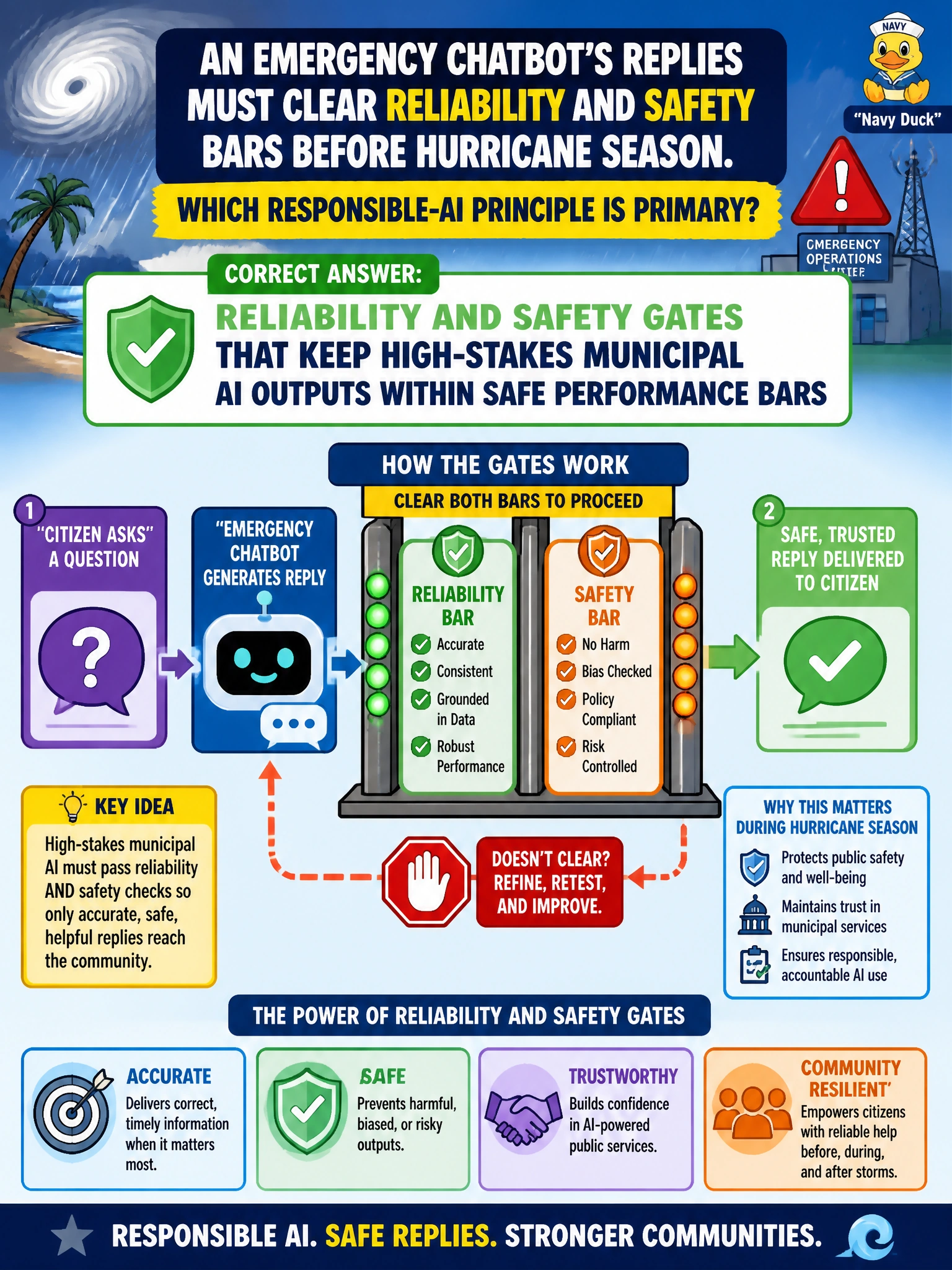
An emergency chatbot’s replies must clear reliability and safety bars before hurricane season. Which responsible-AI principle is primary?
Select an answer to reveal the explanation.
Short Explanation
Hurricane-season bots that give wrong or unsafe guidance are worse than no bot — reliability and safety bars come first. If you swap real release gates for just publishing benchmarks, auditing them across neighborhoods, or applying them to location histories, you'll let civic AI fail when people need you most.
Full Explanation
Reliability and safety are core responsible-AI principles that require high-stakes systems to meet defined performance and harm-minimization thresholds before they serve the public. Gating an emergency municipal chatbot—verifying answer accuracy, refusal behavior, escalation paths, and fallback messaging—before hurricane season is how a city keeps storm-guidance outputs inside safe bars. Residents who ask about shelters, boil-water notices, or evacuation timing during a crisis need trustworthy answers; a bot that fails those bars can cause real harm, so release gates are not bureaucracy—they are the control that matches civic duty to model risk.
Relying on transparency documentation that publishes reliability benchmarks and safety bars for public oversight fails as the primary safety gate: publishing benchmarks informs public oversight but does not itself verify answer accuracy, refusal behavior, escalation paths, or fallback messaging, and cannot keep storm-guidance outputs inside safe performance bars. Prioritizing fairness assessments that audit reliability gates and safety bars across neighborhoods and languages fails as the primary gate here: equity auditing matters, but checking distribution across groups does not verify that shelter, boil-water, or evacuation answers meet overall safety thresholds before hurricane season. Applying privacy safeguards that apply reliability reviews and safety bars to resident location and shelter histories fails as the primary reliability control: securing handling of resident location and shelter data is essential, but it does not test whether storm guidance is accurate or whether fallback and escalation paths work under load.
Exam caveat: reliability and safety gates are preconditions for high-stakes municipal deployment—not optional polish after launch. Distinguish product growth metrics from operational safety bars when the stem involves life-safety or emergency services AI.
Operational check: before storm season, require documented pass criteria (accuracy samples, refusal tests, escalation SLAs), keep fallback and human-transfer paths enabled, and sign off release only when reliability/safety owners attest the chatbot meets the municipal performance bar.
Prefer to study offline? Printable PDF study book + test engine ($7.50, unofficial). These questions stay free here.