
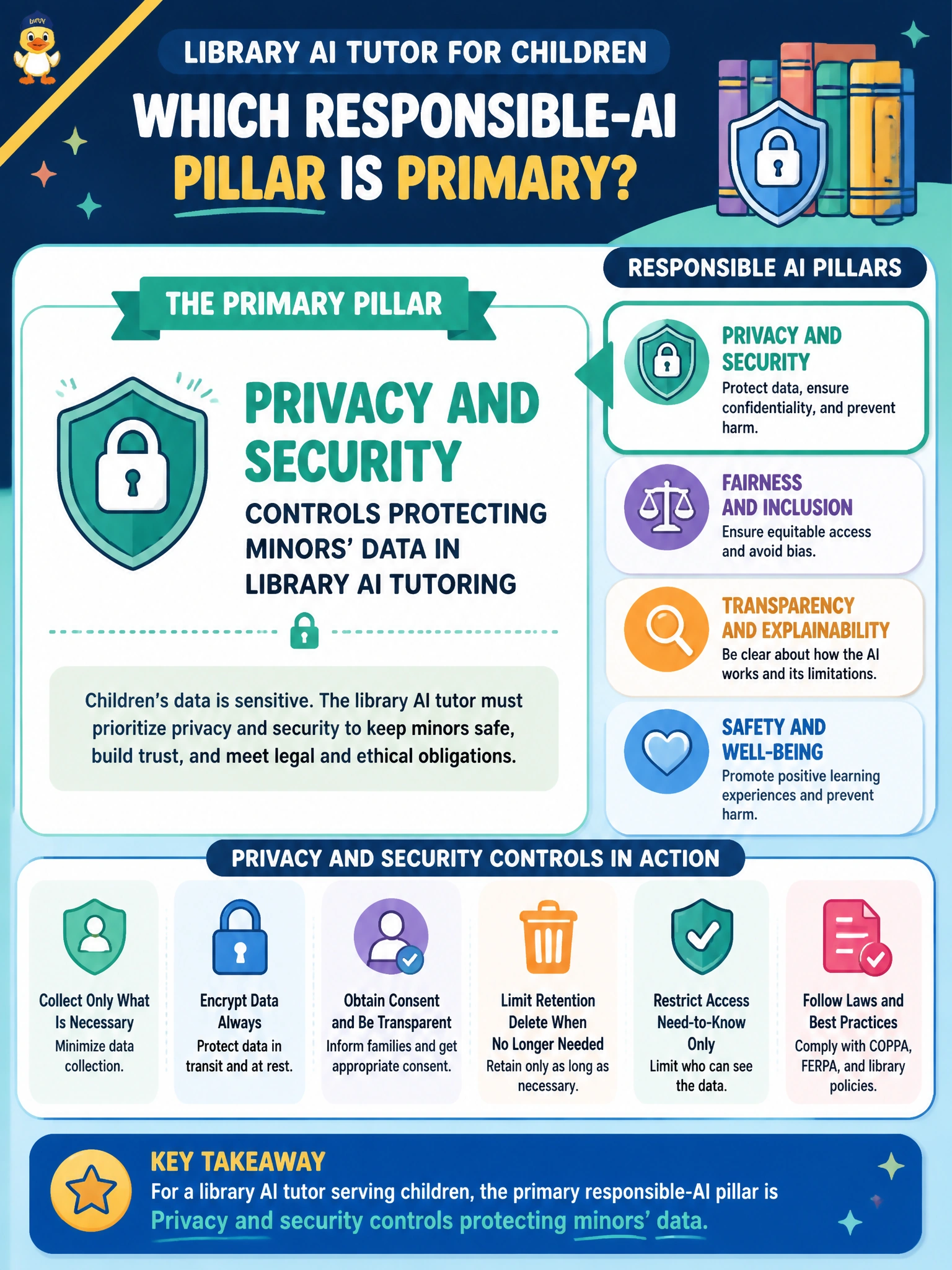
A library AI tutor must uphold privacy and security commitments in children’s programs. Which responsible-AI pillar is primary?
Select an answer to reveal the explanation.
Short Explanation
You might think privacy and security controls reviewing staff logins in library AI tutoring are the pillar, but protecting minors' data is the deal when a library AI sits with minors. Privacy and security controls tracking model versions in library AI tutoring and privacy and security controls auditing vendor contracts in library AI tutoring won't cut it — you'll still need encryption, retention limits, and guardian notice for kids' tutoring data.
Full Explanation
Privacy and security are responsible-AI pillars that demand protection of sensitive personal data and appropriate access controls—especially for minors. Upholding those commitments for a library AI tutor in children’s programs means encryption, least-privilege access, retention limits, parental/guardian notice where required, and bans on publishing or scraping identifiable tutoring content. Municipal libraries act in loco parentis for many program contexts; children’s chat logs and guardian contacts are sensitive civic records, and privacy and security controls reviewing staff logins in library AI tutoring fail to provide the core protections for minors’ data needed to protect them. Privacy and security controls reviewing staff logins in library AI tutoring fail by scope: reviewing staff logins monitors internal access but does not implement the encryption, retention limits, and guardian-notice controls required for minors; checking login records does not protect children’s learning interactions from exposure or misuse. Privacy and security controls tracking model versions in library AI tutoring fail because they prioritize version inventory over the least-privilege access and data protection essential for children’s programs; tracking which model version was used does not implement encryption, access controls, or retention limits to protect sensitive tutoring content. Privacy and security controls auditing vendor contracts in library AI tutoring fail because they only address vendor paperwork, not provide the data-minimization and consent controls required for minors’ tutoring data; confirming contracts are in order does not itself establish guardian notice, retention limits, or protection of guardian PII and tutoring logs from unauthorized access or publication. Exam caveat: privacy/security controls for minors are primary over privacy and security controls reviewing staff logins in library AI tutoring—do not confuse monitoring internal staff access with the core obligation to protect children’s learning interactions. Operational check: confirm that privacy and security controls reviewing staff logins in library AI tutoring do not substitute for protecting minors’ data, that privacy and security controls tracking model versions in library AI tutoring are not a replacement for protecting children’s data, and that privacy and security controls auditing vendor contracts in library AI tutoring do not themselves constitute the confidentiality controls for minors’ tutoring interactions.
Prefer to study offline? Printable PDF study book + test engine ($7.50, unofficial). These questions stay free here.