
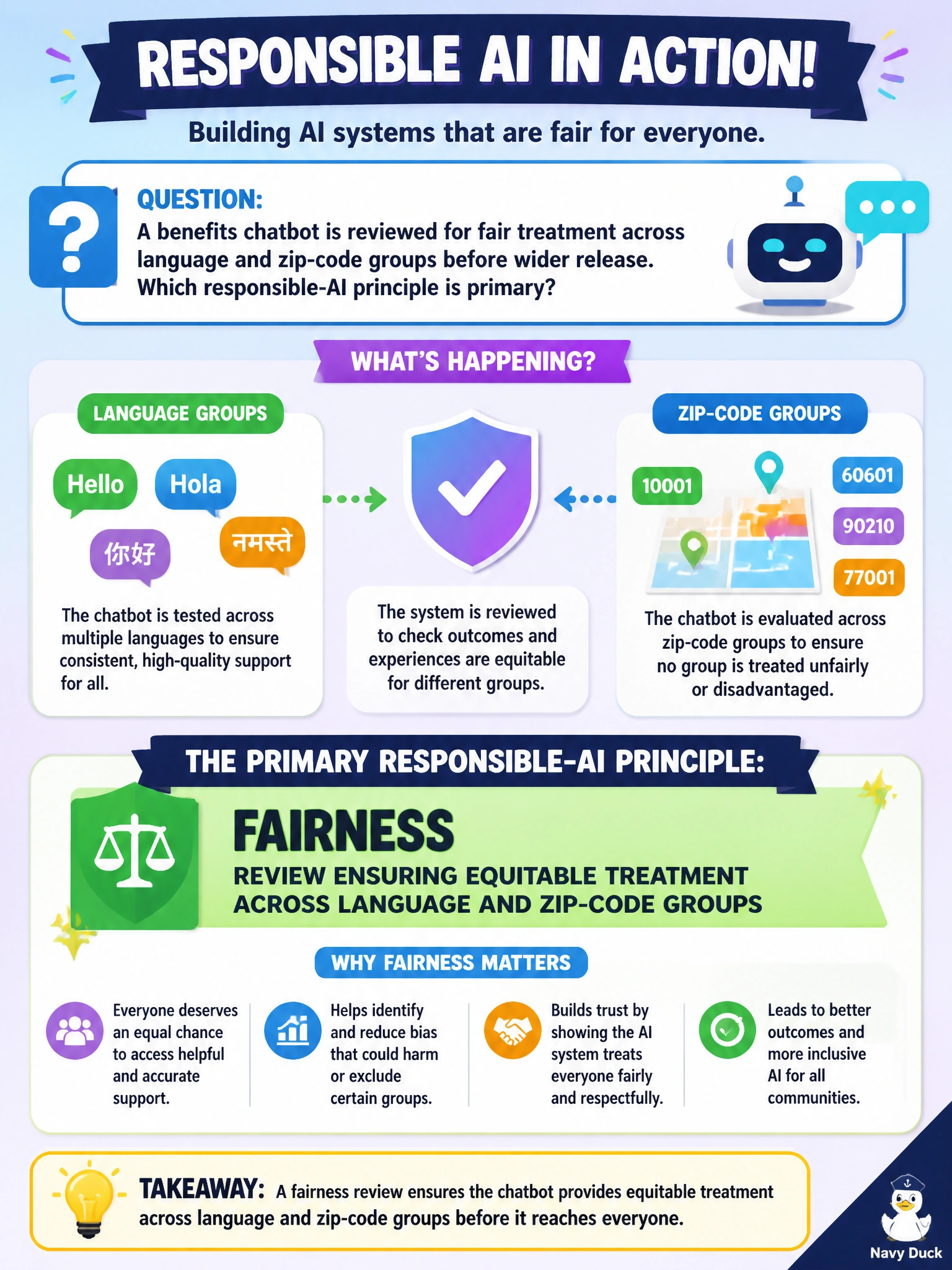
A benefits chatbot is reviewed for fair treatment across language and zip-code groups before wider release. Which responsible-AI principle is primary?
Select an answer to reveal the explanation.
Short Explanation
Does the benefits bot treat language and zip-code groups fairly? That check is fairness — a responsible-AI pillar for civic services. When you're checking reliability review ensuring fair uptime treatment across language and zip-code groups, you're testing uptime and stability, but it's not proving equitable treatment even if it's called fair.
Full Explanation
Fairness review ensuring equitable treatment across language and zip-code groups is the primary responsible-AI principle when a benefits chatbot is evaluated on those dimensions before wider release. In municipal benefits contexts, unequal answer quality, unjustified denials/escalations, or weaker service in non-English languages can create disparate impact on residents. Systematic fairness review works by measuring outcomes or error rates across defined groups, investigating causes (data imbalance, retrieval coverage, UX friction), and requiring mitigations before scale-out. Privacy review ensuring fair confidential treatment across language and zip-code groups is not the primary check here; protecting confidentiality is important but does not measure or address disparate outcomes across language and zip-code groups, and adding the word fair does not turn privacy into fairness. Reliability review ensuring fair uptime treatment across language and zip-code groups is not the primary check here; uptime shows stability but does not show whether outcomes are equitable across language and zip-code groups, and labeling uptime as fair does not make it a fairness assessment. Transparency review ensuring fair cited treatment across language and zip-code groups is not the primary check here; cited explanations support explainability but do not by themselves demonstrate equitable treatment across language and zip-code groups, even when described as fair. Exam caveat: fairness metrics depend on carefully chosen groups and outcomes; poorly defined zip/language slices can both invent and hide problems, and fairness does not automatically override legal eligibility rules for benefits. Operational check: define language and geography cohort tests for the benefits bot, review differential escalation/error rates with program owners, document mitigations (data, prompts, retrieval corpora, human handoff), and re-run fairness checks after each major model or content change before wider municipal release.
Prefer to study offline? Printable PDF study book + test engine ($7.50, unofficial). These questions stay free here.