
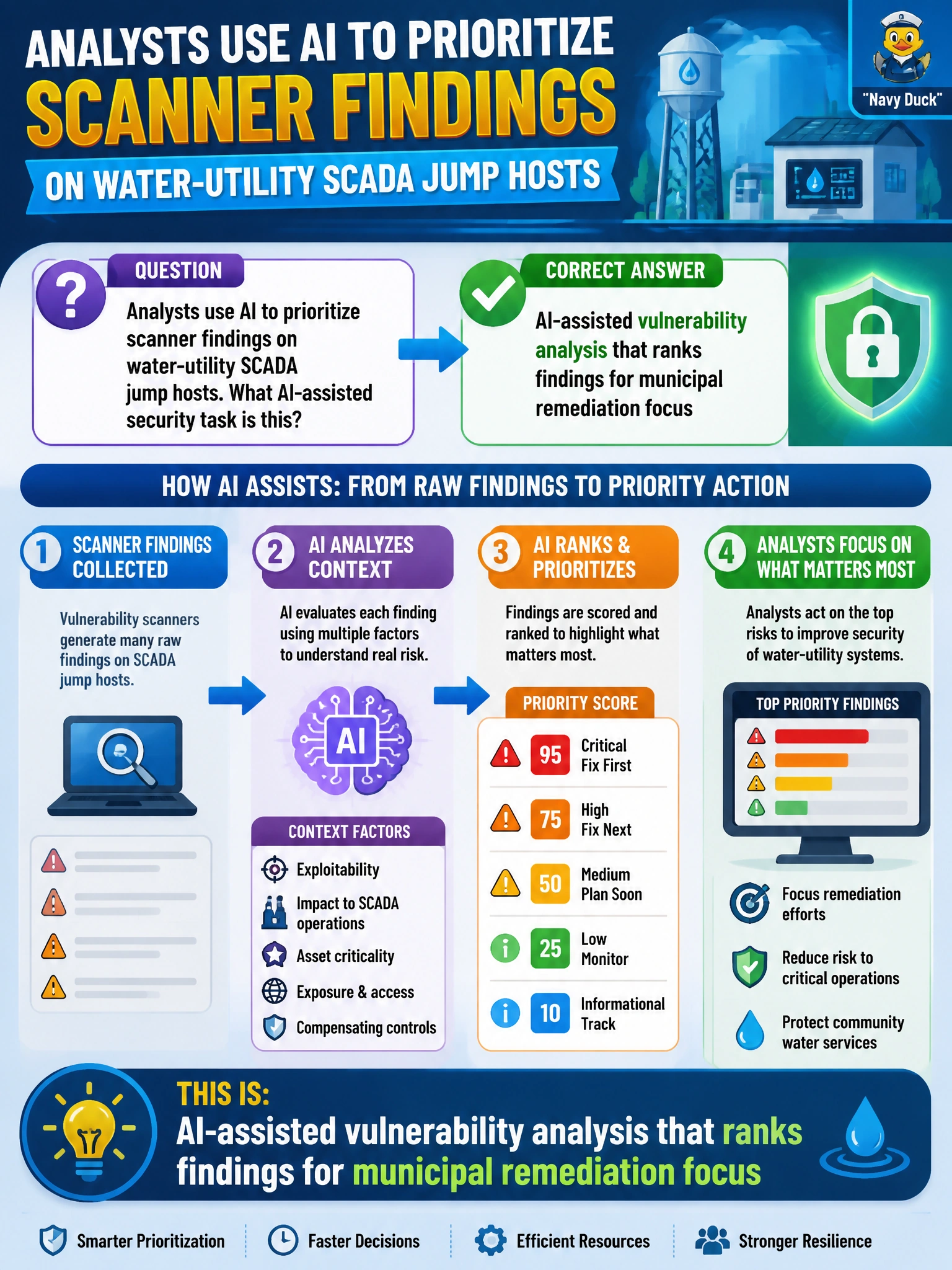
Analysts use AI to prioritize scanner findings on water-utility SCADA jump hosts. What AI-assisted security task is this?
Select an answer to reveal the explanation.
Short Explanation
AI sorting which SCADA jump-host findings matter first is prioritization help — you're ranking scanner vulnerabilities, not exploiting hosts through penetration testing or mapping controls through compliance mapping that ranks findings for municipal remediation focus. It's also not configuration auditing that ranks findings for municipal remediation focus; you're ordering known scan results, not checking configs against baselines. Fix the real risks in order.
Full Explanation
Analysts using AI to prioritize scanner findings on water-utility SCADA jump hosts demonstrates AI-assisted vulnerability analysis that ranks findings for municipal remediation focus because constrained teams must order work by impact, exposure, and exploitability. Jump hosts into water SCADA are high-consequence assets; prioritization that elevates them over low-impact noise is the correct AI-assisted security task. Domain 3 frames this as analysis assistance, not AI-assisted penetration testing that ranks findings for municipal remediation focus, because the task is ranking scanner vulnerabilities rather than actively exploiting systems to validate attack paths.
AI-assisted penetration testing that ranks findings for municipal remediation focus fails because the analysts are ranking existing scanner vulnerabilities on SCADA jump hosts, not actively exploiting systems to demonstrate compromise. AI-assisted compliance mapping that ranks findings for municipal remediation focus fails conceptually because the scenario concerns SCADA jump-host scanner vulnerabilities, not mapping security controls to regulatory requirements. AI-assisted configuration auditing that ranks findings for municipal remediation focus fails because the described task is prioritizing existing scanner findings on OT-adjacent hosts, not checking host configurations against secure baselines.
Exam caveat: AI prioritizers can undervalue obscure OT protocols or over-weight CVSS alone; water utilities should override rankings with process-safety and zoning context from OT engineers. Operational check: tag SCADA jump hosts as critical in the CMDB, require AI-ranked queues to surface those tags first, preserve full scanner output for audit, and schedule compensating controls when patch windows on OT paths are constrained.
Prefer to study offline? Printable PDF study book + test engine ($7.50, unofficial). These questions stay free here.