
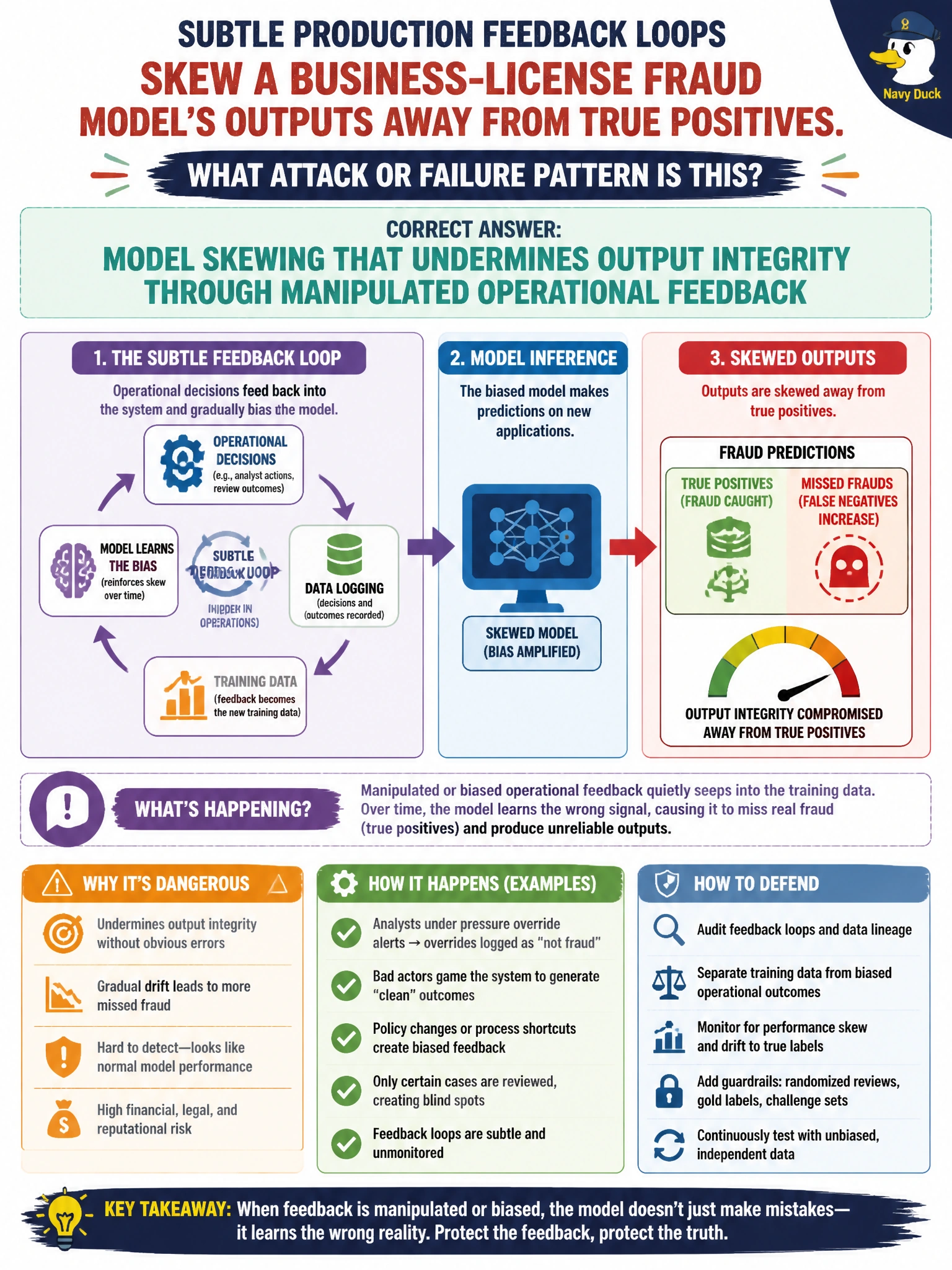
Subtle production feedback loops skew a business-license fraud model’s outputs away from true positives. What attack or failure pattern is this?
Select an answer to reveal the explanation.
Short Explanation
Quiet feedback that teaches the fraud model to miss real cases is skewing—output integrity takes the hit. Label poisoning through compromised training feedback, concept drift through evolving production feedback, or input evasion through crafted queries isn't the same as the manipulated operational feedback you're tracking. Watch the loops and validate live feedback.
Full Explanation
Identifying subtle production feedback loops that skew a business-license fraud model away from true positives as model skewing that undermines output integrity through manipulated operational feedback is correct because manipulated operational feedback or labels can drift production behavior from the intended detection goal. Skewing attacks and failure patterns corrupt what the model learns from live outcomes, quietly suppressing fraud flags while dashboards may still look “stable.” For licensing fraud, missed true positives mean lost revenue and unfair competition for compliant businesses. Label poisoning that skews output integrity through compromised training feedback fails because it occurs through compromised labels during initial training, not through the production-time feedback-loop manipulation described in the stem. Concept drift that degrades output integrity through evolving production feedback fails because it reflects genuine changes in the environment rather than manipulated operational feedback skewing the model's outputs. Input evasion that distorts output integrity through crafted operational queries fails because it involves crafting malicious inputs to dodge the model, not manipulating the operational feedback loop that suppresses true positives. Exam caveat: Concept drift that degrades output integrity through evolving production feedback can resemble adversarial skewing; teams need labeled holdouts and investigator feedback quality controls before assuming malice. Operational check: maintain a sealed evaluation set of confirmed fraud/non-fraud license cases, compare live precision/recall against that set on a schedule, and alert when true-positive rate drops without a documented policy or market explanation.
Prefer to study offline? Printable PDF study book + test engine ($7.50, unofficial). These questions stay free here.