
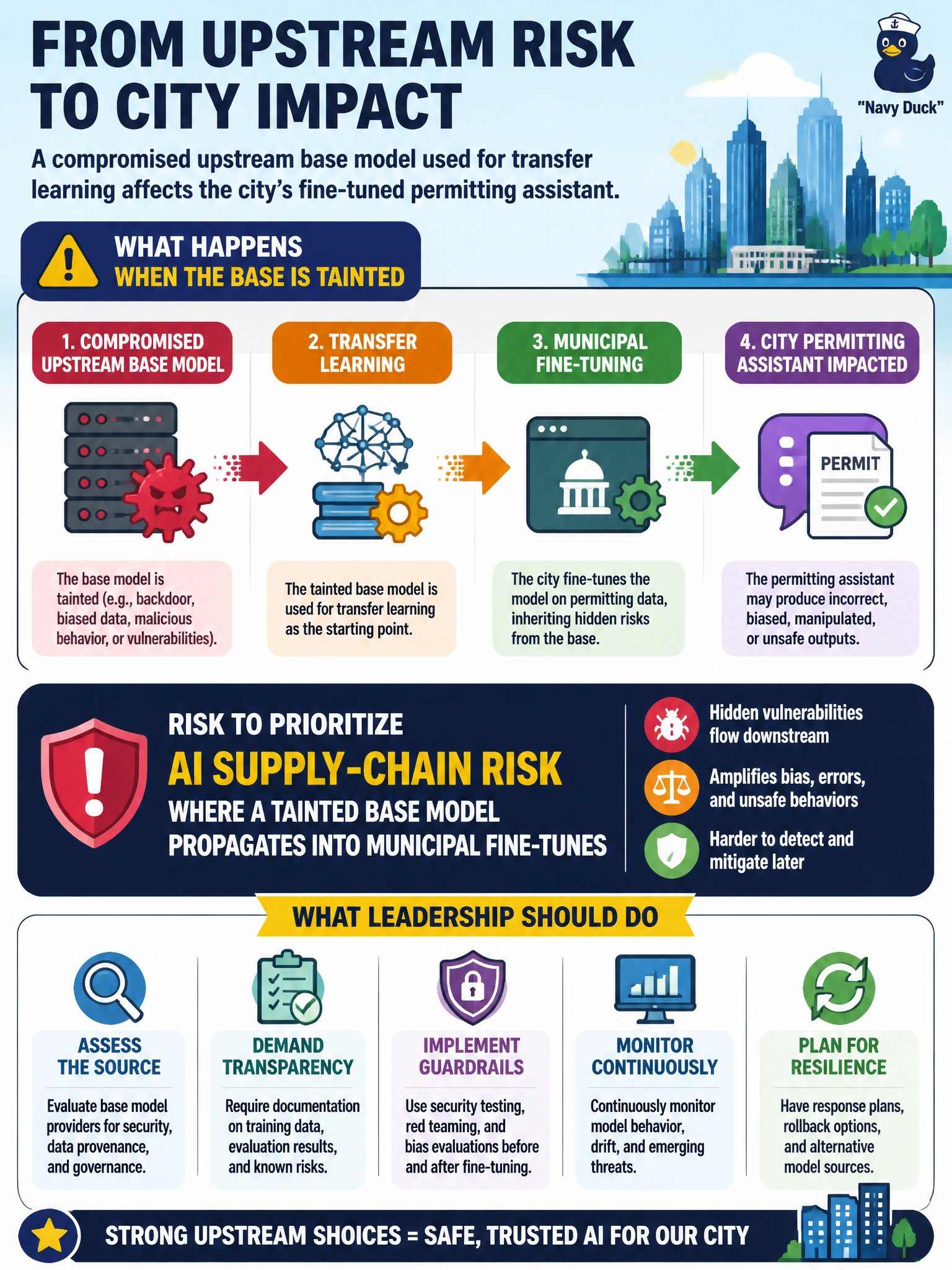
A compromised upstream base model used for transfer learning affects the city’s fine-tuned permitting assistant. What risk should leadership prioritize?
Select an answer to reveal the explanation.
Short Explanation
If the upstream base model was poisoned, your fine-tune inherits the mess—that is AI supply-chain risk. Poisoned training data, stolen weights from queries, and hijacked prompts won't explain what you've inherited from a tainted foundation. Vet sources and re-evaluate the fine-tune.
Full Explanation
Prioritizing AI supply-chain risk when a compromised upstream base model used for transfer learning affects the city’s fine-tuned permitting assistant is correct because tainted foundations propagate into downstream fine-tunes and inherited behaviors. Transfer learning couples municipal systems to external model provenance; if the base is backdoored, biased, or otherwise compromised, local fine-tuning may not fully erase the defect. Leadership should treat model suppliers and base checkpoints with the same seriousness as software dependency risk.
Data poisoning risk where tainted records corrupt base training before municipal fine-tunes fails because it describes corruption of training data during upstream base creation, not the downstream inheritance problem for a city receiving an already compromised base for fine-tuning. Model extraction risk where permit queries steal base model weights via municipal fine-tunes fails conceptually because weight theft through querying is a confidentiality attack on the deployed assistant, not inherited compromise flowing down from a tainted upstream foundation. Prompt injection risk where malicious prompts hijack base behavior via municipal fine-tunes fails because malicious prompts manipulate behavior at inference time with no causal relationship to a compromised foundation inherited through transfer learning.
Exam caveat: not every upstream CVE-style advisory maps cleanly to generative models; supply-chain assurance for AI includes provenance, checksums, evaluation harnesses, and contractual update paths, not only traditional SBOM CVE matching. Operational check: inventory base models and versions for every municipal fine-tune, pin and verify artifacts, re-evaluate permitting-assistant safety and policy tests after any base change, and define a kill/rebuild trigger if upstream compromise is confirmed.
Prefer to study offline? Printable PDF study book + test engine ($7.50, unofficial). These questions stay free here.