
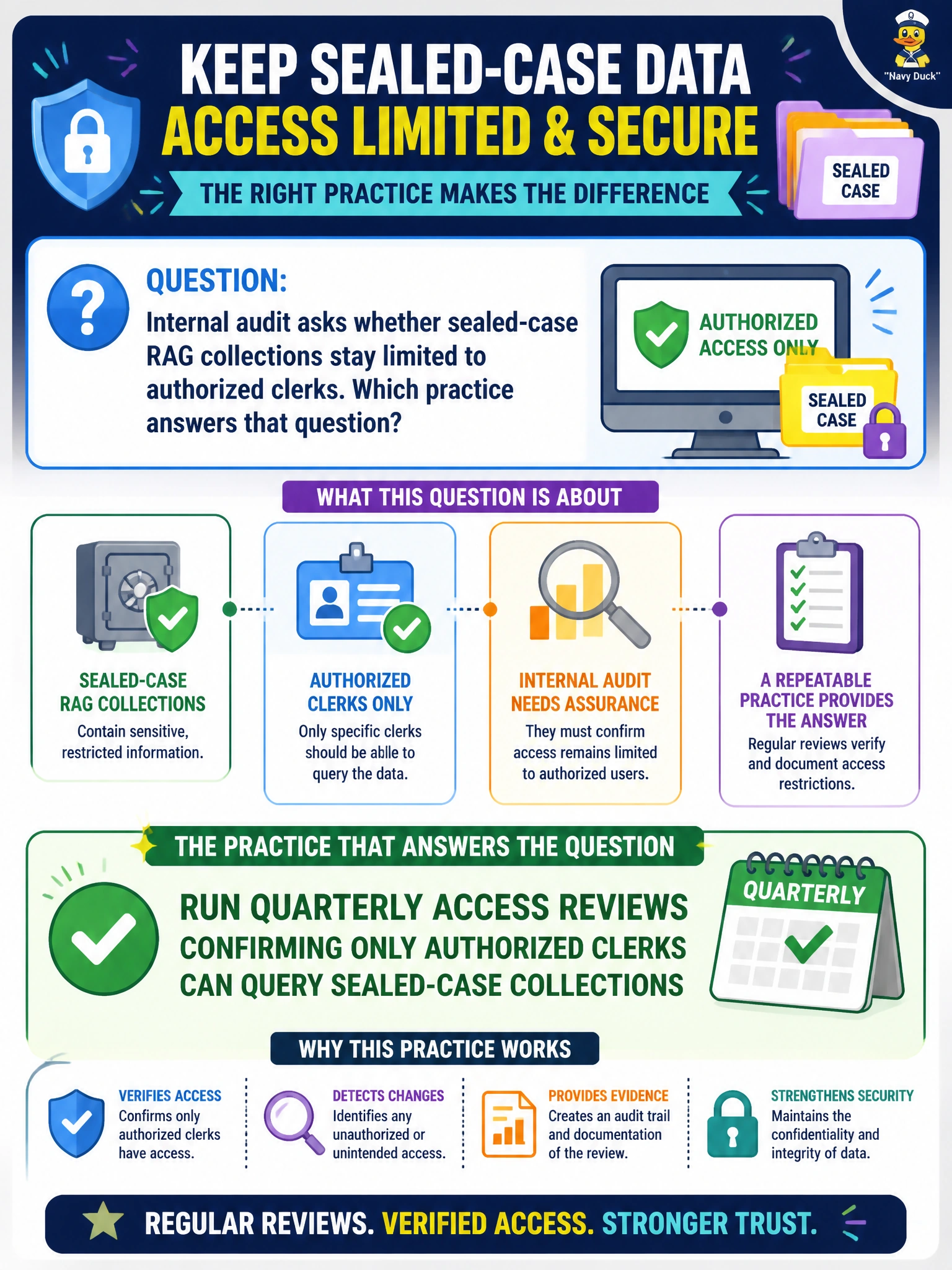
Internal audit asks whether sealed-case RAG collections stay limited to authorized clerks. Which practice answers that question?
Select an answer to reveal the explanation.
Short Explanation
Who still has the key to the sealed drawer? You'll prove it's only authorized clerks when you run quarterly access reviews on sealed-case collections covering service accounts and API keys, not just whether query access is human-only. Just confirming authorized clerks can query, just confirming who can edit, or just confirming query access is human-only won't tell you if unauthorized clerks or stray service accounts can still query sealed data.
Full Explanation
Internal audit's question about whether sealed-case RAG collections stay limited to authorized clerks is answered by access auditing: quarterly reviews confirming only authorized clerks can query those collections. Entitlement reviews compare identity-provider groups, RAG ACLs, and service principals against the official roster for sealed matters, then remediate orphans, contractors past end-date, and over-broad roles. For courts or clerk systems, sealed-case corpora are highly sensitive; periodic access attestation is how the city proves least privilege rather than assuming confirming only who can edit sealed-case collections is sufficient for query access control. Access logs support the review by showing who actually queried what. Running quarterly access reviews confirming authorized clerks can query sealed-case collections fails because it confirms access without proving exclusivity — showing authorized clerks retain query access does nothing to detect extra entitlements for unauthorized clerks, lingering contractors, or over-broad roles that still allow querying sealed-case collections. Running quarterly access reviews confirming only authorized clerks can edit sealed-case collections fails because it audits the wrong permission — limiting who can edit says nothing about who can query sealed-case collections, so over-broad query entitlements would remain undetected. Running quarterly access reviews confirming only human identities can query sealed-case collections fails because it checks identity type rather than authorization: showing query access is human-only says nothing about whether those humans are authorized clerks, and it leaves service accounts and API keys that can query sealed-case collections out of the authorization check. Exam caveat: Access reviews must recur on a defined cadence and cover both human users and machine identities (API keys, service accounts) that can query RAG. Confirming only who can edit sealed-case collections, or confirming only that query access is human-only, misses exactly the unauthorized query entitlements most likely to drift unnoticed. Quarterly is a common cadence, but high-risk sealed data may need more frequent review after role changes. Operational check: Schedule quarterly access reviews confirming who can query sealed-case RAG, not just who can edit sealed-case collections; reconcile IdP groups to clerk rosters; remove excess entitlements; keep access logs enabled; include service principals and API keys alongside human accounts; and report results to internal audit with evidence of remediation.
Prefer to study offline? Printable PDF study book + test engine ($7.50, unofficial). These questions stay free here.