
The SOC wants low-confidence AI IR summaries handled safely. Which workflow best operationalizes confidence monitoring?
Select an answer to reveal the explanation.
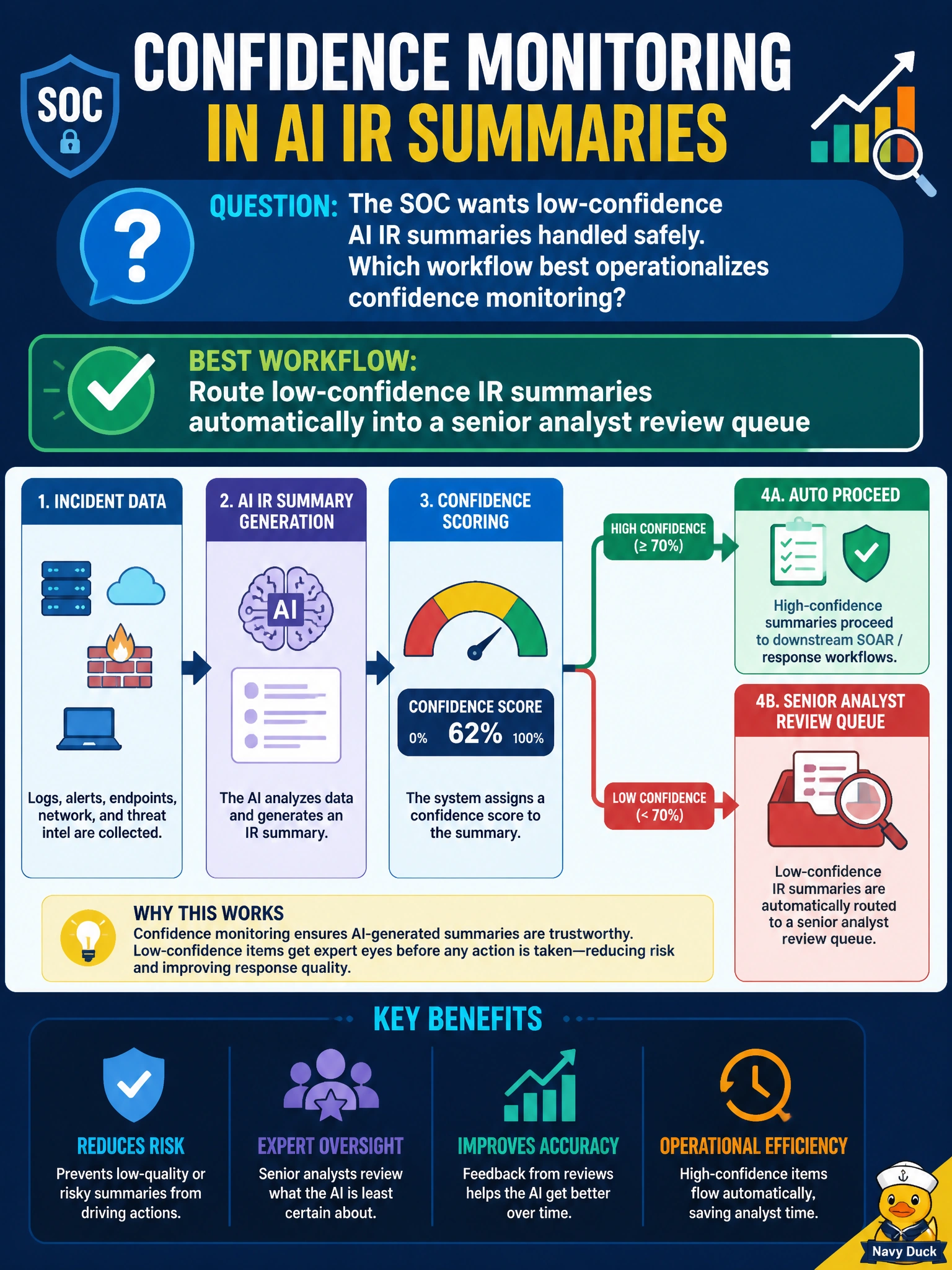
Short Explanation
You should escalate low confidence, not shrug. Parking shaky IR summaries automatically in a dedicated senior analyst queue turns the confidence score into a real control. You'll let shaky summaries slip through if you route them manually, get fooled if you trust verbal hedging over the numeric score, and let harm happen if you contain before a senior looks.
Full Explanation
The SOC operationalizes confidence monitoring for AI IR summaries by automatically routing low-confidence outputs into a senior analyst review queue. Uncertain incident summaries can mis-prioritize response, omit critical IOCs, or overstate confidence about containment; a mandatory human checkpoint converts the confidence score into a workflow control. Automation should place gray-area summaries where experienced analysts can validate, edit, or escalate—not where they disappear into noise. This pattern fits municipal SOCs that use AI drafting aids but retain human accountability for incident decisions.
Routing low-confidence IR summaries manually into a senior analyst review queue fails because it relies on human triage to catch uncertain outputs—it lets shaky summaries sit unnoticed or bypass review when analysts are busy, so mis-prioritization and missed IOCs go unchecked. Routing low-confidence IR summaries to senior analyst review using verbalized uncertainty fails because verbalized hedging is not a calibrated confidence signal, and gating the queue on wording lets truly low-score summaries slip through when the text sounds assured. Routing low-confidence IR summaries to senior analyst review after SOAR containment fails because it acts on uncertain output before human validation—containment based on a shaky summary can block legitimate activity or mishandle a real threat, making senior review after-the-fact rather than a preventive control.
Exam caveat: Confidence routing must be automatic, into a dedicated queue, and keyed to the actual confidence score—not left to manual routing into senior review, keyed to verbalized uncertainty, or delayed until after SOAR containment. Human review must be staffed; a queue nobody works is not a control.
Operational check: Wire low-confidence IR summaries automatically to a dedicated senior analyst queue; measure time-to-review and override rates; prohibit SOAR containment of low-confidence items before senior review and manual routing of low-confidence items that lets them sit unnoticed or bypass review; keep numeric scores visible to analysts rather than relying on verbalized uncertainty; and alert if confidence instrumentation is disabled or scores are forcibly inflated.
Prefer to study offline? Printable PDF study book + test engine ($7.50, unofficial). These questions stay free here.