
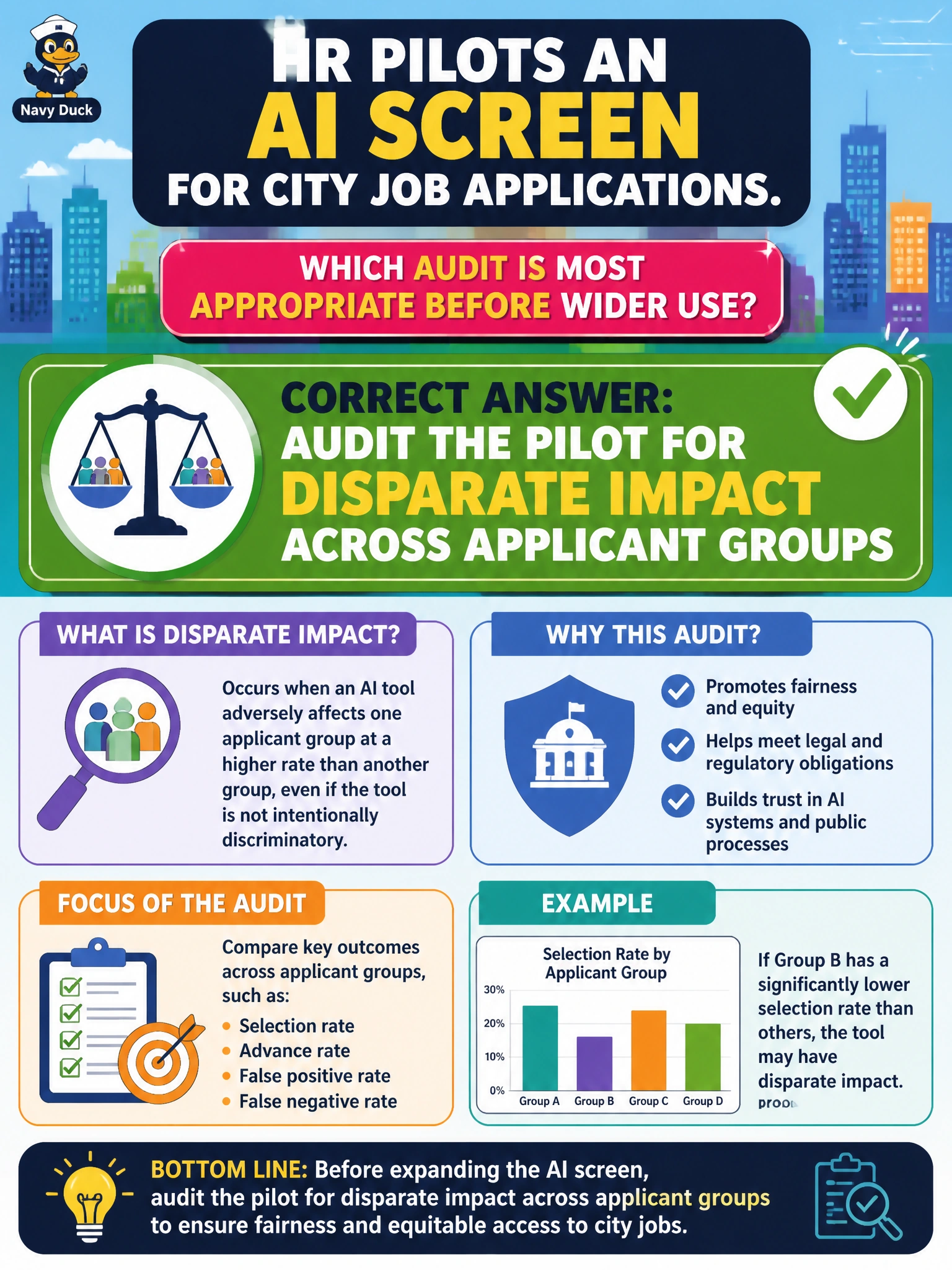
HR pilots an AI screen for city job applications. Which audit is most appropriate before wider use?
Select an answer to reveal the explanation.
Short Explanation
A hiring screen that tilts the field is a civil-service problem, not a tech flex. Auditing the city job AI pilot for disparate impact across groups is the fairness check before scale-up. Predictive parity or individual fairness checks won't tell you whether selection rates disadvantage a group, so you'll miss the gate that matters.
Full Explanation
Before wider use of an AI screen for city job applications, the most appropriate audit is a fairness review for disparate impact across applicant groups. Civic hiring tools can encode or amplify bias from historical data, proxy features, or uneven error rates, creating civil-service and legal risk. Measuring selection rates, score distributions, and error patterns across protected or policy-relevant groups—and documenting mitigation—is the assurance step that belongs in a pilot gate. HR and equity stakeholders need evidence the screen does not systematically disadvantage qualified applicants before scale-up across departments.
Auditing the pilot for predictive parity across applicant groups fails the gate: equal precision among those flagged as qualified does not show whether selection rates themselves disadvantage a protected or policy-relevant group. Auditing the pilot for individual fairness across applicant groups fails the gate: requiring similar individuals to receive similar scores depends on a contested similarity metric and does not provide the group-level selection-rate evidence needed for a hiring pilot. Auditing the pilot for overall accuracy across applicant groups fails the fairness question: high overall accuracy can still mask disparate impact across protected or policy-relevant groups.
Exam caveat: Disparate-impact analysis is necessary but not always sufficient; also examine feature legitimacy, human override paths, and adverse-action processes. An individual-fairness review answers a different fairness question than disparate-impact analysis and cannot substitute for it at the pilot gate, because it does not measure whether selection rates disadvantage a protected or policy-relevant group. Distinguish bias audits from accuracy audits—both matter for hiring AI.
Operational check: Run a documented disparate-impact analysis on the pilot cohort before expansion; involve HR/legal; keep applicant scores confidential; define mitigation and human-review paths for borderline cases; and re-audit after model or data updates—not merely after predictive-parity analysis across applicant groups or an individual-fairness review across applicant groups looks healthy.
Prefer to study offline? Printable PDF study book + test engine ($7.50, unofficial). These questions stay free here.