
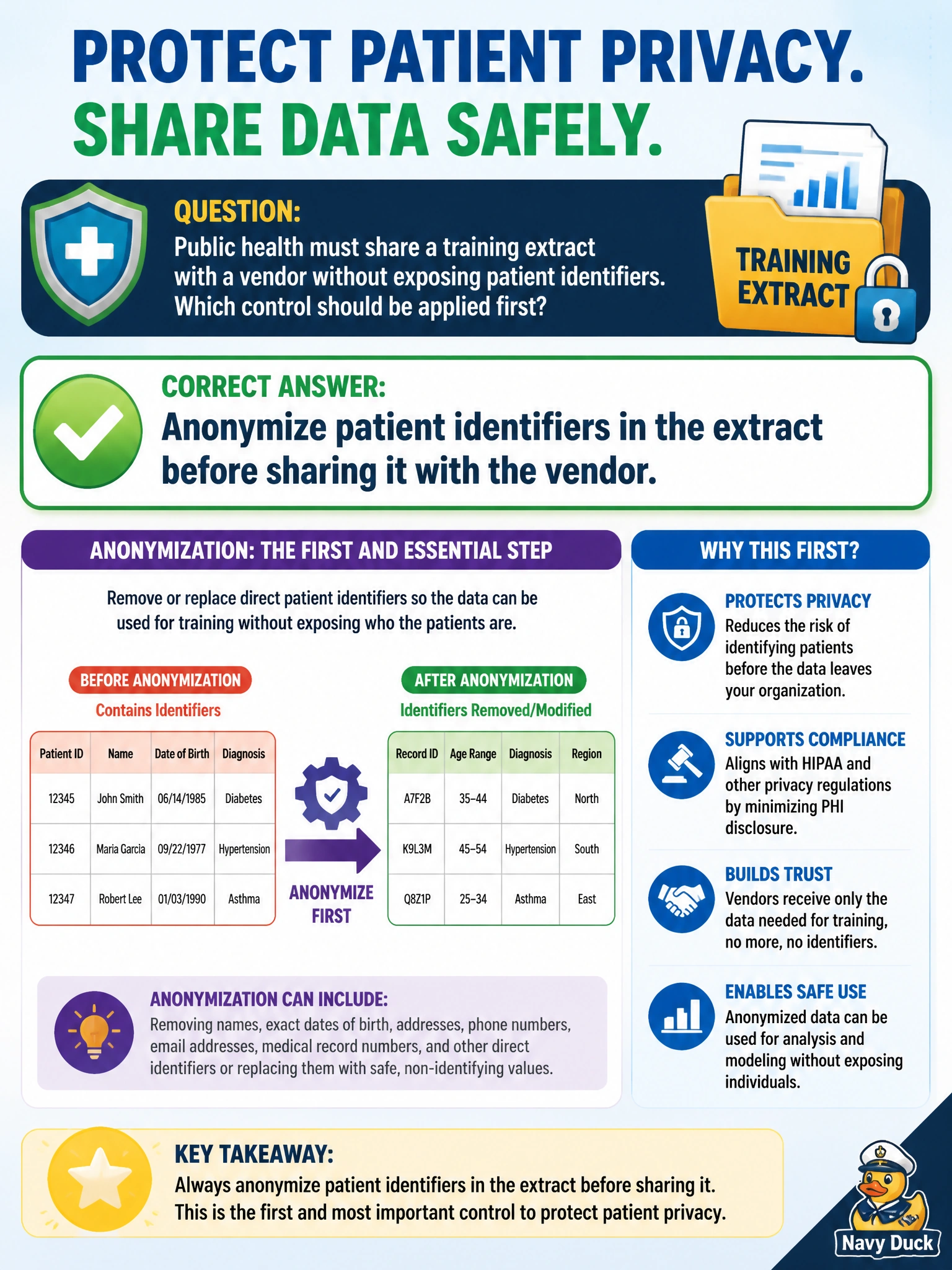
Public health must share a training extract with a vendor without exposing patient identifiers. Which control should be applied first?
Select an answer to reveal the explanation.
Short Explanation
Vendors do not need names and chart numbers to train on patterns. Anonymize patient identifiers before the extract leaves public health. Encrypting, hashing, or pseudonymizing patient identifiers won't protect the copy the vendor actually gets, since you'll still leave them reversible or linkable.
Full Explanation
Anonymizing patient identifiers in the extract before sharing it with the vendor is the control that should be applied first when public health must share a training extract without exposing patient identifiers. Anonymization (or equivalent de-identification appropriate to policy) removes or transforms direct identifiers before data leaves the municipal trust boundary. That step reduces privacy and compliance risk for public-health AI training collaborations while still allowing a vendor to work on non-identifying patterns if the extract is properly prepared.
Encrypting patient identifiers in the extract before sharing it with the vendor fails by concept because encryption is reversible — the identifiers remain in the copy in encrypted form and can be restored with the key, so the copy that left the municipal trust boundary was never anonymized.
Pseudonymizing patient identifiers in the extract before sharing it with the vendor fails because pseudonyms remain linkable — the identifiers are replaced with reversible tokens that can be re-identified with the mapping, so the vendor still receives indirectly identifiable data rather than an anonymized extract.
Hashing patient identifiers in the extract before sharing it with the vendor fails because deterministic hashes remain linkable — identical identifiers produce the same hash and common values can be reversed by dictionary attack, so identifiers were never truly removed from the copy that left the municipal trust boundary.
Exam caveat: External AI data sharing starts with minimize/anonymize the copy that actually leaves the boundary. Hashing patient identifiers in the extract before sharing it with the vendor, and encrypting patient identifiers in the extract before sharing it with the vendor, are not substitutes for anonymizing what the vendor receives.
Operational check: Define identifier fields for the public-health extract, anonymize or remove them from the copy that will actually be sent, review a sample for residual identifiers, transfer only the sanitized extract through an approved channel under contract, and never rely on hashing patient identifiers alone to stand in for anonymization.
Prefer to study offline? Printable PDF study book + test engine ($7.50, unofficial). These questions stay free here.