
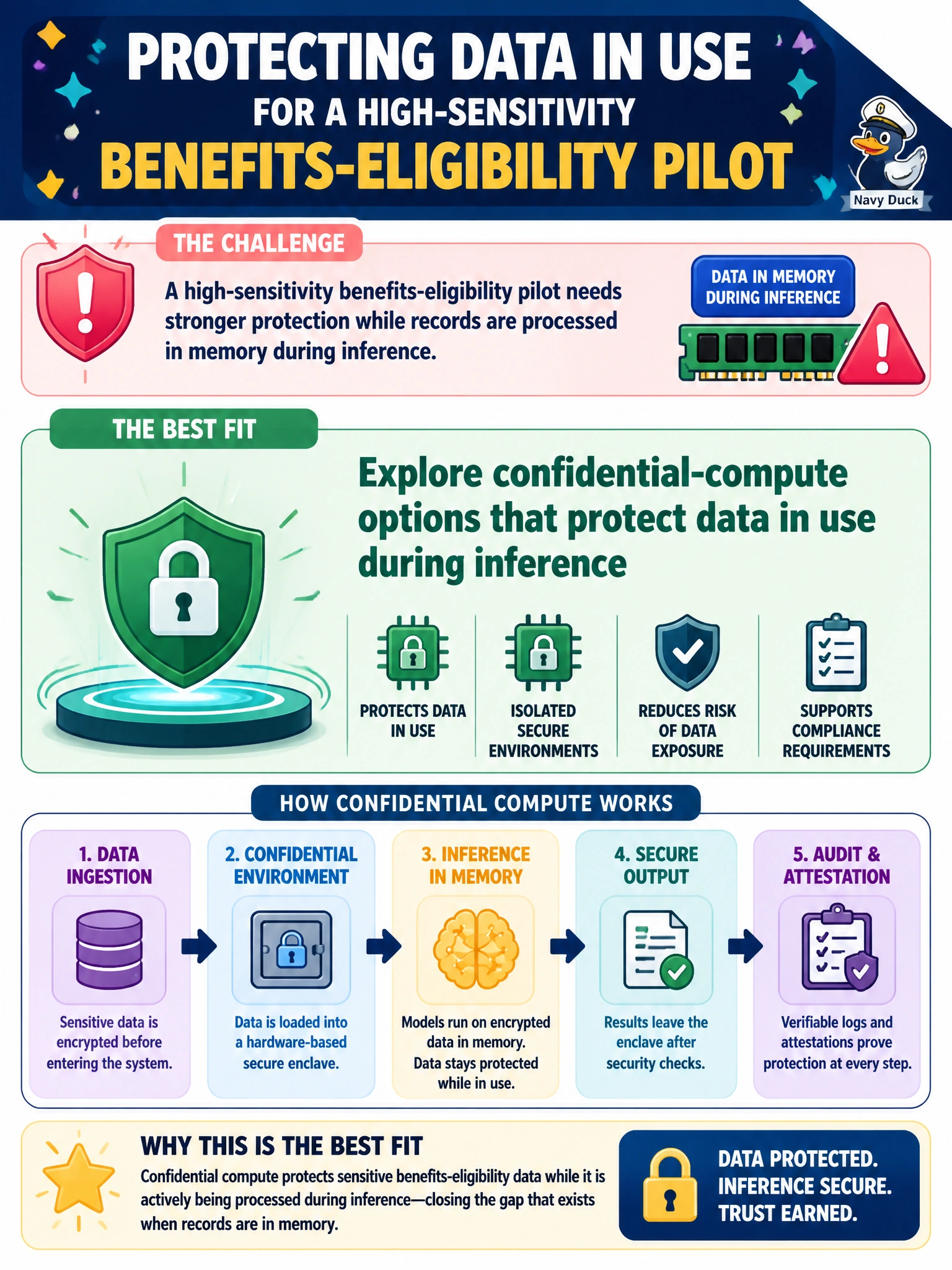
A high-sensitivity benefits-eligibility pilot needs stronger protection while records are processed in memory during inference. Which approach best fits?
Select an answer to reveal the explanation.
Short Explanation
Encrypted disk volumes and TLS-protected transit channels help at rest and in transit, but you'll still need cover while the model is thinking. Confidential compute protects data in use during inference, while signed audit logging won't isolate plaintext in memory.
Full Explanation
Exploring confidential-compute options that protect data in use during inference best fits a high-sensitivity benefits-eligibility pilot that needs stronger protection while records are processed in memory. Exploring encrypted disk-volume options that protect data in use during inference is a data-at-rest protection that only encrypts volumes on disk; confidential computing and related isolation techniques target exposure during active processing when plaintext may otherwise exist in memory, shared accelerators, or multi-tenant inference hosts. For benefits records, that in-use protection is the gap the stem highlights.
Exploring encrypted disk-volume options that protect data in use during inference fails by concept because encrypting volumes only protects data at rest on disk and leaves exactly the gap the stem calls out—plaintext eligibility data still exposed in RAM while the model processes it with no encryption or hardware-backed isolation. Exploring TLS-protected transit channels that protect data in use during inference fails because encrypting network channels only protects data in transit between endpoints but does not stop plaintext eligibility data from being exposed in memory while the model processes it, which is the in-use gap confidential compute is designed to close. Exploring signed audit-logging pipelines that protect data in use during inference fails because tamper-evident logging only provides detective accountability after events but does not provide technical in-use protection for plaintext eligibility data while the model processes it in memory.
Exam caveat: Distinguish data in transit, at rest, and in use. Exploring encrypted disk-volume options for at-rest protection does not encrypt memory during processing, and exploring TLS-protected transit channels for transit protection still leaves resident memory exposed during inference, while signed audit-logging pipelines only record events without isolating plaintext.
Operational check: For the benefits pilot, evaluate confidential-compute or strong tenant isolation for inference hosts; encrypted disk-volume options, TLS-protected transit channels, and signed audit-logging pipelines are not substitutes for in-use memory protection, so block cross-tenant GPU/hypervisor memory access to resident records and require that any privileged VM-host administrator path be restricted and audited.
Prefer to study offline? Printable PDF study book + test engine ($7.50, unofficial). These questions stay free here.