
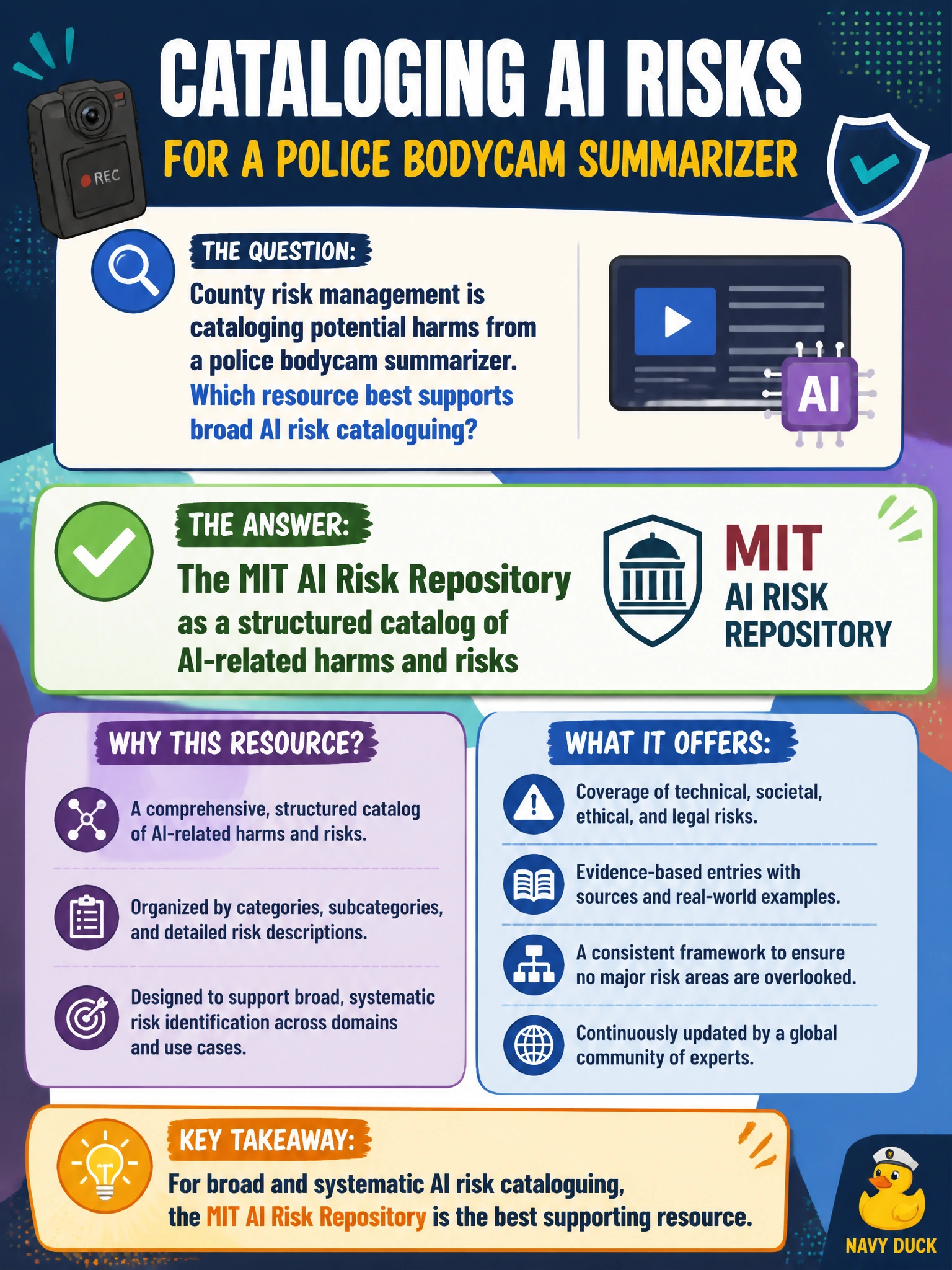
County risk management is cataloging potential harms from a police bodycam summarizer. Which resource best supports broad AI risk cataloguing?
Select an answer to reveal the explanation.
Short Explanation
Bodycam summaries can go wrong in lots of ways — privacy, bias, overreach. The MIT AI Risk Repository helps counties inventory those harms without reinventing the taxonomy. Relying on the MITRE ATLAS matrix for adversarial tactics won't get you there, and the AI Incident Database for past failure events won't get you there either.
Full Explanation
Broad AI risk cataloguing for municipal governance needs an independent, structured taxonomy of harms—not vendor marketing. The MIT AI Risk Repository organizes AI-related risks and harms that county risk management can use when scoping a police bodycam summarizer, including privacy invasion, biased outcomes, misuse by operators, unreliable summaries, civil-liberty impacts, and downstream investigative or disclosure harms. Consulting that catalog helps teams inventory potential harms systematically across technical and societal dimensions, assign policy owners, and decide which assessments must complete before the summarizer influences case review or public-records workflows. Structured cataloguing also makes residual-risk discussions comparable across departments instead of depending on ad hoc brainstorming. The OWASP Top 10 for LLM Applications as a structured catalog of LLM security risks is still scoped to LLM application security issues rather than an independent, cross-domain taxonomy of the harms a county's own bodycam summarizer could cause, so it under-covers broad risk cataloguing. The MITRE ATLAS matrix as a structured catalog of adversarial tactics for AI systems covers adversary tactics and techniques rather than a structured catalog of AI-related harms, so it under-covers broad risk cataloguing. The AI Incident Database as a structured catalog of past AI failure events collects examples of past failures rather than an independent, cross-domain taxonomy of harms, so it under-covers broad risk cataloguing. Exam caveat: governance teams should use structured AI risk catalogs when identifying harms for civic AI systems, not substitute LLM security lists, adversarial-tactic matrices, or past-incident collections for broad harm inventories. Operational check: walk the bodycam summarizer through repository risk categories, tag each applicable harm with an owner and mitigation, and retain the completed cataloguing worksheet for the county risk committee before production use.
Prefer to study offline? Printable PDF study book + test engine ($7.50, unofficial). These questions stay free here.