
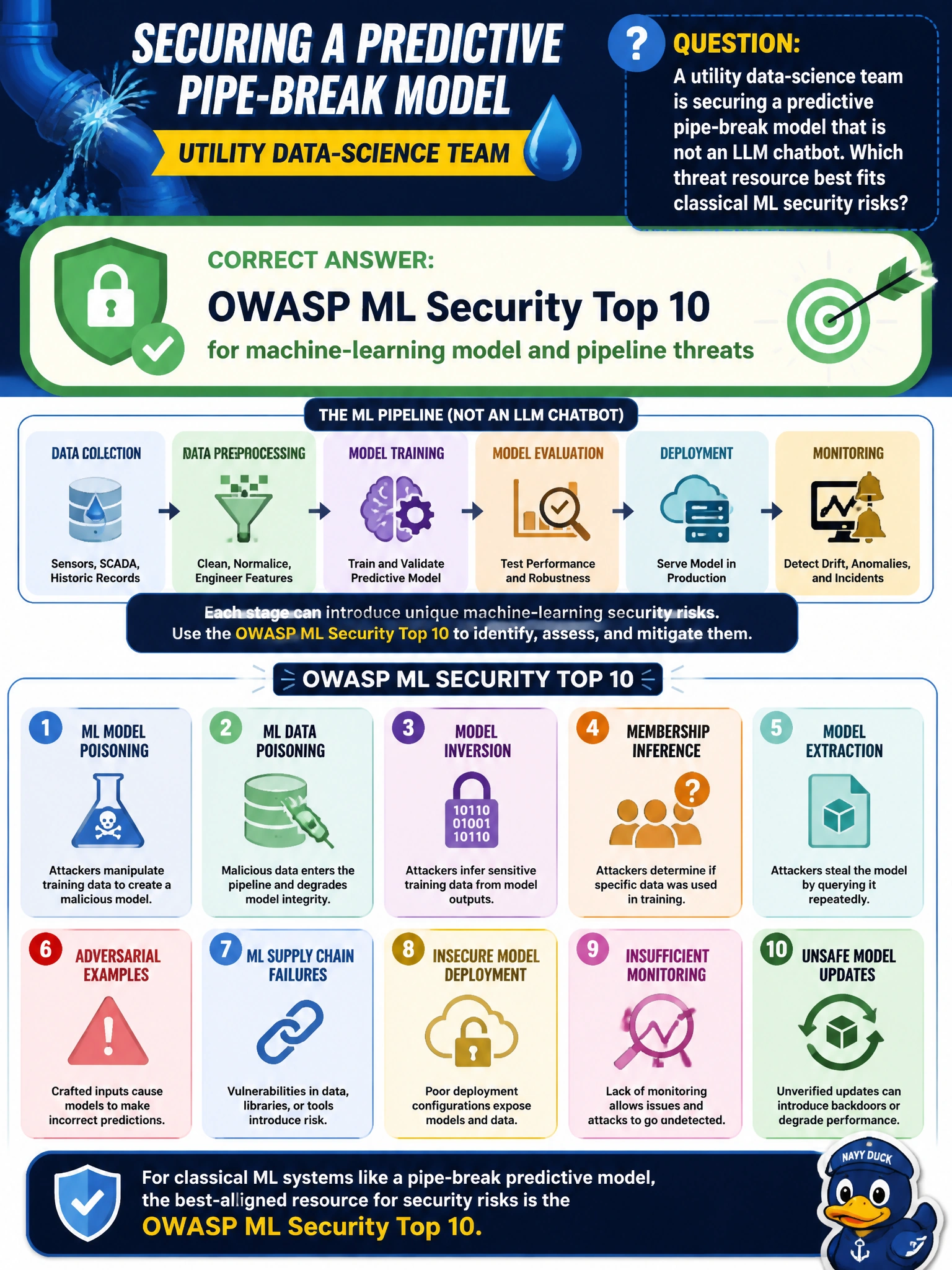
A utility data-science team is securing a predictive pipe-break model that is not an LLM chatbot. Which threat resource best fits classical ML security risks?
Select an answer to reveal the explanation.
Short Explanation
Pipe-break models get poisoned data, not witty jailbreaks. OWASP ML Security Top 10 speaks that classical ML language. You'll see an API list for deployment workflows still covers API flaws, governance risk controls still cover process, and a MITRE ATT&CK Enterprise list still covers enterprise intrusion tactics, so they miss what's in your training data and pipeline.
Full Explanation
Classical machine-learning systems face a different primary threat surface than LLM chatbots. A predictive pipe-break model used by a utility data-science team is typically a supervised or similar ML pipeline without a language-model interface. The OWASP ML Security Top 10 catalogs risks such as data poisoning, model inversion, adversarial examples, membership inference, and pipeline integrity failures that fit that architecture. Selecting that resource aligns threat analysis to training data, features, model artifacts, and serving pipelines rather than chat prompt patterns.
The OWASP API Security Top 10 for machine-learning model deployment workflows still addresses API-layer flaws in how the model is exposed, not the poisoning, inversion, and adversarial-example risks that live in the pipe-break model's training data and feature pipeline itself. The NIST AI Risk Management Framework for machine-learning model risk controls remains a governance and risk-management structure, not a technical threat catalog for classical ML attack patterns. Presenting the MITRE ATT&CK Enterprise for machine-learning model intrusion techniques misapplies general enterprise-intrusion tactics to a classical ML pipeline problem, leaving the pipe-break model's actual classical-ML threats like poisoning and inversion under-specified.
Exam caveat: choose the threat catalog that matches system type — ML Security Top 10 for classical models, not the API Security Top 10 for machine-learning model deployment workflows which covers API flaws, not the MITRE ATT&CK Enterprise for machine-learning model intrusion techniques which covers enterprise intrusion tactics, and not the NIST AI RMF for machine-learning model risk controls which is governance. Operational check: map the pipe-break data pipeline and model store to ML Top 10 entries, harden poisoning and inversion paths, and document controls on training data integrity and model artifact access.
Prefer to study offline? Printable PDF study book + test engine ($7.50, unofficial). These questions stay free here.