
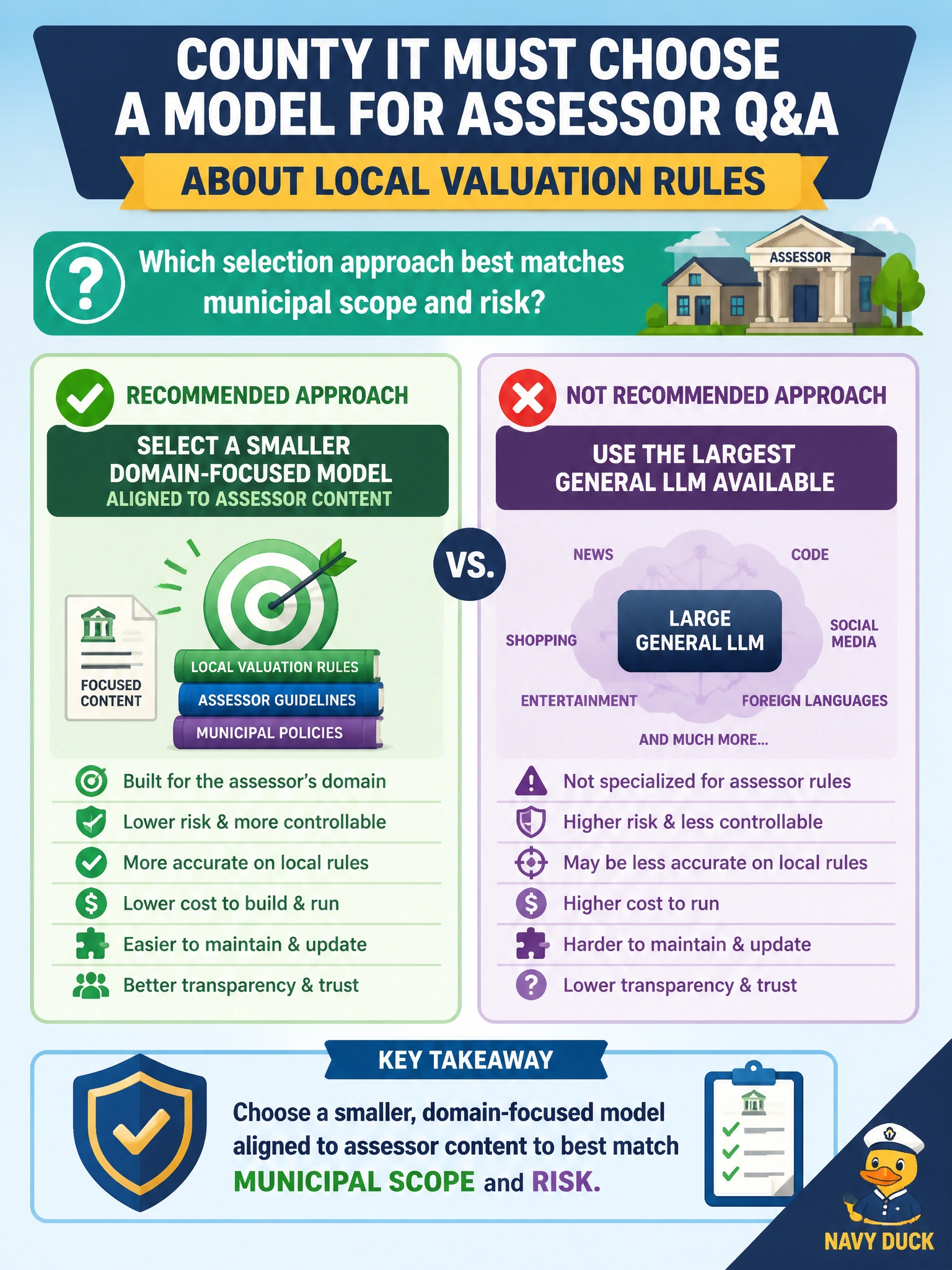
County IT must choose a model for assessor Q&A about local valuation rules. Which selection approach best matches municipal scope and risk?
Select an answer to reveal the explanation.
Short Explanation
Chasing top benchmark scores for document reasoning won't guarantee you'll get local valuation rules right — sometimes you want the specialist, not the stadium PA system. Picking the biggest context window to stuff in codebooks and dialogue history won't save you from poor retrieval — you'll still get drift and high bills without targeted tuning. Going cheapest while hitting latency targets for appeal season isn't enough — you'll still risk wrong valuations if you don't test accuracy on real appeal queries.
Full Explanation
Model selection for municipal workloads should optimize fit to scope, data sensitivity, latency, cost, and residual risk—not top benchmark scores for document reasoning as a proxy for accuracy on local valuation rules. County assessor Q&A about local valuation rules is a bounded, high-sensitivity domain. A smaller domain-focused model aligned to assessor content typically offers tighter grounding, lower inference cost, clearer data-handling boundaries, and an evaluation surface the county can actually own. Preferring fit over top benchmark scores for document reasoning reduces unnecessary exposure of tax and parcel context to models that were not designed around local statutes or municipal hosting constraints.
Prioritizing top benchmark scores for document reasoning as a proxy for accuracy on local valuation rules ignores fit to valuation rules, data sensitivity, latency budgets, and the city's ability to evaluate and operate the system. Favoring the model with the largest context window to process county codebooks with assessor dialogue history inverts governance: a large window does not replace targeted retrieval tuning, grounding checks, and validation on valuation rules. Optimizing selection for lowest inference cost while meeting latency targets for peak assessment appeal volume is insufficient—cost and speed alone do not ensure accuracy on assessment appeal queries, and narrow domains still hallucinate, omit exceptions, and mishandle edge parcels without held-out tests.
Exam caveat: top benchmark scores for document reasoning do not automatically mean better accuracy on local valuation rules; domain alignment and controllable risk often beat raw benchmark performance. Operational check: score candidate models against assessor held-out questions, document data-flow and hosting constraints, and select the smallest model that meets accuracy, latency, and security thresholds before procurement.
Prefer to study offline? Printable PDF study book + test engine ($7.50, unofficial). These questions stay free here.