
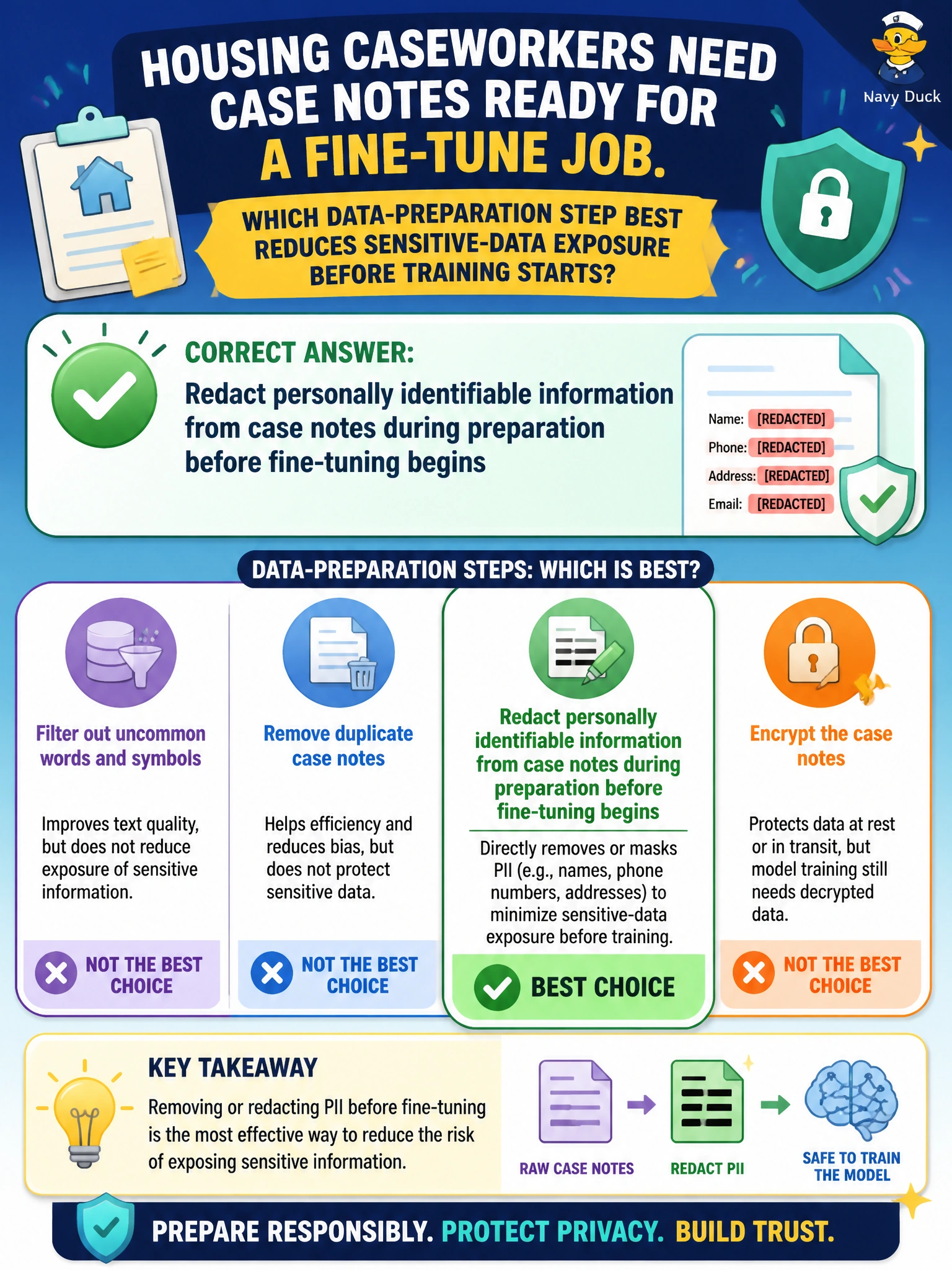
Housing caseworkers need case notes ready for a fine-tune job. Which data-preparation step best reduces sensitive-data exposure before training starts?
Select an answer to reveal the explanation.
Short Explanation
Picture case notes as sealed envelopes — you strip the private labels before you hand them to the trainer. Redacting PII during preparation keeps sensitive resident details out of the fine-tune set. Pseudonymizing with reversible tokens during preparation won't truly protect them since you'll still hold a key that can link those tokens back to residents.
Full Explanation
Secure data preparation is a mandatory lifecycle gate before fine-tuning on municipal case content. Housing case notes often contain names, addresses, income details, household composition, and other personally identifiable information. Redacting that PII during preparation—before fine-tuning begins—reduces the chance that the resulting model memorizes or regurgitates unique resident identifiers and shrinks the blast radius if training artifacts, logs, or checkpoints are later exposed. Preparation-time redaction also keeps sensitive fields out of labeling tooling and vendor processing paths that may sit outside the city's primary system of record. Encrypting personally identifiable case notes in storage during preparation protects data at rest, but it does not redact PII from the fine-tune corpus, so resident identifiers remain exposed to memorization once decrypted for training. Restricting personally identifiable case notes with roles during preparation limits who can view the data, but it does not remove PII before training, so sensitive identifiers can still be learned by the model during fine-tuning. Pseudonymizing identifiable case notes with reversible tokens during preparation replaces direct identifiers but leaves a reversible mapping, so residents can still be re-identified and token patterns remain exposed to memorization. Exam caveat: data minimization and de-identification belong in preparation, not as an afterthought once models are distributed. Operational check: run automated PII scanners plus human review on housing note extracts, retain a redaction log for audit, and refuse to start fine-tune jobs until the prepared corpus passes a no-raw-identifiers gate.
Prefer to study offline? Printable PDF study book + test engine ($7.50, unofficial). These questions stay free here.