
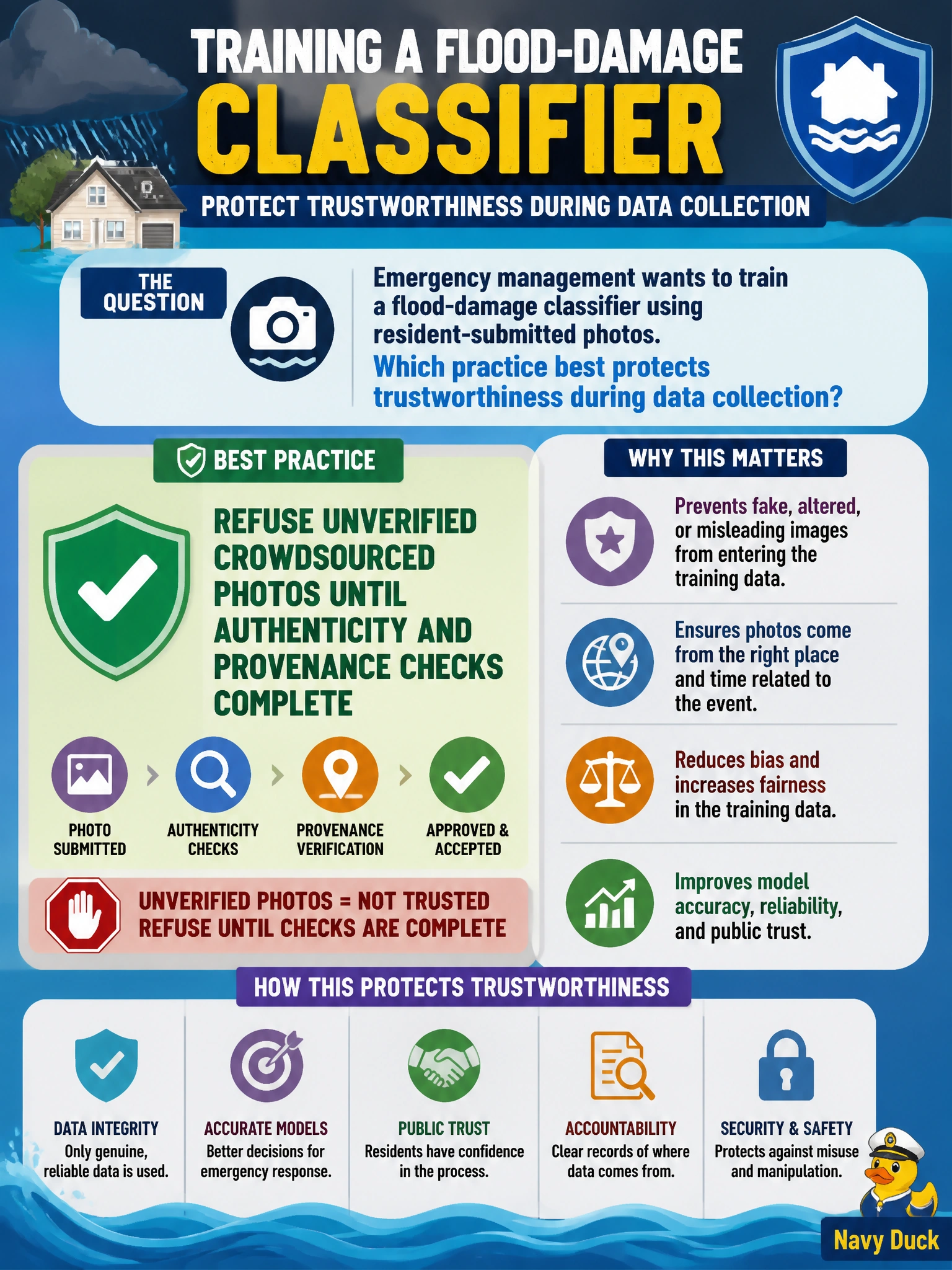
Emergency management wants to train a flood-damage classifier using resident-submitted photos. Which practice best protects trustworthiness during data collection?
Select an answer to reveal the explanation.
Short Explanation
Think of flood photos like evidence bags — if you don't know where they came from, you shouldn't let them drive the case. Municipal teams hold unverified crowdsourced images until authenticity and provenance checks pass. Logging device IDs and timestamps to certify authenticity or filing consent forms to validate labels still skip real authenticity checks, so you'll bake in faked or mislocated scenes before you know it, and stripping EXIF to standardize integrity even destroys the metadata you'd need to verify them.
Full Explanation
In municipal AI lifecycles, data collection is the first trustworthiness control because every later stage inherits the quality and provenance of the training set. Emergency management building a flood-damage classifier from resident-submitted photos must treat those images as untrusted civic evidence until authenticity and provenance checks complete. Refusing unverified crowdsourced uploads until those checks finish prevents staged, outdated, relocated, or adversarially manipulated scenes from poisoning labels and model weights. Provenance review typically confirms capture time, geolocation consistency with known flood footprints, EXIF or platform metadata where available, and whether the image matches authoritative damage reports. Holding material out of the training pool until that gate clears is the professional default for high-stakes public-safety models.
Recording device IDs and timestamps to certify photo authenticity for training use only logs claimed source identifiers but does not verify image content, so unverified staged or misattributed scenes can still enter training and poison labels and public trust when the classifier later misranks damage. Stripping EXIF metadata from submissions to standardize photo integrity before training does not standardize integrity but destroys the capture-time and geolocation evidence needed for provenance checks, leaving no way to prove authenticity or currency. Filing resident consent statements alongside photos to validate damage labels for training proves permission to use an image, not that the damage label is correct or that the scene is authentic, current, or correctly located, and it embeds unverified phone-camera scenes into weights that are costly to remediate and may already influence field decisions.
Exam caveat: recording device IDs and timestamps to certify authenticity is not a substitute for provenance controls; CompTIA-style items expect collection gates before training when civic imagery can be faked or misattributed. Operational check: require a documented accept/quarantine/reject workflow for flood photo intake, sample-audit provenance fields before each training run, and block any unverified batch from entering the labeled corpus used for model updates.
Prefer to study offline? Printable PDF study book + test engine ($7.50, unofficial). These questions stay free here.