
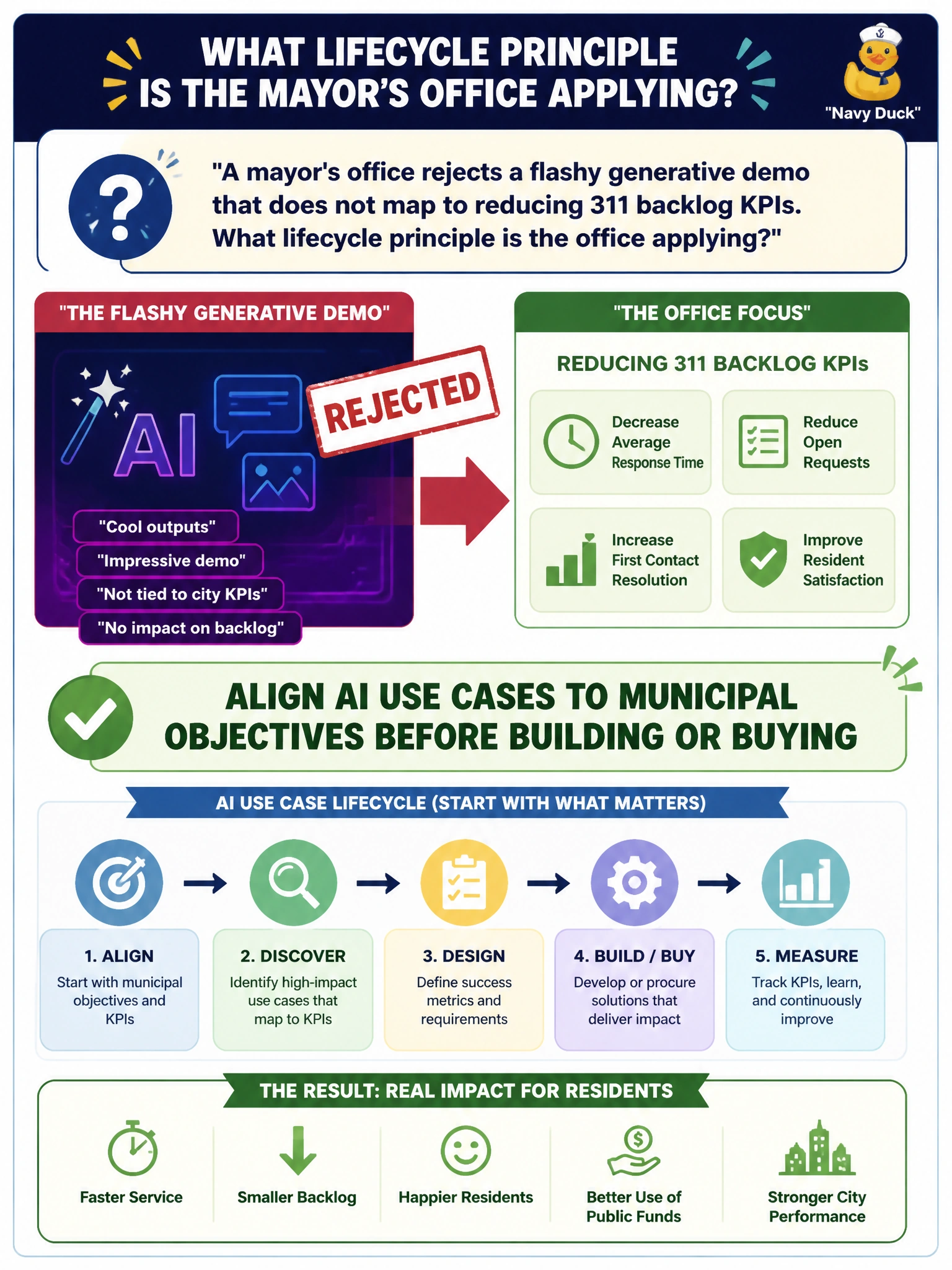
A mayor's office rejects a flashy generative demo that does not map to reducing 311 backlog KPIs. What lifecycle principle is the office applying?
Select an answer to reveal the explanation.
Short Explanation
Cool demos aren't a strategy. If it doesn't move the 311 backlog KPI, the mayor's office is right to pass—align the AI use case to city goals before you build.
Full Explanation
Rejecting a flashy generative demo that does not map to reducing 311 backlog KPIs applies the lifecycle principle of aligning AI use cases to municipal objectives before building or buying. Cities should define mission outcomes and success metrics first, then evaluate whether a tool moves those metrics—not invert the order around vendor spectacle. Standardizing citywide AI platforms before prioritizing municipal use cases fails by concept because it locks in infrastructure before confirming which municipal objectives it should serve, risking purchase of the wrong platform. Mapping AI use cases to municipal objectives after citywide deployment reviews fails because it deploys first and defines success later, rather than confirming the use case aligns with 311 backlog goals before building or buying. Advancing 311 pilot models to production before confirming backlog impact fails because, while pilots matter, moving to production without measured impact scales first and confirms success later, rather than confirming the use case maps to municipal objectives before procurement. Exam caveat: KPI alignment must still respect legal, equity, and security constraints—an AI that cuts backlog by unsafe automation can meet a narrow metric while violating civic duty. Operational check: write a use-case brief tying the proposed AI to 311 backlog KPIs, define baseline and target measures, require security and privacy review before procurement, and refuse pilots that cannot state how success will be measured.
Prefer to study offline? Printable PDF study book + test engine ($7.50, unofficial). These questions stay free here.