
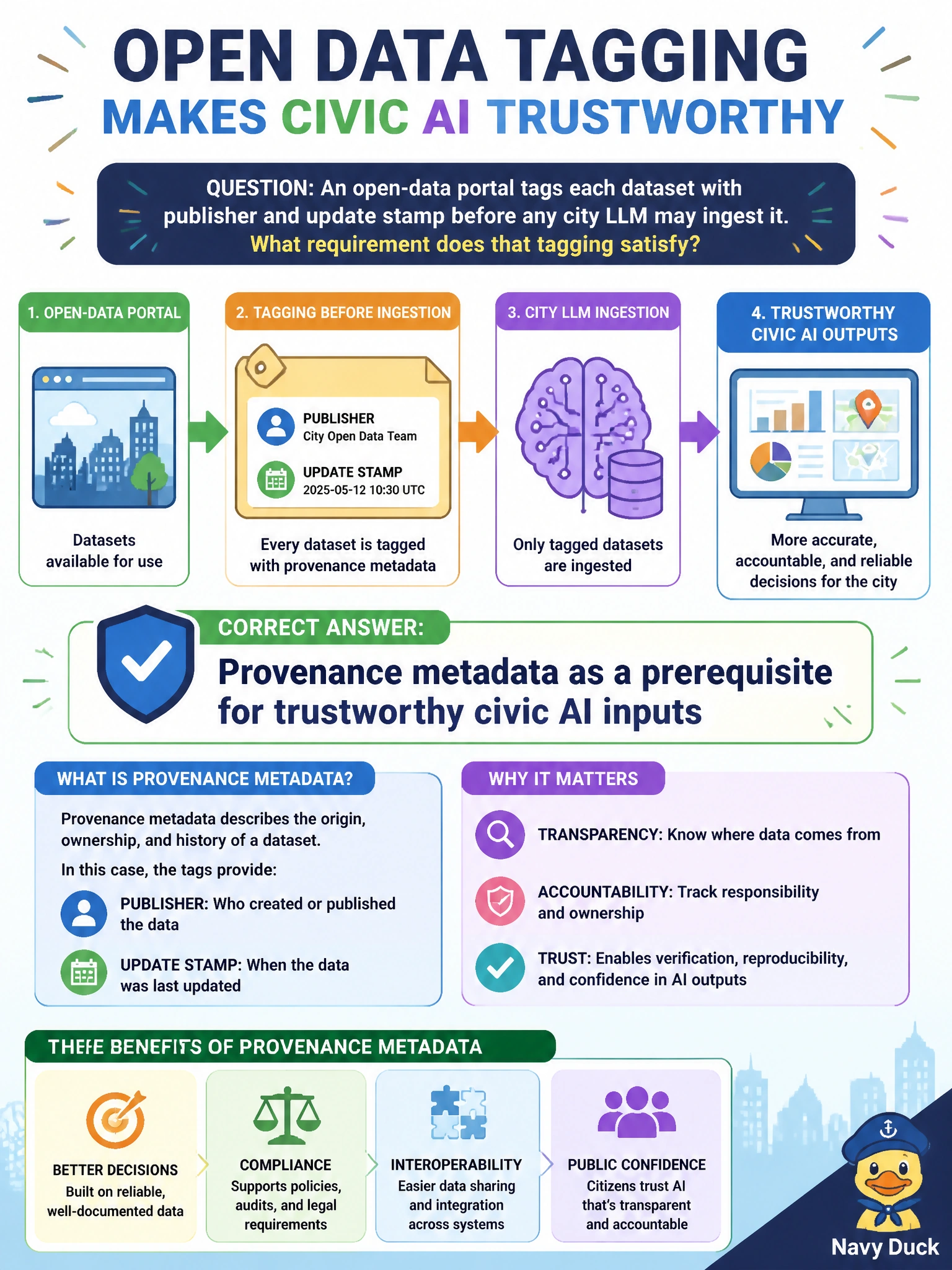
An open-data portal tags each dataset with publisher and update stamp before any city LLM may ingest it. What requirement does that tagging satisfy?
Select an answer to reveal the explanation.
Short Explanation
Publisher and update stamps are provenance tags—who published it and when. City LLMs shouldn't swallow open data until those trust labels are on the can.
Full Explanation
Tagging each open-data portal dataset with publisher and update stamp before any city LLM may ingest it satisfies provenance metadata as a prerequisite for trustworthy civic AI inputs. Provenance answers who published the data and when it was last updated so models do not silently train or retrieve from untrusted or stale sets. Schema definition metadata as a prerequisite for trustworthy civic AI inputs fails because it describes structure and field definitions rather than establishing the publisher attribution and update-stamp freshness that provenance requires for trustworthy civic AI inputs. Usage license metadata as a prerequisite for trustworthy civic AI inputs fails because it covers reuse permissions, not the publisher attribution and update-stamp metadata that must be verified before any city LLM ingests the data. Access policy metadata as a prerequisite for trustworthy civic AI inputs fails because it describes who may access data under what conditions, not the provenance tagging that must accompany datasets before ingestion by city LLMs. Exam caveat: provenance tags are only as reliable as the portal’s publishing process; forged or copied tags still need integrity protection and human data-steward review for sensitive domains. Operational check: enforce publisher and update-stamp fields as mandatory ingest gates, reject untagged datasets in the LLM data pipeline, log which tagged versions entered each training or RAG build, and re-verify stamps on a schedule.
Prefer to study offline? Printable PDF study book + test engine ($7.50, unofficial). These questions stay free here.