
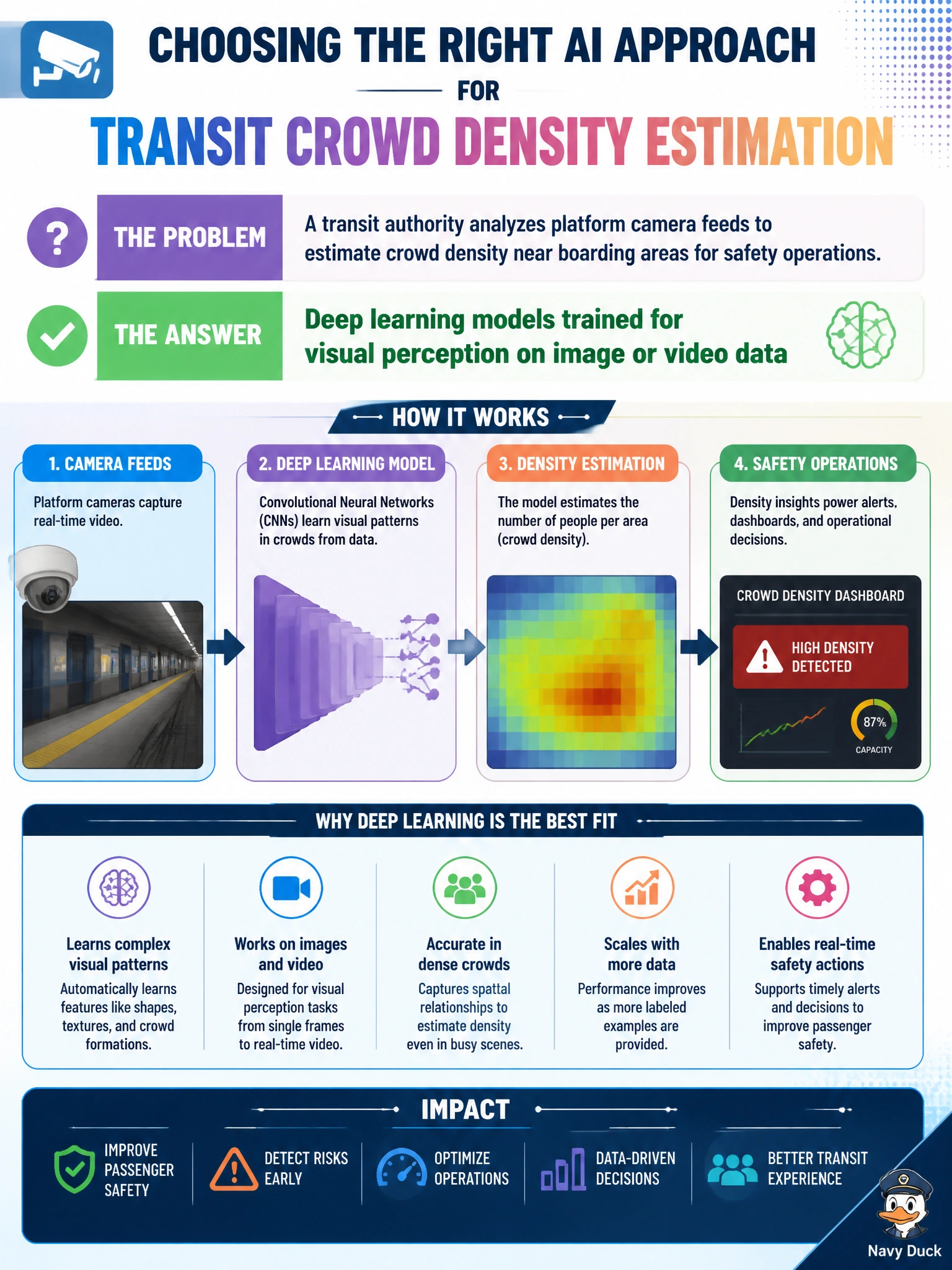
A transit authority analyzes platform camera feeds to estimate crowd density near boarding areas for safety operations. Which AI approach best fits that vision workload?
Select an answer to reveal the explanation.
Short Explanation
Crowd density from cameras is a see-and-recognize job, and deep learning is built for that kind of visual perception. Person re-identification or multi-object tracking won't help you since they're about tracking who's who across views and frames, not how packed the boarding area is. Action recognition in crowd video clips can't give you a crowd count either, as it's classifying behavior, not density.
Full Explanation
Estimating crowd density near boarding areas from platform camera feeds is a visual perception problem: models must interpret pixels or video frames to infer occupancy for safety operations. Deep learning models trained for vision on image or video data fit that workload because convolutional and related architectures learn spatial features that map camera scenes to density estimates at municipal scale. Deep learning models trained for person re-identification across camera views fail because they link the same person between views for tracking rather than estimating aggregate occupancy from platform scenes. Deep learning models trained for multi-object tracking across video frames fail because they follow individual trajectories across frames for tracking rather than perceiving crowd levels in video frames. Deep learning models trained for action recognition in crowd video clips fail because they classify activities in video clips to interpret crowd behavior rather than providing continuous visual crowd density from camera streams. Exam caveat: vision density models raise privacy and retention issues in public transit spaces and can err under occlusion, weather, or camera outages—safety decisions should not rest on a single unvalidated estimate. Operational check: calibrate against controlled counts, define retention and blurring policies for platform video, monitor model drift after camera moves, and escalate to human operations when confidence is low.
Prefer to study offline? Printable PDF study book + test engine ($7.50, unofficial). These questions stay free here.