
A courts clerk chatbot summarizes long motion filings for docket staff using a modern language model. Which architecture family most directly enables that summarization capability?
Select an answer to reveal the explanation.
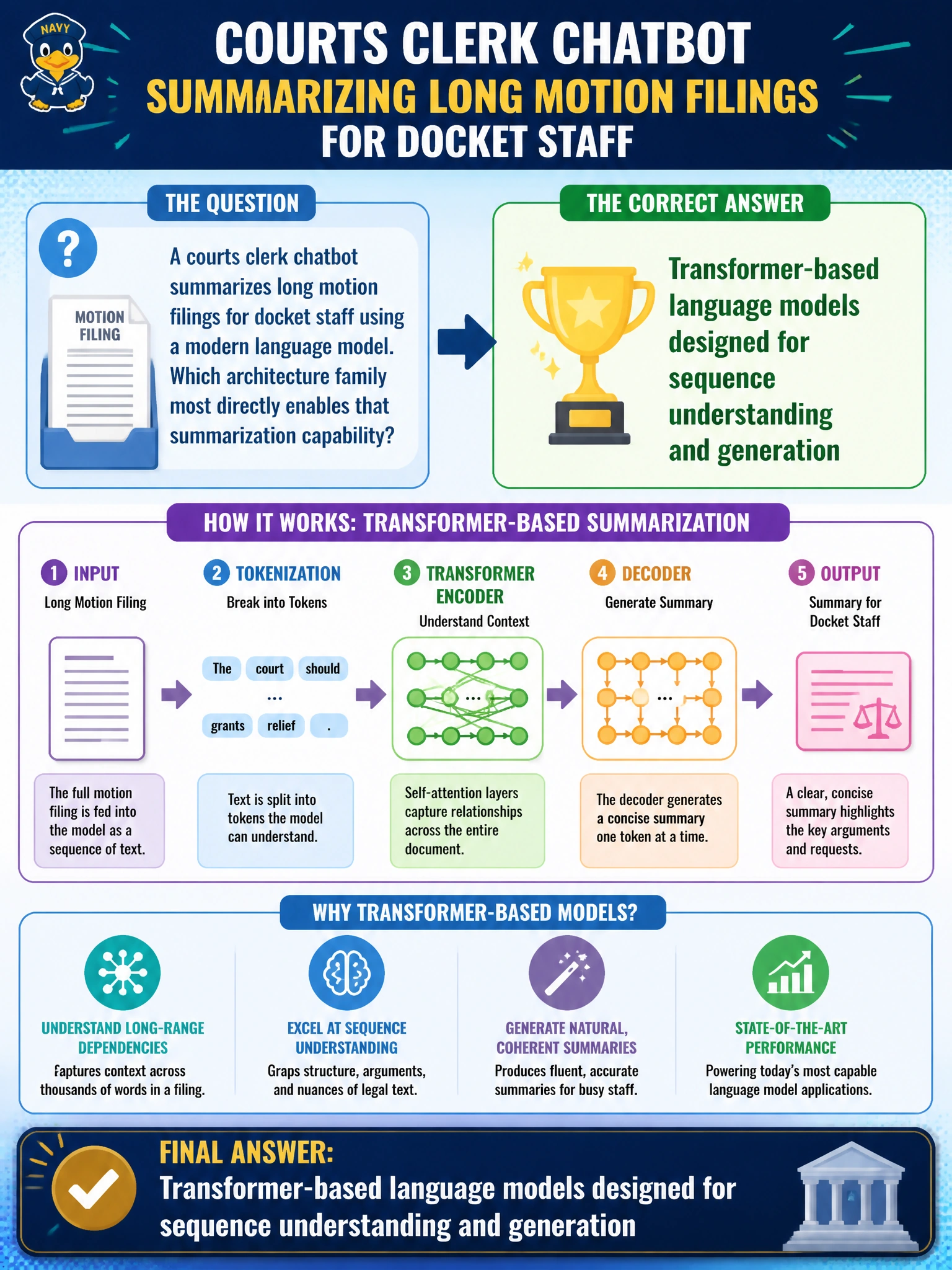
Short Explanation
Transformers are the engine under today's clerk-friendly summarizers—they read long filings as sequences and compress them into usable digests. You won't get a reliable motion digest from a recurrent language model designed for sequence understanding and generation or a convolutional language model designed for sequence understanding and generation, since sequential steps and narrow windows don't give you global attention across a long filing. You won't get it from an encoder-only language model designed for sequence understanding and generation either, since it lacks the decoder you'll need to generate a fluent summary.
Full Explanation
Summarizing long motion filings for docket staff with a modern language model is enabled by transformer-based architectures designed for sequence understanding and generation. Transformers attend across tokens in long documents, compress salient procedural points, and emit coherent digests—capabilities that directly match courts-clerk summarization workloads. Recurrent language models designed for sequence understanding and generation fail by concept because sequential recurrence bottlenecks long-range context across a lengthy motion and does not provide the parallel self-attention that directly enables modern long-document summarization. Convolutional language models designed for sequence understanding and generation fail because stacked local filters capture local patterns rather than global attention over pages of argument, so they do not directly enable fluent multi-sentence digest generation the way transformers do. Encoder-only language models designed for sequence understanding and generation fail because encoder-only designs produce embeddings for understanding but lack a decoder for generation, so they cannot read a motion filing and emit a condensed narrative digest. Exam caveat: transformer summaries can omit critical procedural nuances or invent citations; docket staff must treat AI digests as assistive drafts, not authoritative records of the filing. Operational check: constrain context to the filed PDF, require page citations in the summary, log model and prompt versions, and keep human acceptance before any digest enters the official case workflow.
Prefer to study offline? Printable PDF study book + test engine ($7.50, unofficial). These questions stay free here.