
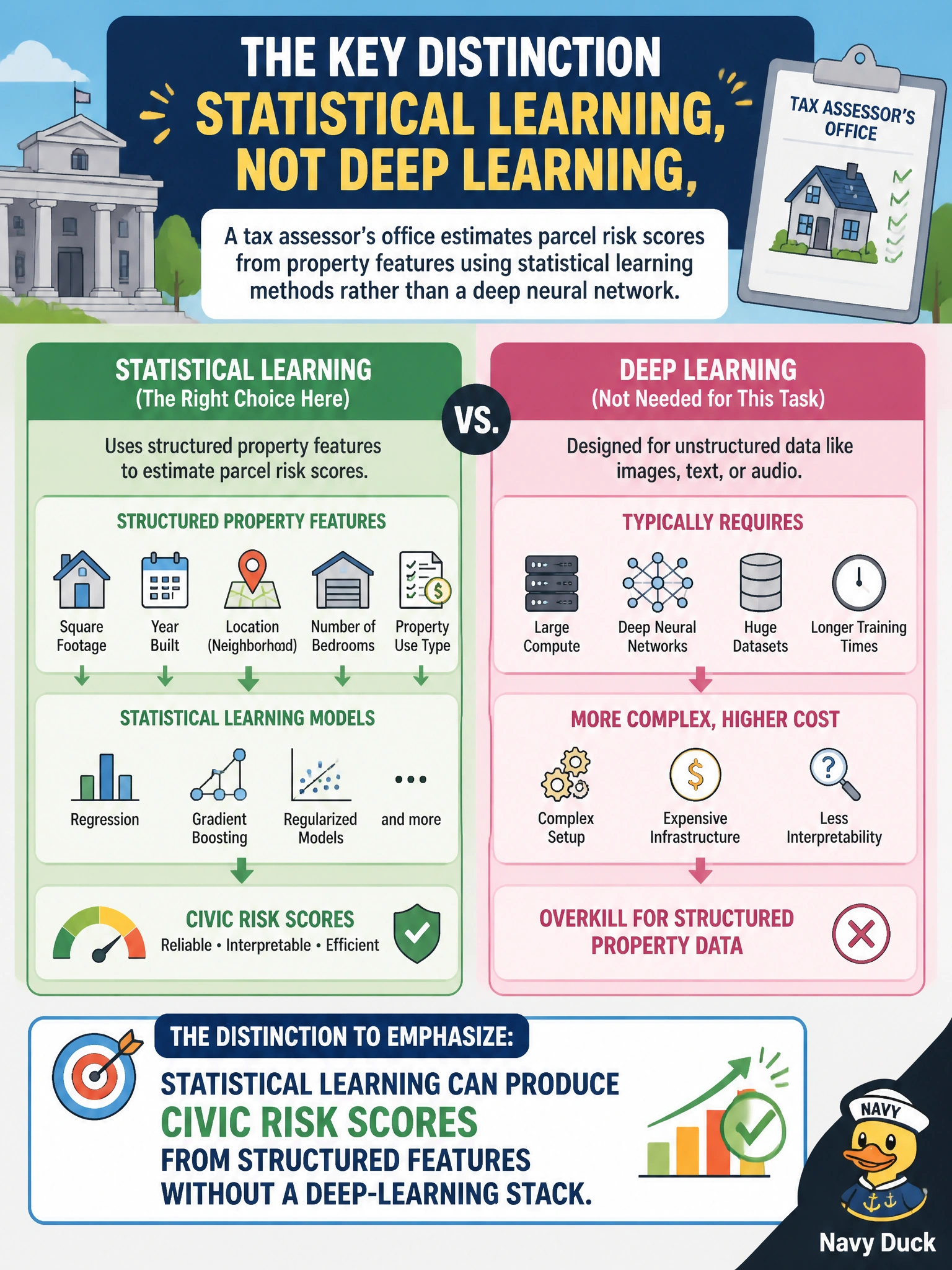
A tax assessor's office estimates parcel risk scores from property features using statistical learning methods rather than a deep neural network. What distinction should the AI lead emphasize?
Select an answer to reveal the explanation.
Short Explanation
Not every city scorecard needs a giant neural net. Statistical learning can chew on parcel tables—lot size, age, zoning—and spit out risk scores without standing up a deep-learning stack. Pick the lighter tool when the data is structured and the problem is predictive scoring.
Full Explanation
Estimating parcel risk scores from property features with statistical learning methods rather than a deep neural network emphasizes that structured civic tabular predictors—lot size, age, zoning, assessed value—can be modeled with classical statistical or shallow ML approaches without a deep-learning stack. The distinction works because many municipal numeric scoring problems are well served by interpretable regression or tree-based models that run on county servers, produce auditable coefficients or feature importances, and avoid GPU dependency. Claiming statistical learning improves parcel scoring by calibrating risk estimates directly from training correlations fails because training correlations capture sample-specific noise, and reliable risk scores require regularized fitting and validation for generalization to new parcels rather than direct reproduction of training patterns. Asserting statistical learning refines parcel scoring by reporting risk accuracy measured on training parcels fails because training-set performance is optimistically biased from fitting, and true scoring quality must be evaluated on held-out parcels not seen during training. Claiming statistical learning stabilizes parcel scoring by imputing missing values with test averages during fitting fails because computing imputations from test data leaks information into model fitting, and proper practice derives imputation values from training parcels only and then applies them. Exam caveat: "statistical learning" versus "deep learning" is a tooling distinction, not a guarantee of fairness—bias in assessed features or labels can still harm residents. Operational check: document feature definitions, compare a transparent baseline model against any deep alternative on the same parcel holdout set, and retain explanations suitable for assessor appeals.
Prefer to study offline? Printable PDF study book + test engine ($7.50, unofficial). These questions stay free here.