
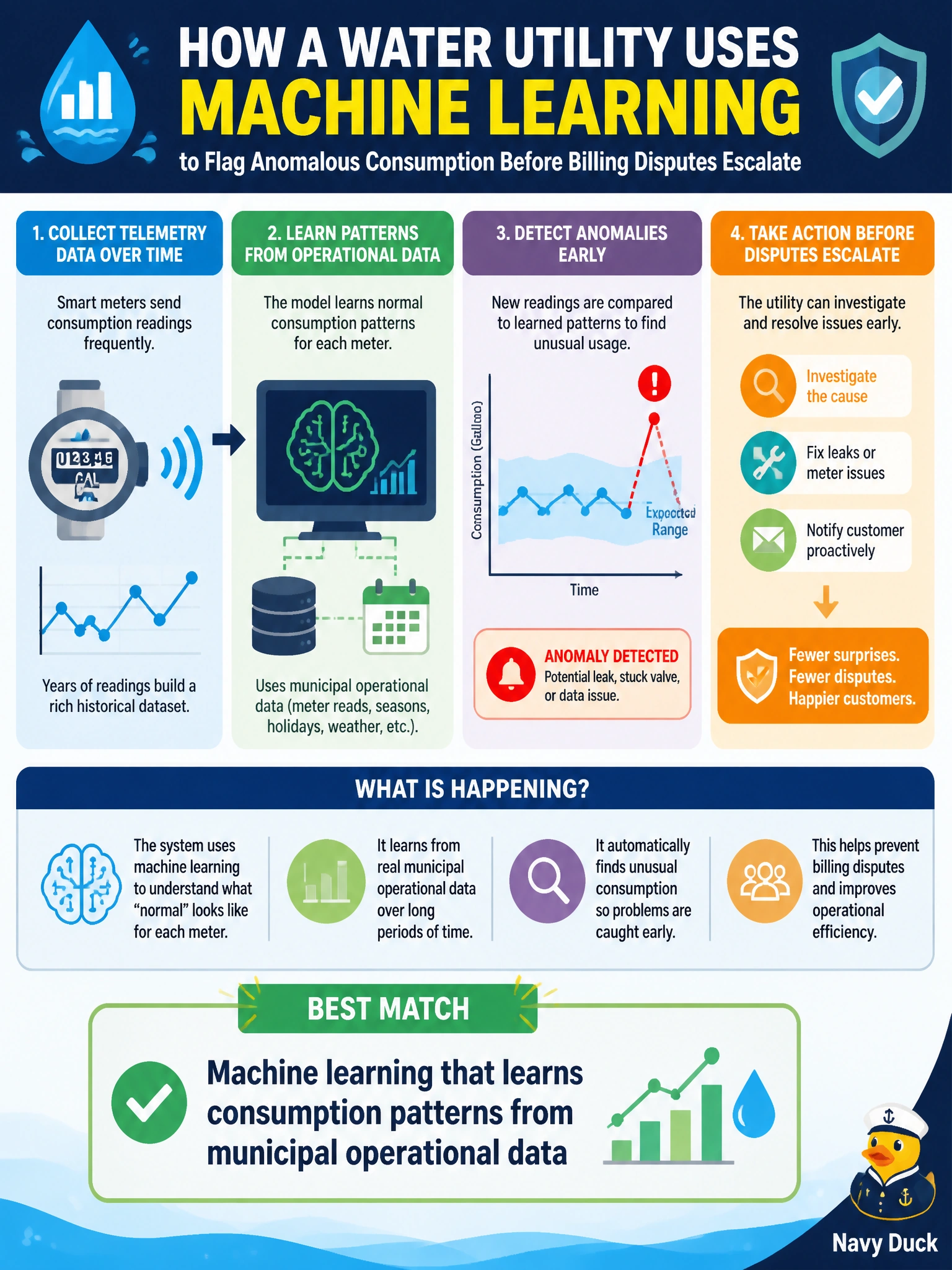
A water utility trains a model on years of meter telemetry so it can flag anomalous consumption before billing disputes escalate. Which description best matches that approach?
Select an answer to reveal the explanation.
Short Explanation
You're teaching the system to notice weird water use by studying years of past meters so you'll catch oddballs before billing disputes escalate. It's learning normal consumption patterns, not just applying fixed rule-based cutoffs to flag outliers.
Full Explanation
Training on years of meter telemetry so the system can flag anomalous consumption is machine learning on municipal operational data: algorithms fit patterns of normal and abnormal use from historical examples rather than relying solely on hand-authored thresholds. The approach works because predictive flagging before billing disputes escalate depends on learning distributional behavior from real utility meters—seasonality, occupancy cycles, and known leak signatures—then scoring new reads against that learned baseline. Relying on rule-based logic that flags consumption outliers from municipal operational data fails by concept because fixed hand-authored rules do not learn consumption patterns from years of telemetry and do not score anomalous water use from a learned baseline for billing disputes. Regression forecasting that predicts consumption totals from municipal operational data fails because it estimates future total volumes, not anomalous consumption at individual meters; it does not learn to score consumption risk for billing disputes. Clustering that groups daily consumption profiles from municipal operational data fails because it segments similar use shapes into groups, not anomalous consumption patterns for billing disputes; it does not learn from historical telemetry to score outliers before disputes escalate. Exam caveat: ML anomaly scores still need operational thresholds, explainability for customer disputes, and protection against poisoning or sensor faults that could skew the training distribution. Operational check: version the telemetry training window, validate precision/recall on held-out dispute cases, and require analyst confirmation before any flag alters a resident bill.
Prefer to study offline? Printable PDF study book + test engine ($7.50, unofficial). These questions stay free here.