
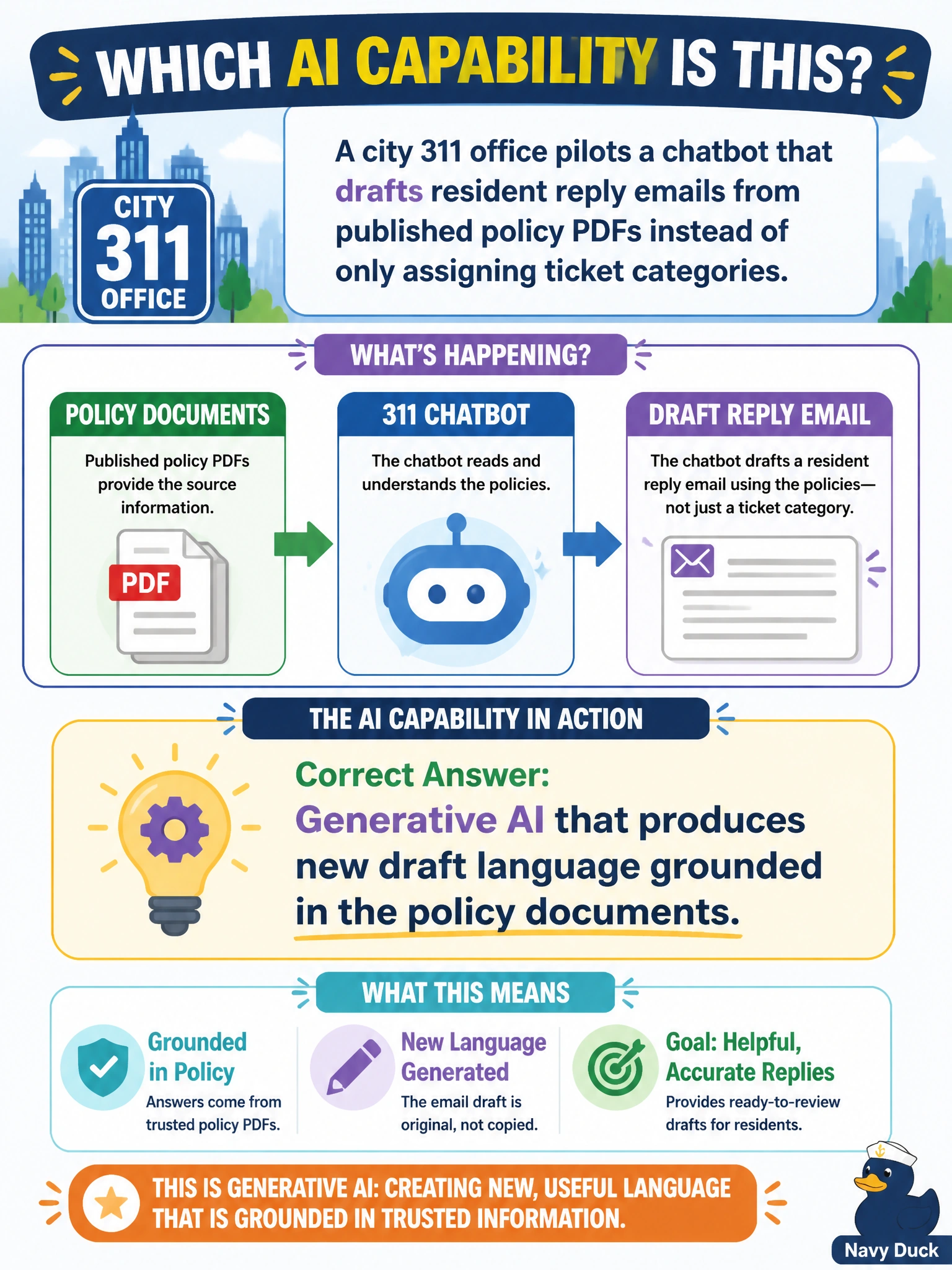
A city 311 office pilots a chatbot that drafts resident reply emails from published policy PDFs instead of only assigning ticket categories. Which AI capability best describes that drafting work?
Select an answer to reveal the explanation.
Short Explanation
Think of classification as sorting mail into bins and generative AI as writing the reply letter. The 311 pilot isn't just labeling the ticket—it's drafting actual resident language from policy PDFs, which is generative assistance.
Full Explanation
The 311 chatbot is not merely labeling tickets; it drafts new resident-facing reply language grounded in published policy PDFs. That is generative AI: a model produces novel text conditioned on municipal source documents rather than predicting service codes to assemble drafts from policy documents. Correctness follows because the operational outcome is authored language—policy-anchored drafts—rather than classification alone. Supervised classification that predicts service codes to assemble drafts from policy documents fails by concept because it only predicts a categorical service code and never composes new reply content grounded in the policy PDFs. Unsupervised clustering that groups policy documents by topic to compose draft replies fails because clustering only discovers topic structure among the policy documents; it does not synthesize novel, policy-grounded email drafts from the source documents. Rule-based keyword matching that inserts relevant policy documents into draft reply wording fails because fixed keyword rules only splice matching excerpts into reply wording and do not generatively draft fluent language from policy PDFs—they recycle predetermined insertions and cannot adapt to novel resident scenarios grounded in evolving ordinances. Exam caveat: generative drafting still requires human review for legal accuracy, tone, and jurisdiction-specific exceptions; grounding in PDFs reduces hallucination risk but does not eliminate it if retrieval is incomplete or policies conflict. Operational check: require citation of the policy sections used in each draft, log which PDF versions fed the prompt or retrieval index, and block send until a clerk accepts or edits the generated reply.
Prefer to study offline? Printable PDF study book + test engine ($7.50, unofficial). These questions stay free here.