
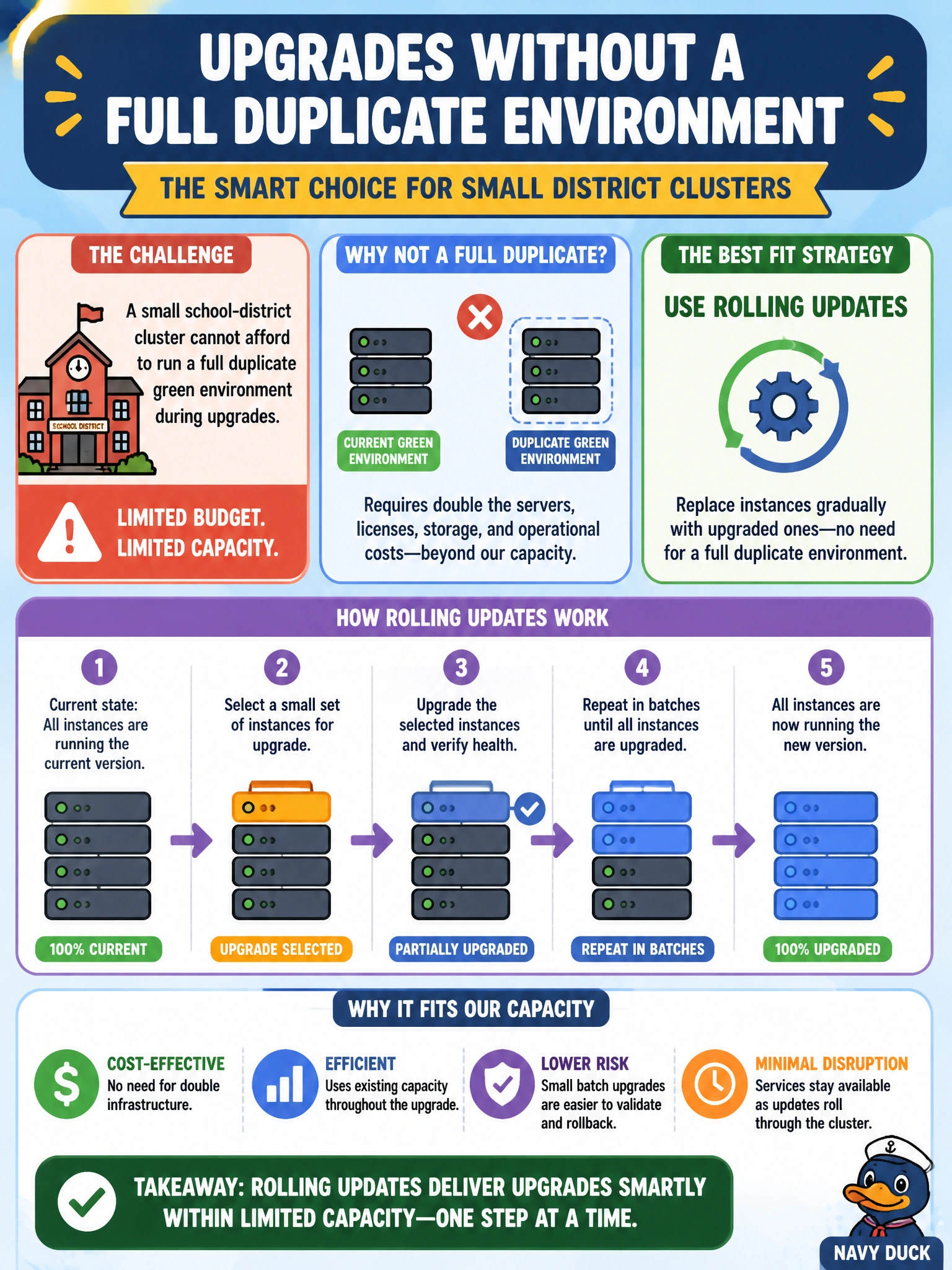
A small school-district cluster cannot afford to run a full duplicate green environment during upgrades. Which strategy fits the capacity constraint?
Select an answer to reveal the explanation.
Short Explanation
Rolling is the "upgrade a few school servers while the rest keep teaching apps online" move when you cannot pay for a whole second campus. Full green twins blow the small-cluster budget.
Full Explanation
Rolling updates replace instances gradually without requiring a full duplicate green environment, which fits small school-district clusters that cannot afford to run a complete idle twin during upgrades. Capacity stays mostly on the live pool while batches are recycled. That is the strategy that respects a tight infrastructure budget while still upgrading services patrons and staff depend on.
Requiring blue-green with a complete idle twin of every school service fails the capacity constraint because it doubles environment cost. Demanding canary infrastructure that doubles peak capacity for every release similarly assumes extra headroom the small cluster does not have. Taking the entire district offline for a week-long maintenance window only fails by maximizing downtime instead of solving the upgrade under limited spare capacity.
Exam caveat: rolling updates reduce duplicate-environment cost but introduce mixed-version periods and slower rollback than blue-green. Canaries can sometimes run with small extra capacity, but the option here that "doubles peak capacity" is deliberately unaffordable. Choose rolling when the scenario stresses "no full duplicate environment."
Operational check: size the school-district pool and maxUnavailable/maxSurge (or equivalent) so upgrades proceed without provisioning a second full stack. During a roll, confirm spare capacity remains within budget and that services stay available without a week-long outage.