
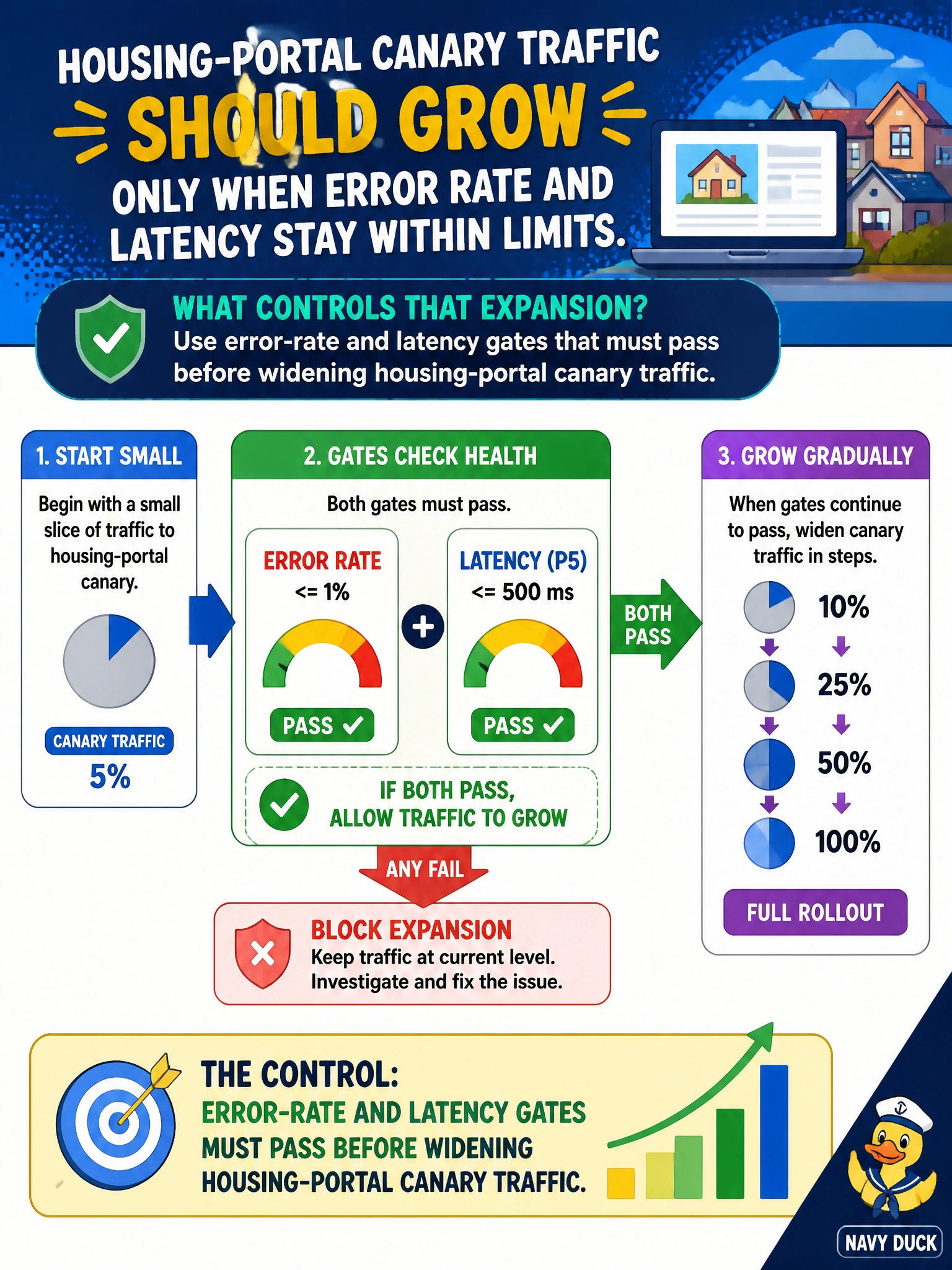
Housing-portal canary traffic should grow only when error rate and latency stay within limits. What controls that expansion?
Select an answer to reveal the explanation.
Short Explanation
You can think of canary gates as the “metrics say the housing lobby is calm—open more doors” rule. Fixed timers, judgment without telemetry, and disabling monitoring all skip the health check.
Full Explanation
Canary expansion should be gated by health metrics such as error rate and latency before more traffic shifts to the new version. Because housing-portal traffic should widen only when those signals stay within limits, configure explicit metric gates in the delivery controller or progressive delivery tool. This makes rollout evidence-based rather than dependent on a blind timer. Expanding to 100% on a fixed timer without consulting health metrics fails because elapsed time alone does not show that the canary is safe. Promoting on the planned schedule based on release-manager judgment rather than telemetry fails because subjective judgment skips an objective check of service health. Disabling monitoring during canary so alerts cannot slow rollout fails because it removes the signals the gates need and treats alerts as obstacles instead of controls. Exam caveat: choose indicators tied to user experience, such as errors, latency, and saturation, rather than vanity counters alone. Also distinguish canary gates from one-time smoke tests: gates continuously or stepwise authorize wider traffic, and progressive delivery implies promotion or abort based on telemetry. Practical check: run a housing-portal canary at a small percentage, keep error rate and latency within thresholds, and confirm widening is allowed. Inject elevated errors on the canary and verify that expansion halts or rolls back instead of advancing on the timer.