
A technician crimps both ends of a new cable and needs to see whether each pin lands on the matching pin at the other end. Which tool shows that?
Select an answer to reveal the explanation.
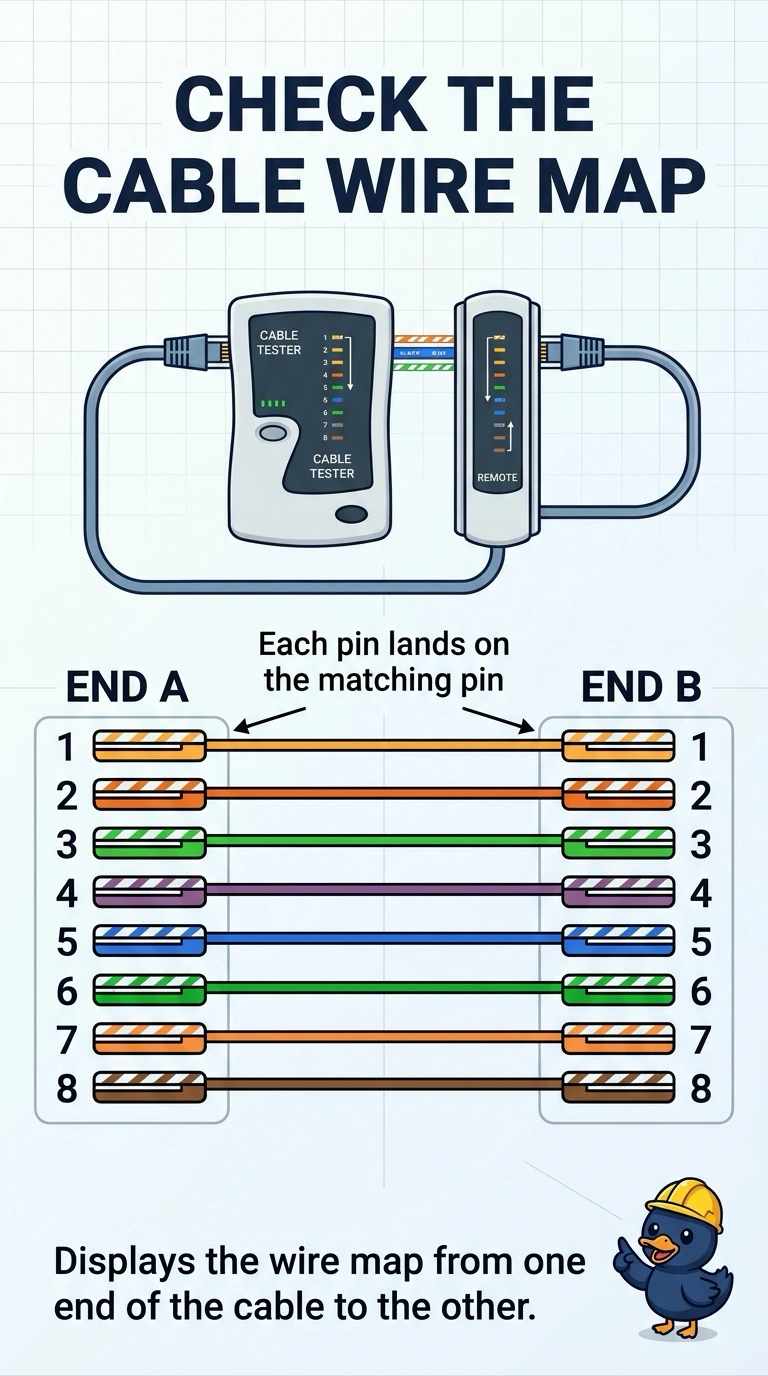
Short Explanation
You just tied eight tiny knots and you need a checklist that each knot hits the right post. A cable tester's wire map is that checklist. A tone finds which cable is which, a loopback plug folds one port back on itself, and the crimp tool only does the squeezing.
Full Explanation
A cable tester puts a signal on each conductor and reports the wire map, including opens, shorts, and swapped pins. After a crimp, that map is how you prove each pin lands on the matching pin. A tone generator and probe find which unlabeled cable is which. They do not display a pin-to-pin map of a cable you already have in your hands. A loopback plug connects a port's transmit path back to its receive path so you can test the port. It does not map a cable that runs between two rooms. A crimper fastens a connector onto the pairs. It has no display that beeps for a wrong pin. Exam caveat: a tester can show a good map on a cable that is still electrically marginal. If the link will be gigabit, use a tester that also checks the pairs the way the shop's standard requires. Operational check: read the wire map, fix any swap or split, and label the cable only after the map is one-to-one. Fix a swapped pair and test again. Label the cable only after the map is one-to-one. If the map shows a split pair, recrimp that end rather than forcing the link up.