
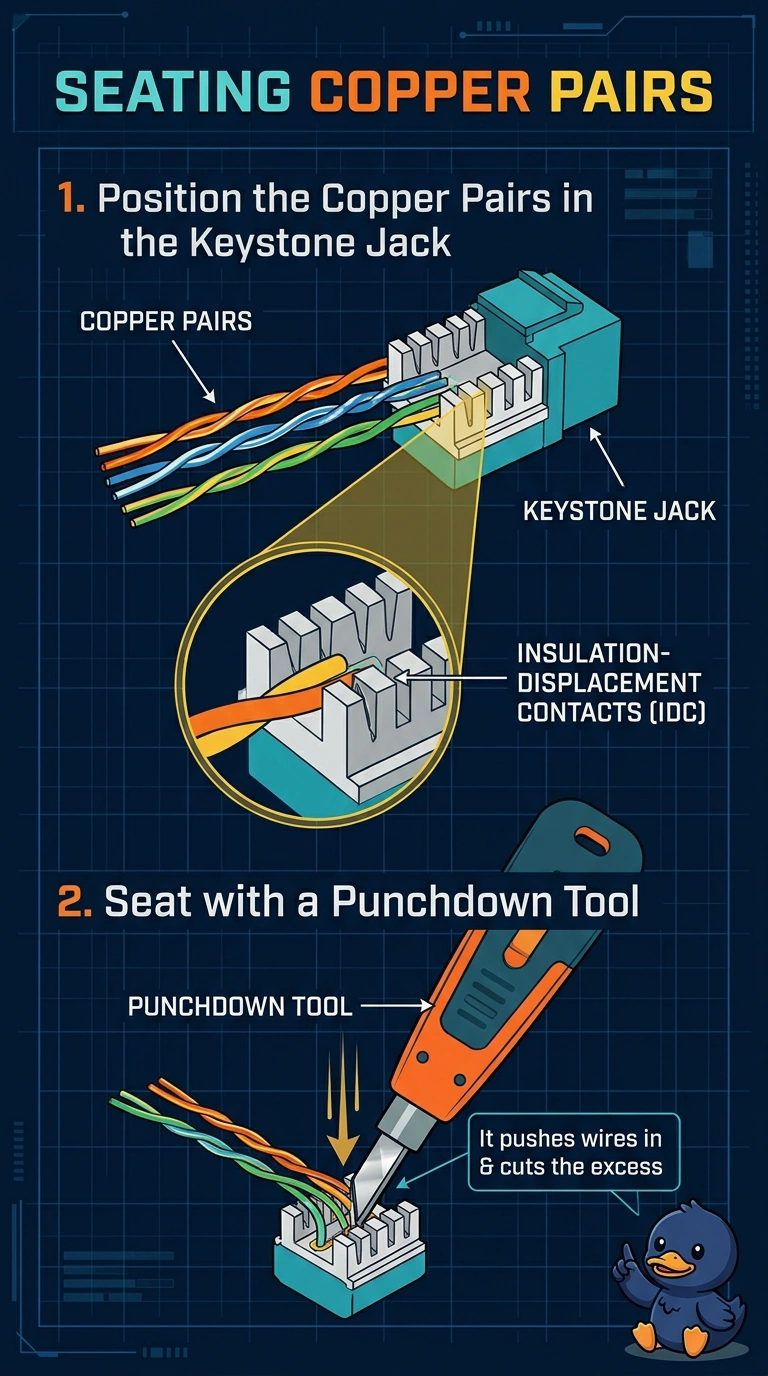
A technician is seating copper pairs into a keystone jack's insulation-displacement contacts. Which tool does that job?
Select an answer to reveal the explanation.
Short Explanation
The pairs have to be pushed into the little metal slots that cut the insulation. You use a punchdown tool. A plug crimper, a tone sender, and a port loopback plug each have a real use, and none of them seats a keystone jack.
Full Explanation
A punchdown tool drives each conductor into an insulation-displacement contact on a keystone jack or a block, which is the termination this technician is doing. A crimper fastens a modular plug onto the end of a cable. It does not seat pairs into a jack. A tone generator puts a signal on a pair so a probe can find it. It does not push the pair into a contact. A loopback plug tests a port by returning its transmit path to its receive path. It is not a termination tool. Exam caveat: use the blade that matches the jack, and trim the spare conductor instead of leaving a tail that shorts the next pair. Operational check: punch the pairs to the jack's color chart, then prove the jack with a cable tester before it goes into the faceplate. Trim the conductor tails and tug each pair lightly so a loose punch is caught before the faceplate goes on. Test the jack with a cable tester before the faceplate screws go in. Follow the jack's color code rather than a habit from a different standard. Do not leave conductor tails long enough to touch.