
A desktop must store cryptographic keys in a dedicated chip on the motherboard. Which component does that?
Select an answer to reveal the explanation.
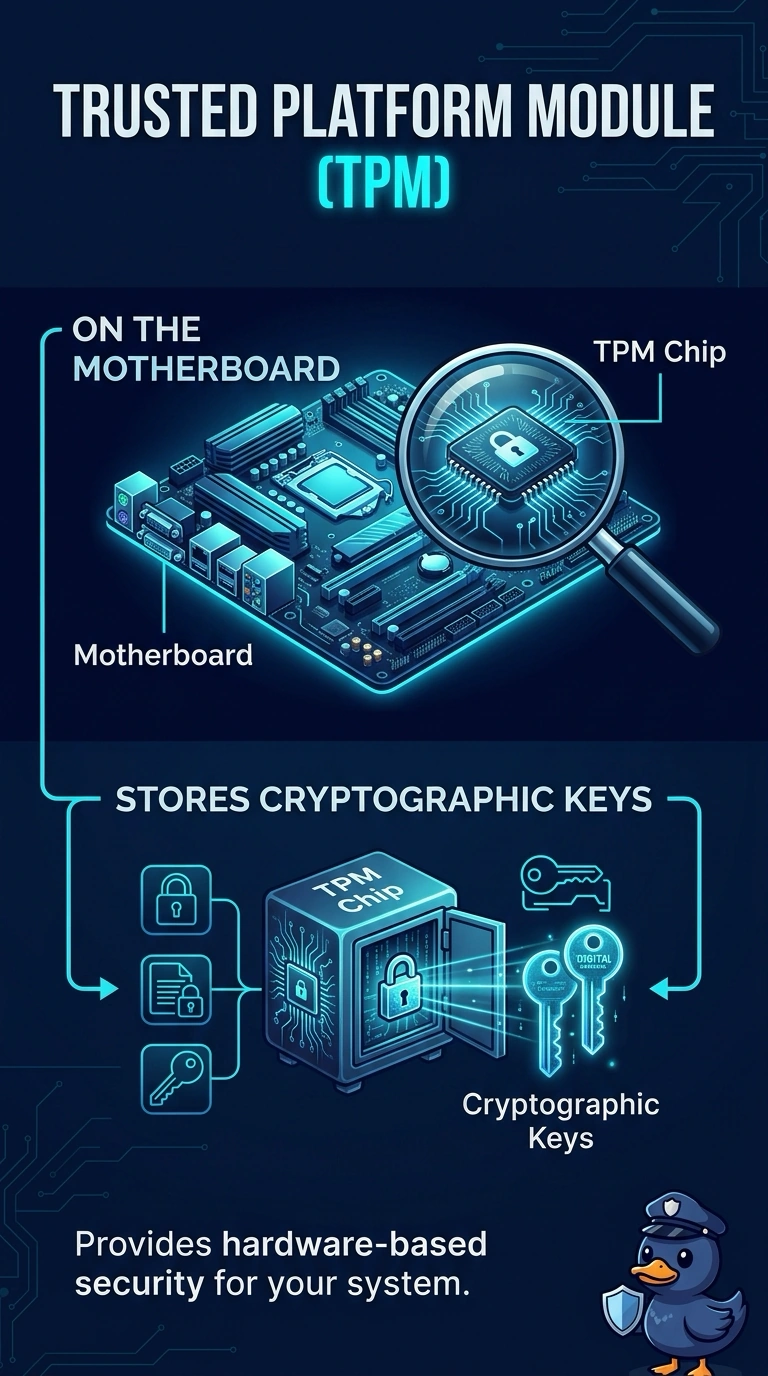
Short Explanation
The keys belong in a little vault soldered to the board, not in a setting or a battery. You want the Trusted Platform Module. A boot signature check, the clock battery, and the network adapter are not that vault.
Full Explanation
A Trusted Platform Module is the dedicated chip used to store cryptographic keys and related measurements on the motherboard. The desktop's requirement is that chip. Secure Boot is a firmware check of boot signatures. It may use keys, and it is not itself the chip that stores them. The CMOS battery keeps the clock and firmware settings while power is off. It does not hold the cryptographic key store. The network adapter moves frames. It is not the motherboard's key-storage chip. Exam caveat: the operating system still has to be set up to use the module. A chip that is disabled in firmware does not help disk encryption or attestation. Operational check: enable the module in firmware, confirm the operating system reports it as present, and confirm a feature that needs it can see the chip. Turn the module on in firmware and confirm the operating system can see it. Leave the module enabled and document the firmware setting. Confirm disk encryption or attestation can see the chip after it is enabled.