
A registrar has two disks and wants each one to hold a live copy of the other, so either disk can fail and the files remain. Which RAID level fits?
Select an answer to reveal the explanation.
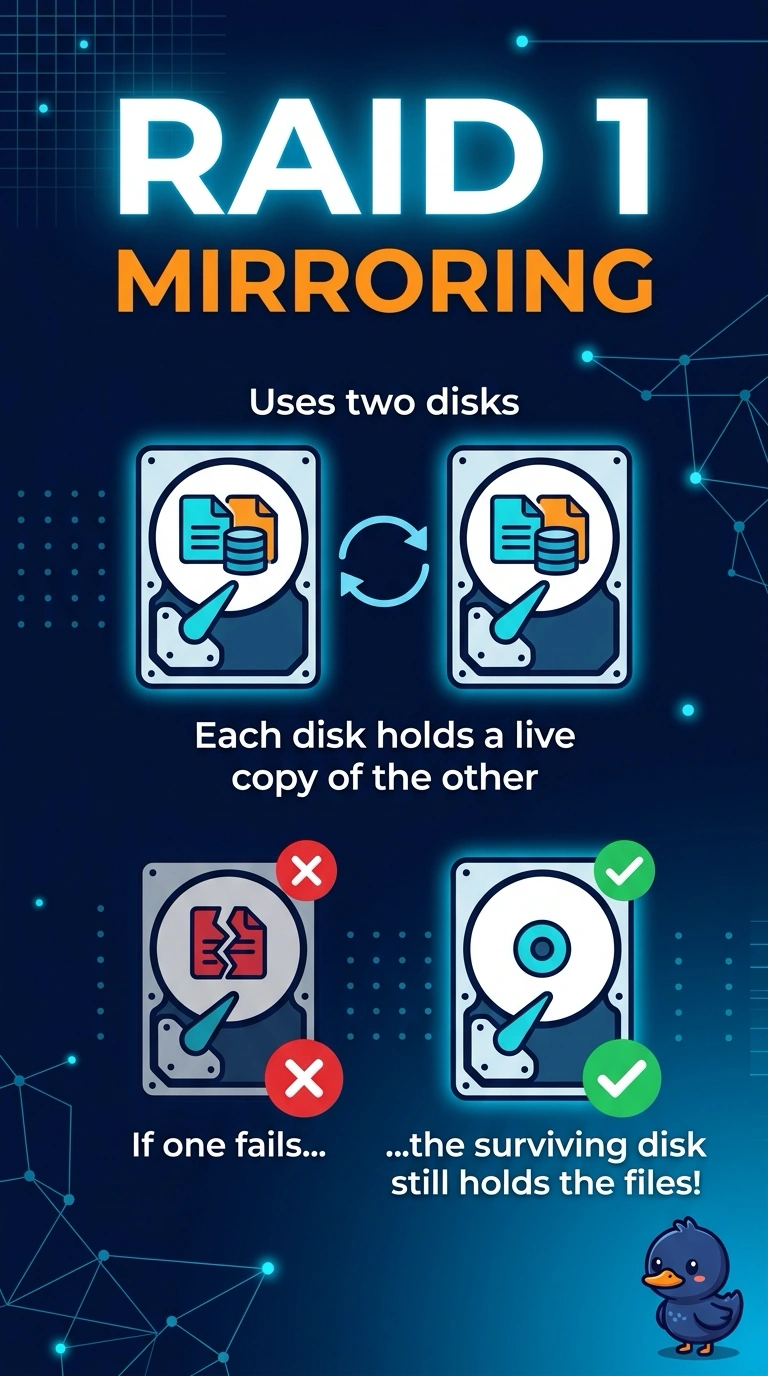
Short Explanation
Two disks, and each one is a full photocopy of the other. You want a mirror, which is RAID 1. A stripe with no copy dies when one disk dies, and the parity layouts want more disks than the registrar has.
Full Explanation
RAID 1 writes the same data to two disks. If either disk fails, the other still has the files, and two disks are enough to build it. That matches the registrar. RAID 0 stripes with no redundancy. One disk failure loses the array, so it cannot keep the files after either disk fails. RAID 5 needs at least three disks because it stripes data and parity. Two disks cannot make that set. RAID 10 combines mirroring and striping and needs at least four disks, two mirrored pairs. It cannot be built on the two disks in this office. Exam caveat: a mirror is not a backup. A deleted file is deleted on both disks, so the registrar still needs copies that are not in the mirror. Operational check: pull one disk in a maintenance window and confirm the files still open from the disk that remains. After the pull test, rebuild or resync before you return the registrar to the window. Put the pulled disk back only after the window, or replace it if it was the failed member. Confirm the alarm clears only after the mirror reports both disks healthy.