
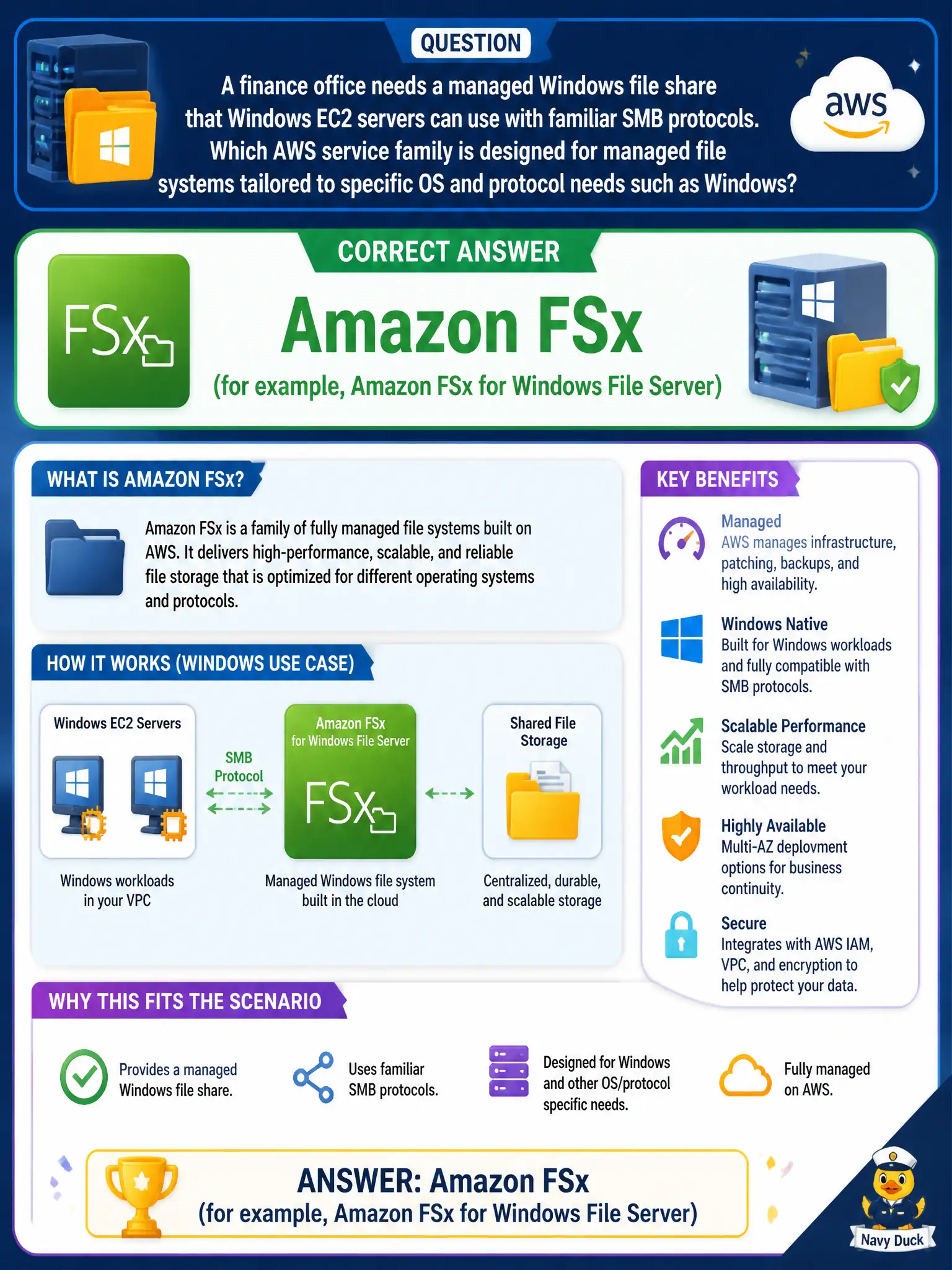
A finance office needs a managed Windows file share that Windows EC2 servers can use with familiar SMB protocols. Which AWS service family is designed for managed file systems tailored to specific OS and protocol needs such as Windows?
Select an answer to reveal the explanation.
Short Explanation
Windows shops often want SMB shares that feel like home. Amazon FSx family options—such as FSx for Windows File Server—deliver managed file systems tuned for those OS and protocol needs. It is not "just another S3 bucket with a Windows sticker."
Full Explanation
A finance office that needs a managed Windows file share for Windows EC2 servers using familiar SMB protocols should look to the Amazon FSx family—particularly Amazon FSx for Windows File Server. FSx provides managed file systems tailored to specific operating system and protocol needs rather than forcing every workload onto generic object storage. For Windows-centric municipal finance apps, SMB shares, NTFS features, and Active Directory integration patterns are the reason FSx appears in Cloud Practitioner identify questions about managed file systems for particular OS/protocol combinations.
Amazon S3 Transfer Acceleration speeds transfers to S3 buckets over long distances; it is not an SMB Windows file share. Amazon OpenSearch Service domain snapshots relate to search/analytics cluster backup, not Windows file shares. AWS CloudTrail lake event selectors configure management/data event capture; they do not export SMB file services. None of those substitute for a managed Windows file system.
Exam caveat: Remember the trio: EFS for Linux NFS shared files, FSx for specialized managed file systems (Windows, Lustre, NetApp, OpenZFS variants depending on need), S3 for objects. "Windows" plus "SMB" in the stem is a strong FSx signal at CLF depth.
Operational check for finance: deploy FSx for Windows File Server joined to the appropriate directory service per design, map drives from Windows EC2 servers, validate permissions and DFS/namespace expectations if used, enable encryption and backups, monitor storage capacity, and confirm that applications that expect SMB semantics are not incorrectly pointed at S3 bucket URLs.