
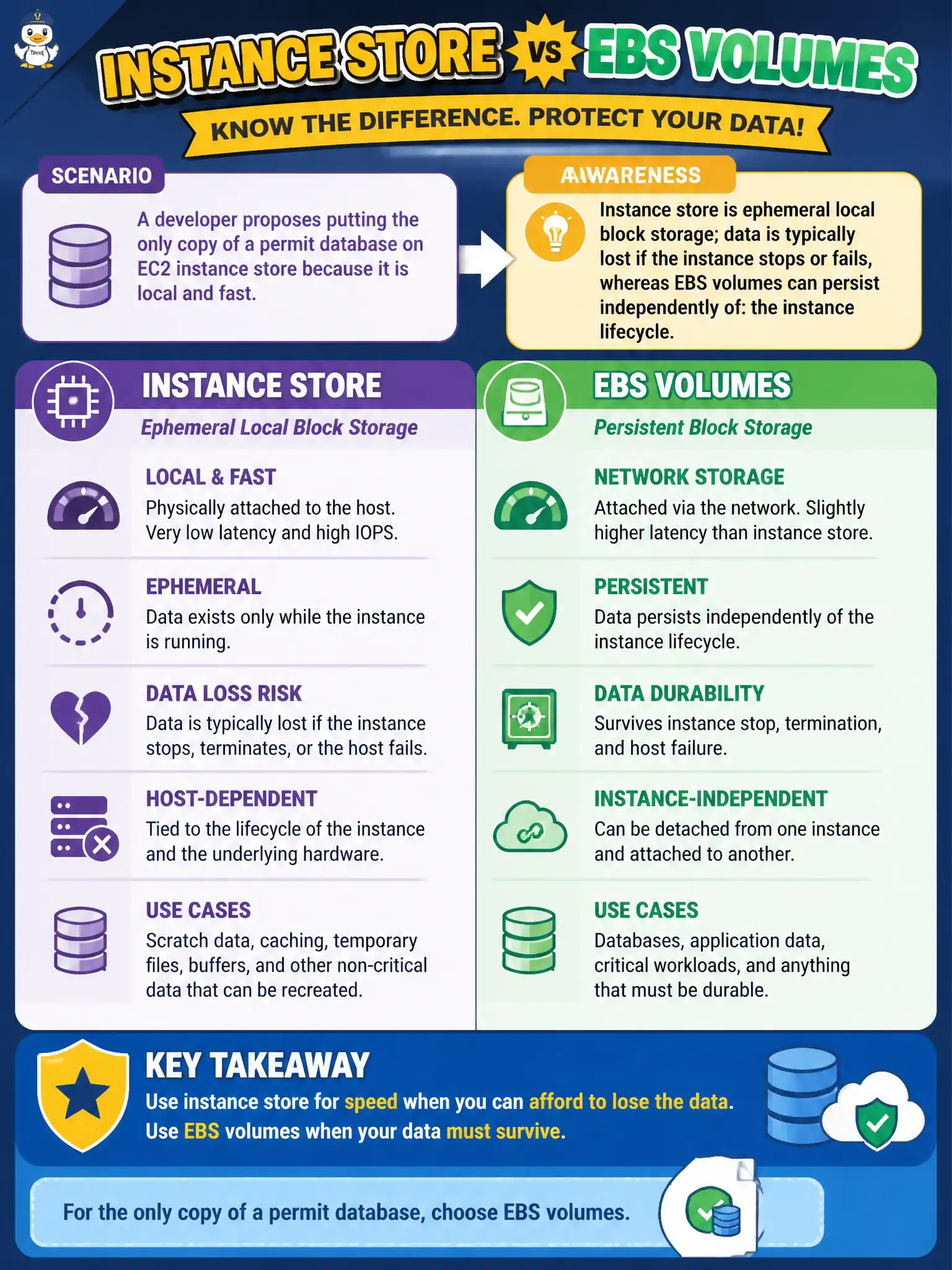
A developer proposes putting the only copy of a permit database on EC2 instance store because it is local and fast. What awareness should the team have about instance store compared with typical Amazon EBS volumes?
Select an answer to reveal the explanation.
Short Explanation
Instance store is the sticky note on the desk—fast and local, gone when the machine stops or fails. EBS is more like a notebook you can unplug and keep. If the permit database is the only copy, do not bet the farm on ephemeral instance store.
Full Explanation
Developers sometimes propose EC2 instance store for speed, but municipal teams must understand its durability model. Instance store is ephemeral local block storage physically attached to the host. Data on instance store is typically lost when the instance stops, terminates, or the underlying host fails. By contrast, Amazon EBS volumes can persist independently of a given instance lifecycle: you can stop an instance, detach and reattach volumes (within constraints), and restore from snapshots. Putting the only copy of a permit database on instance store therefore risks total loss on routine stop or unexpected failure—unacceptable for civic system-of-record data.
Instance store does not synchronously replicate to three Regions by default; that claim invents a durability feature it does not have. It is not billed only through AWS Backup vaults, nor is it the required boot volume for every EC2 instance type—most common boot volumes are EBS-backed. The correct awareness is ephemeral versus persistent: instance store for temporary scratch space; EBS (plus backups) for durable disks.
Exam caveat: "Local and fast" is not the same as "durable." CLF loves contrasting instance store ephemerality with EBS persistence. Also remember that some instance types offer instance store disks in addition to EBS root volumes for caches or scratch—still not the sole copy of a permit database.
Operational check for the permit system: keep databases on EBS (or managed database services), enable snapshots/AWS Backup, prohibit sole copies on instance store via architecture review, use instance store only for temporary caches or scratch that can be rebuilt, and validate stop/start behavior in non-production so trainees see firsthand that instance store contents do not survive the way EBS volumes do.