
A public-works EC2 instance needs a persistent block-storage volume for its operating system and application data disks. Which AWS service provides that attachable block storage?
Select an answer to reveal the explanation.
Short Explanation
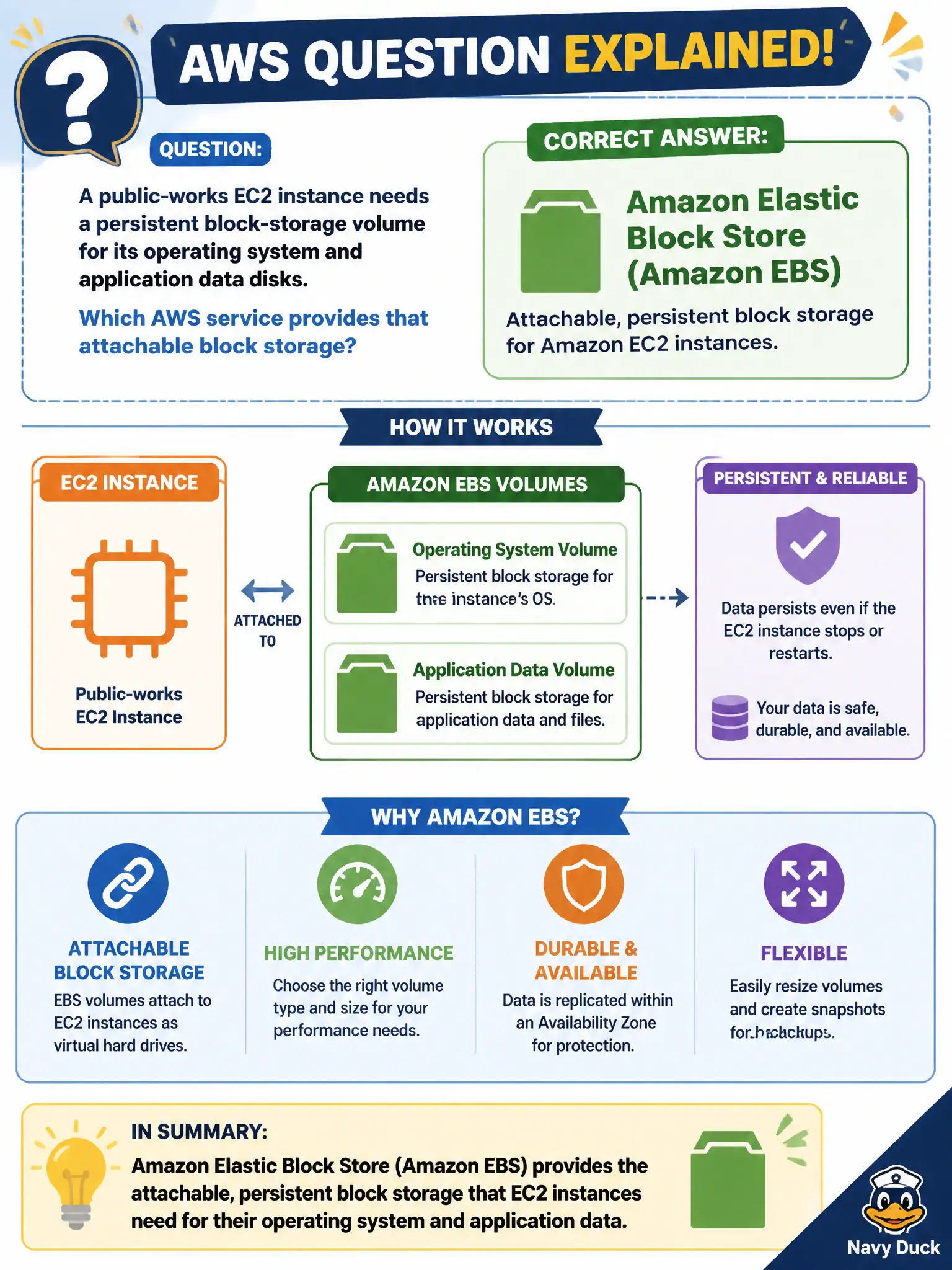
EC2 needs a real disk personality for the OS—block storage you can attach and persist. That is Amazon EBS: volumes that behave like drives for your instances. S3 buckets are fantastic for objects, but they are not the boot-and-data volumes your virtual server mounts.
Full Explanation
A public-works EC2 instance that needs a persistent block-storage volume for its operating system and application data disks should use Amazon Elastic Block Store (Amazon EBS). EBS provides network-attached block volumes that behave like disks: you create a volume, attach it to an instance, format or use it as the root/data device, snapshot it for backup, and resize or change volume types as civic workloads evolve. Persistence independent of a single ephemeral local disk is exactly why municipal servers boot from and store application data on EBS in typical designs.
Amazon S3 Standard-Infrequent Access buckets store objects by key; they are not attachable block volumes for an OS. Amazon CloudFront origin groups improve CDN origin failover; they are not server disks. Amazon Athena workgroups organize SQL query settings against data lakes; they do not provide EC2 block storage. Mixing object, CDN, and analytics services into the "attachable disk" role is a common exam trap.
Exam caveat: Root volumes for most EC2 instance types are EBS-backed. Instance store exists for certain types as ephemeral local block storage and should not be confused with EBS persistence. Also know snapshot → AMI relationships for backup and imaging at a high level.
Operational check for public works: choose volume type appropriate to IOPS/throughput needs, enable encryption, schedule snapshots via AWS Backup or Data Lifecycle Manager, ensure critical file systems are on EBS rather than instance store, monitor burst credits or provisioned IOPS, and test restore from snapshot so a failed OS disk does not strand field-operations applications.