
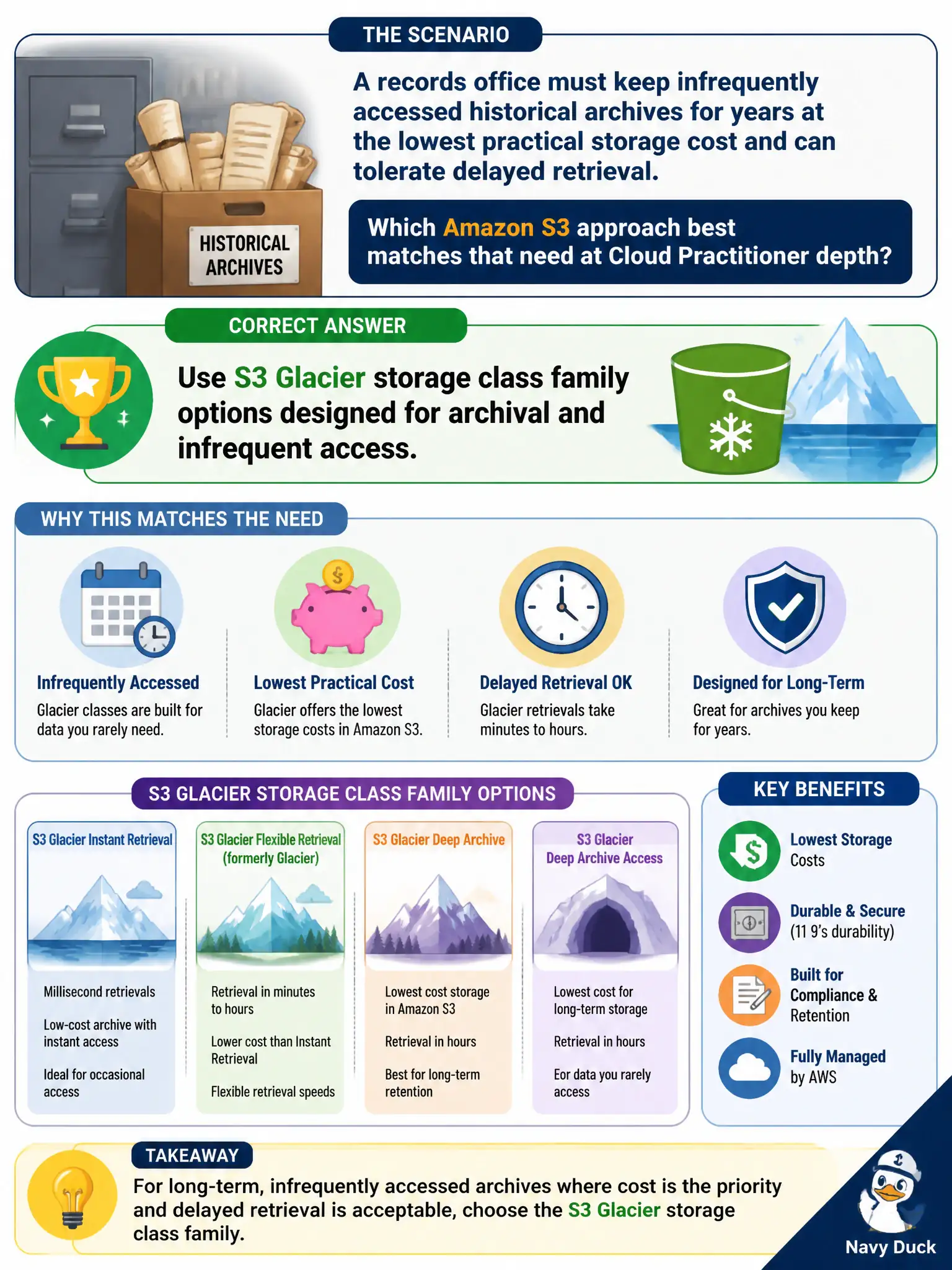
A records office must keep infrequently accessed historical archives for years at the lowest practical storage cost and can tolerate delayed retrieval. Which Amazon S3 approach best matches that need at Cloud Practitioner depth?
Select an answer to reveal the explanation.
Short Explanation
Cold archives are like boxes in a warehouse—you rarely open them, so you pay less to store and wait longer to retrieve. S3 Glacier family classes are built for that infrequent-access archive story. Leaving everything on hot Standard forever is simpler but usually pricier for deep history.
Full Explanation
A records office that must retain infrequently accessed historical archives for years at the lowest practical storage cost—and can tolerate delayed retrieval—should use Amazon S3 Glacier storage class family options designed for archival and infrequent access. At Cloud Practitioner depth, the Glacier family (including Instant Retrieval, Flexible Retrieval, and Deep Archive class options depending on access urgency) exists specifically so municipalities can keep long-retention evidence, closed cases, and historical scans without paying hot S3 Standard rates forever. The trade-off is intentional: lower storage cost in exchange for retrieval time and possible retrieval fees when someone finally needs the archive.
Keeping every archive forever on S3 Standard with no class changes works functionally but usually fails the "lowest practical storage cost" requirement for cold history. Storing archives only on Amazon EBS io2 maximizes IOPS for attached disks; it is expensive block storage for a single-instance access pattern, not multi-year cold object archival. Placing archives on Amazon CloudFront edge caches treats a CDN cache as durable storage, which it is not—CloudFront caches content for performance; it is not the system of record for municipal archives.
Exam caveat: Know the direction of the trade-off—colder generally means cheaper storage and slower/more deliberate retrieval—without memorizing every millisecond SLA. Do not confuse Glacier vault legacy terminology with modern S3 storage classes presented in current CLF materials; focus on archival classes under S3.
Operational check for the records office: classify which datasets are truly cold, select an archival class matching retrieval urgency (minutes versus hours), set lifecycle policies from warmer classes into Glacier family classes, test a restore/retrieval drill so staff know the delay before a public-records request deadline, and monitor storage versus retrieval cost so surprise restore bills do not hit during election-year document rushes.