
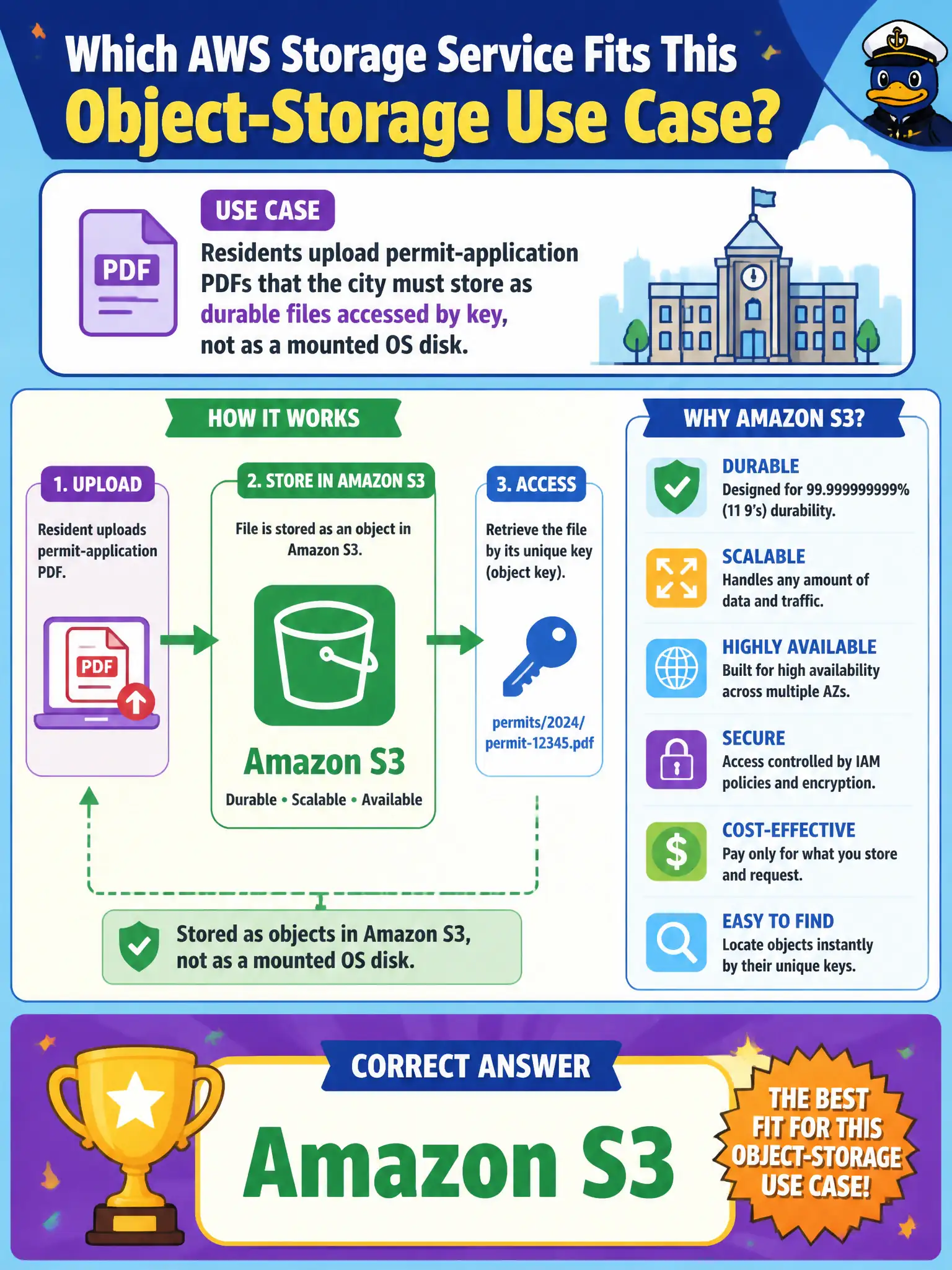
Residents upload permit-application PDFs that the city must store as durable files accessed by key, not as a mounted OS disk. Which AWS storage service fits this object-storage use case?
Select an answer to reveal the explanation.
Short Explanation
PDFs as files keyed by name scream object storage, and Amazon S3 is the go-to for that. You are not attaching a disk to one server—you are dropping objects into durable buckets apps can reach over the API. EBS is for block disks on EC2; S3 is for the citizen upload pile.
Full Explanation
Resident permit-application PDFs that must be stored as durable files accessed by key are an object-storage use case, and Amazon S3 is the AWS service that fits. S3 stores objects in buckets addressed by key, provides high durability, and exposes HTTP/API access so municipal apps and workflows can upload, retrieve, version, and lifecycle-manage documents without treating the store as a single server's mounted OS disk. For citizen uploads and records pipelines, S3 is the standard identify-level answer when the stem emphasizes files by key rather than a block volume attached to one EC2 instance.
Amazon EBS volumes are block storage attached to an EC2 instance (typically one instance at a time for a given volume), which is the wrong abstraction for a shared durable object store of resident PDFs. EC2 instance store is ephemeral local disk tied to the instance lifecycle and is inappropriate as the system of record for permit files. Amazon ElastiCache for Redis is an in-memory cache/data store for low-latency application state—not durable object storage for PDFs as the authoritative archive.
Exam caveat: Map storage personality to the need: S3 = objects/files by key; EBS = block disks for EC2; EFS/FSx = shared file systems; instance store = temporary local disk. CLF stems that say "accessed by key" or "object storage" almost always point to S3.
Operational check for the city upload path: create a dedicated bucket with Block Public Access enabled, encrypt with SSE-S3 or SSE-KMS per policy, use IAM roles or presigned URLs for uploads, enable versioning for accidental overwrite protection, apply lifecycle rules for older permits if required, and verify applications retrieve objects by key over the API rather than expecting a POSIX mount of the entire bucket as a boot disk.