
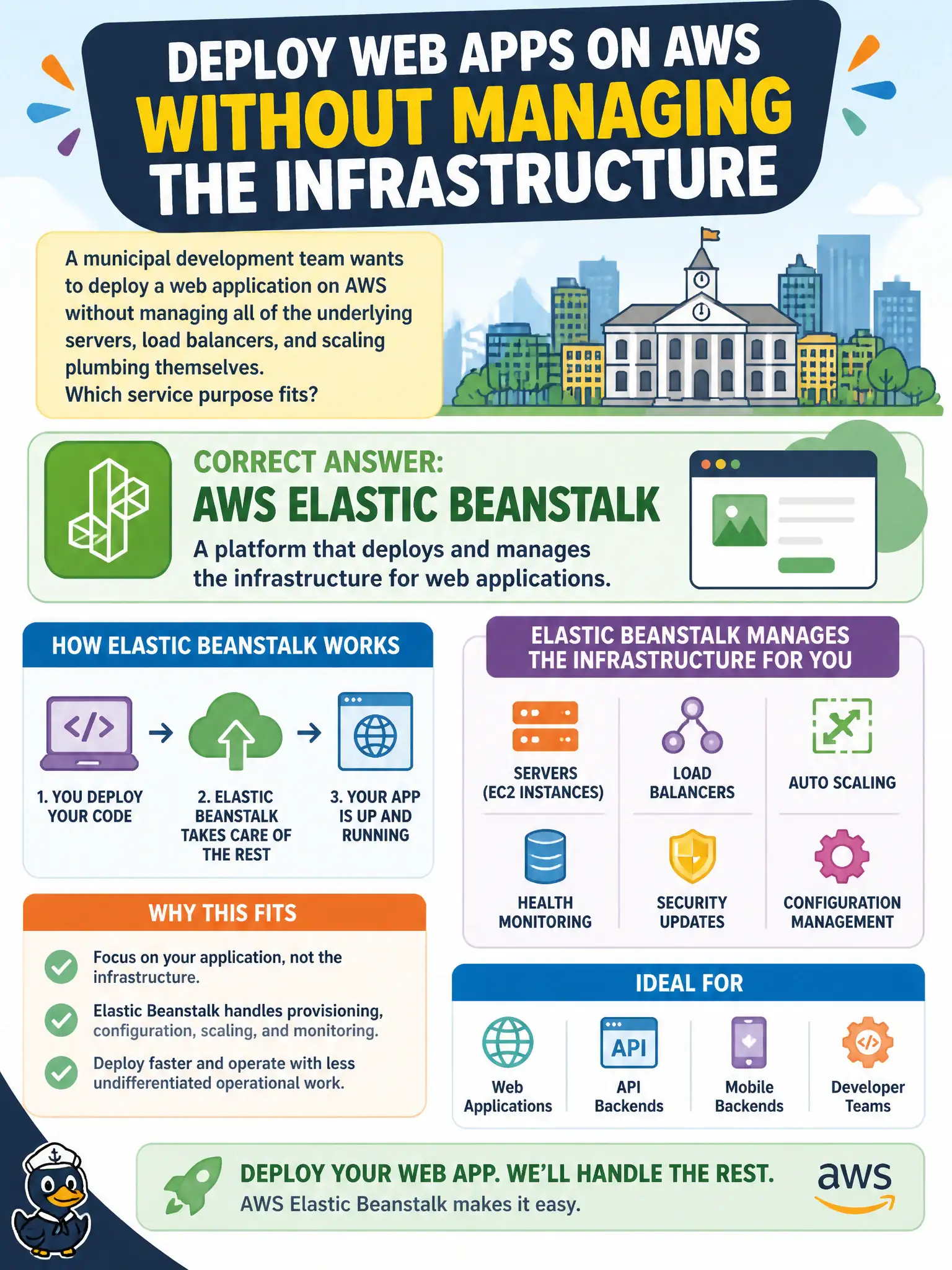
A municipal development team wants to deploy a web application on AWS without managing all of the underlying servers, load balancers, and scaling plumbing themselves. Which service purpose fits?
Select an answer to reveal the explanation.
Short Explanation
Elastic Beanstalk is like handing your app to a stage crew that sets up the lights, mics, and seating while you bring the performance. You upload the app; it handles a lot of the infrastructure busywork. VPC is your private network, Route 53 is DNS, and Artifact is compliance reports—not an app deploy platform.
Full Explanation
A municipal development team that wants to deploy a web application on AWS without managing all of the underlying servers, load balancers, and scaling plumbing themselves should use AWS Elastic Beanstalk. Elastic Beanstalk is a platform service that accepts application code and provisions and manages the supporting infrastructure—compute, load balancing, scaling, and monitoring—according to the chosen platform. City teams keep ownership of the application while AWS handles much of the undifferentiated environment assembly.
Amazon VPC provides isolated networking; it is not an application deployment platform that builds code pipelines by itself. Amazon Route 53 is DNS and routing, not a PaaS that compiles and hosts application source code. AWS Artifact provides compliance reports and agreements; it is not a runtime that auto-scales web application containers.
Exam caveat: Elastic Beanstalk = deploy web apps without managing all infrastructure plumbing. Lightsail = simple bundled VPS-like hosting. ECS/EKS = containers. Lambda = event-driven functions. Match “web application” + “without managing infrastructure” to Beanstalk.
Operational check: create a Beanstalk application and environment in a non-production account, deploy a sample municipal web app bundle, verify the created load balancer and Auto Scaling resources, set deployment policies, and decide whether platform constraints still meet the team’s long-term customization needs.