
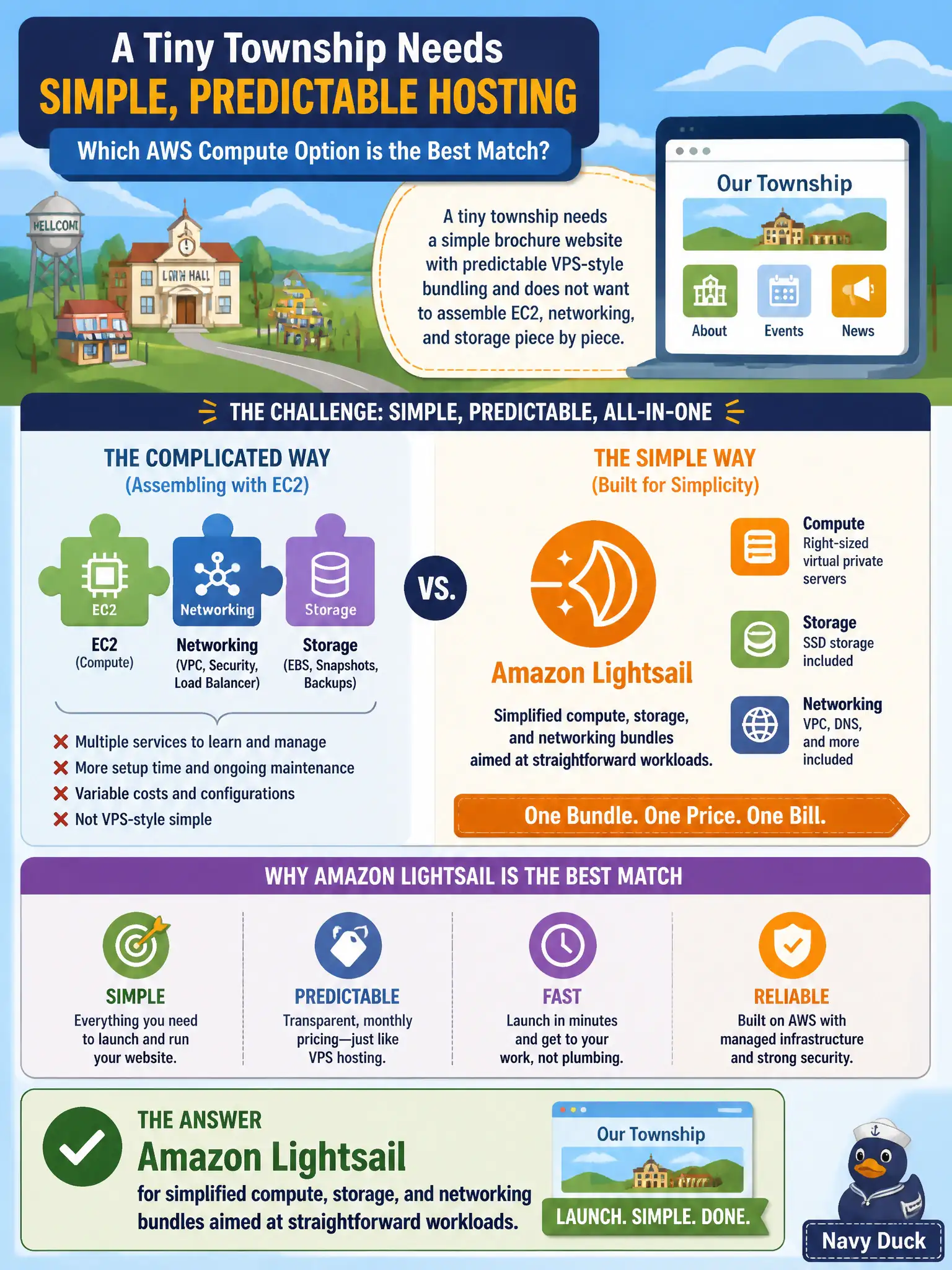
A tiny township needs a simple brochure website with predictable VPS-style bundling and does not want to assemble EC2, networking, and storage piece by piece. Which AWS compute option best matches that simplicity need?
Select an answer to reveal the explanation.
Short Explanation
Lightsail is the "starter kit" box—compute, storage, and networking packaged so a small brochure site does not need a full EC2 Lego build. Redshift is analytics warehousing, Direct Connect is private network plumbing, and Neptune is a graph database—none of those are the simple VPS-like host for a tiny site.
Full Explanation
A tiny township that needs a simple brochure website with predictable VPS-style bundling—and does not want to assemble EC2, networking, and storage piece by piece—should choose Amazon Lightsail. Lightsail packages compute, storage, networking, and predictable pricing for straightforward workloads, which fits small civic brochure sites and similar simple hosting needs better than building a full VPC reference architecture on day one for a five-page site.
Amazon Redshift is a cloud data warehouse, not a host for static HTML brochure pages. AWS Direct Connect provides dedicated private network connectivity; it is not the only way—or the simplest way—to host a public brochure site. Amazon Neptune is a managed graph database and does not serve brochure HTML as its purpose.
Exam caveat: Simple, bundled, VPS-like hosting → Lightsail. Full AWS platform flexibility → EC2/VPC. Managed web application platform with more PaaS shape → Elastic Beanstalk. Match “do not want to assemble piece by piece” language to Lightsail.
Operational check: launch a Lightsail instance or appropriate blueprint, attach a static IP, point the township DNS, enable HTTPS, snapshot before content changes, and document growth criteria for migrating to broader AWS services if traffic or architecture needs expand.