
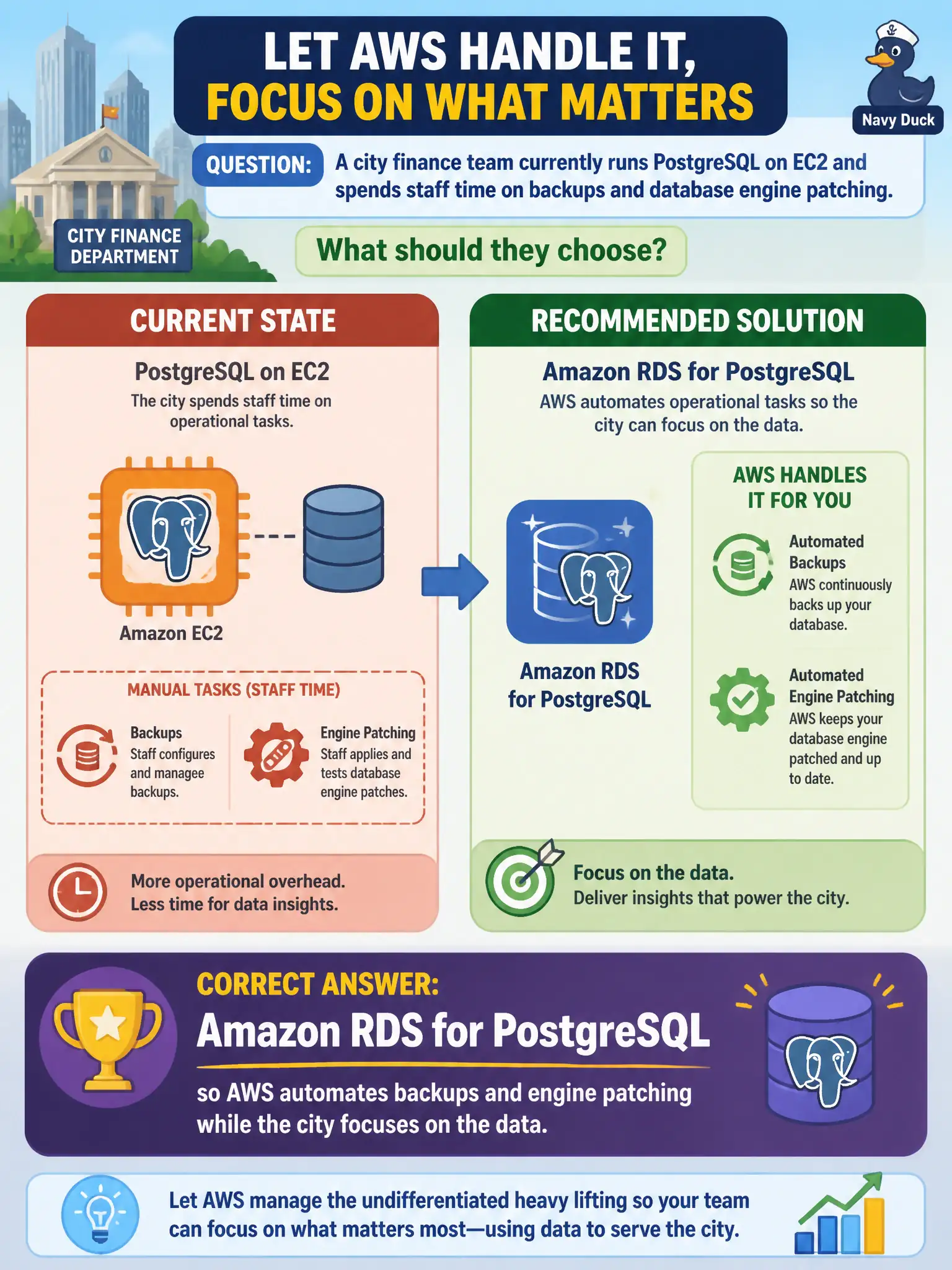
A city finance team currently runs PostgreSQL on EC2 and spends staff time on backups and database engine patching. They want AWS to handle those operational tasks. What should they choose?
Select an answer to reveal the explanation.
Short Explanation
Running Postgres on EC2 is like owning the whole restaurant kitchen—you cook and you fix the dishwasher. RDS is closer to a managed kitchen where the vendor handles backups and patching so your team can focus on the recipes (the data). Glacier is cold archives, CloudFront is a CDN—neither is your online SQL database.
Full Explanation
A city finance team running PostgreSQL on EC2 and spending staff time on backups and database engine patching should move to Amazon RDS for PostgreSQL so AWS can automate backups and engine patching while the city focuses on schema, data, and application queries. Managed relational databases reduce undifferentiated heavy lifting compared with self-managing the engine on EC2, which is exactly the operational pain described.
It is false that AWS never manages database engines or that PostgreSQL must remain only on EC2. Amazon S3 Glacier Deep Archive is for rarely accessed archival storage, not a primary online transactional database. Amazon CloudFront is a CDN and is not a relational database with SQL patching.
Exam caveat: Self-managed DB on EC2 versus managed RDS/Aurora is a classic shared-responsibility and operations question. Backups + patching relief → RDS.
Operational check: snapshot and migrate using a tested path (for example, dump/restore or DMS), enable automated backups and Multi-AZ if HA is required, schedule maintenance windows around finance close, restrict security groups, and retire the old EC2 PostgreSQL hosts only after cutover validation and backup restores succeed.