
A city 311 portal runs on several EC2 web servers. Staff want traffic spread across healthy targets and unhealthy ones taken out of rotation. Which AWS service purpose fits that need at Cloud Practitioner depth?
Select an answer to reveal the explanation.
Short Explanation
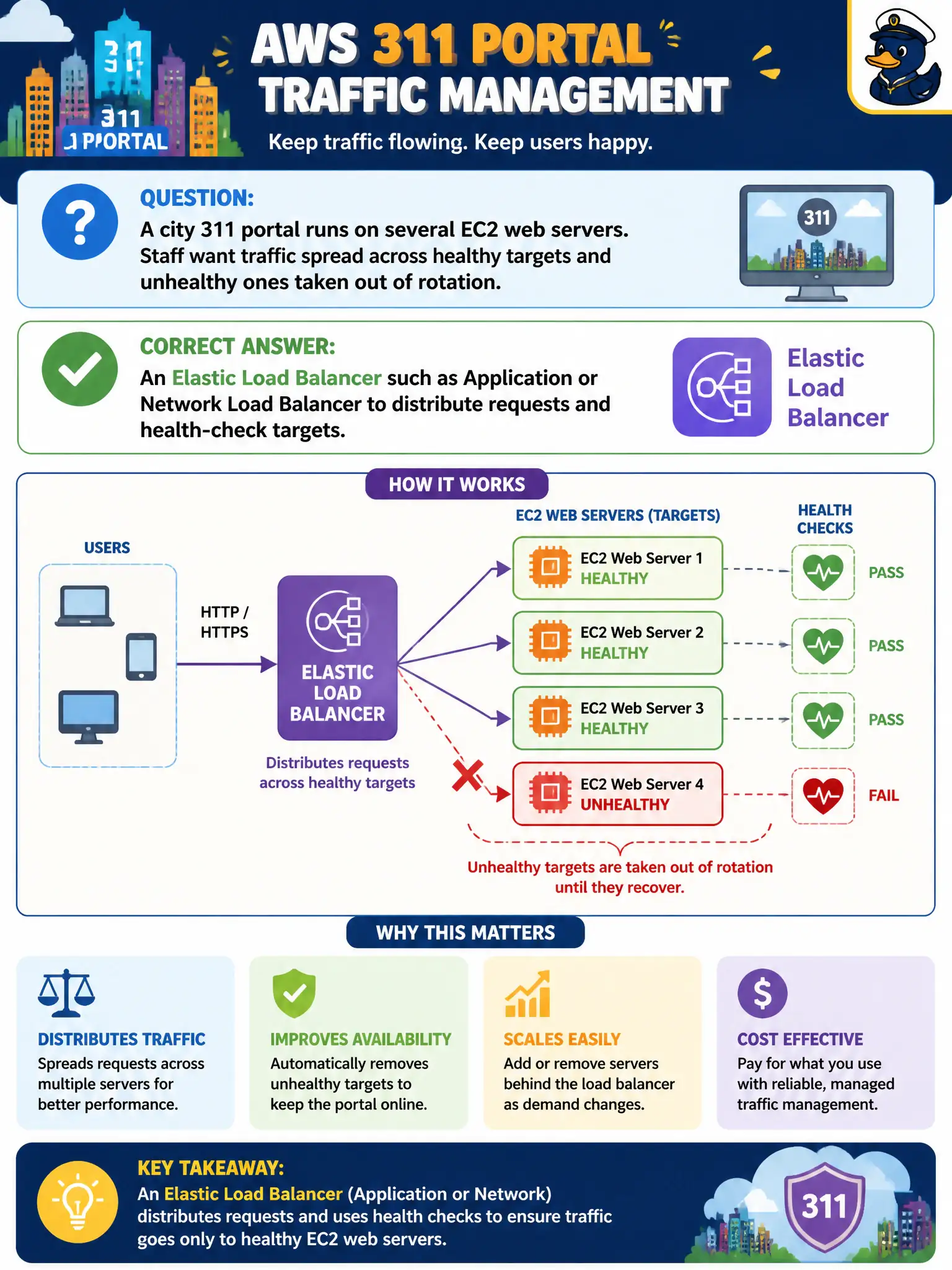
Picture a traffic cop at a busy intersection sending cars only to open lanes. An Application or Network Load Balancer does that for web requests—it spreads load and stops sending traffic to sick targets. RDS stores data, S3 stores objects, and Snowball moves bulk data offline—none of those are the front-door traffic spreader.
Full Explanation
A city 311 portal on several EC2 web servers that needs traffic spread across healthy targets—with unhealthy ones taken out of rotation—should use an Elastic Load Balancer such as an Application Load Balancer or Network Load Balancer. Load balancers distribute requests and perform health checks so citizens are not sent to failed instances. At Cloud Practitioner depth, that traffic distribution and health-based target selection role is the ELB purpose statement for multi-instance web tiers.
Amazon RDS is a managed relational database; spreading HTTP traffic across web servers is not a database engine feature. Amazon S3 stores objects and can host static websites, but it does not load-balance application sessions across EC2 web servers. AWS Snowball is a data-transfer appliance family; physical appliances do not terminate HTTP connections for municipal web farms as their purpose.
Exam caveat: ELB distributes traffic and health-checks targets; Auto Scaling changes capacity. RDS, S3, and Snowball distractors test whether you know ELB’s job in a classic web architecture.
Operational check: create an ALB for the 311 HTTPS listeners, register the web targets in multiple AZs, tune health-check paths, verify deregistration delays during deploys, and confirm CloudWatch unhealthy-host metrics feed the civic operations channel.