
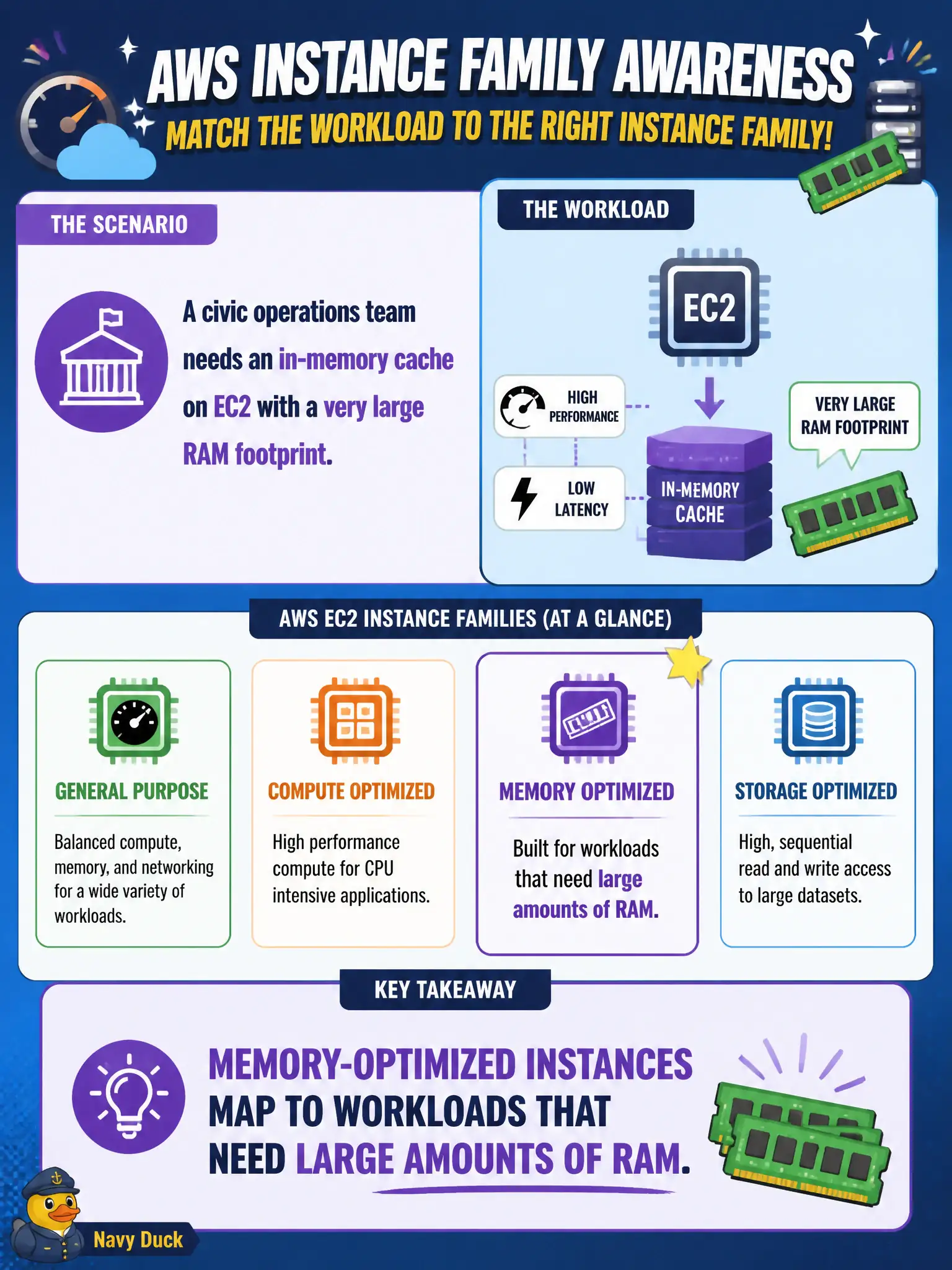
A civic operations team needs an in-memory cache on EC2 with a very large RAM footprint. Which instance family awareness best applies?
Select an answer to reveal the explanation.
Short Explanation
Big in-memory civic cache means reach for memory-optimized instances—the family built around lots of RAM. Compute-optimized and storage-optimized optimize different dials, and families are definitely not all the same mix of resources.
Full Explanation
A civic operations team that needs an in-memory cache on EC2 with a very large RAM footprint should look to memory-optimized instances. Memory-optimized families are designed for workloads that require large amounts of RAM relative to CPU—large in-memory caches, real-time big-data processing, and high-performance relational or in-memory databases hosted on EC2 when that pattern is chosen. Matching family to RAM-heavy cache use is the Cloud Practitioner skill being tested.
Compute-optimized instances prioritize CPU and do not always provide the most memory per dollar. Storage-optimized instances emphasize local disk throughput; they do not “remove RAM to maximize tape throughput.” It is false that all EC2 families expose identical memory, CPU, and storage ratios—family choice exists precisely because ratios differ.
Exam caveat: Large RAM footprint → memory-optimized. Do not pick compute-optimized by habit when the stem stresses memory.
Operational check: size the cache working set, choose a memory-optimized type with enough headroom, place nodes in private subnets, monitor memory utilization and eviction behavior, and decide whether a managed service such as ElastiCache might eventually replace self-managed EC2 caching for lower undifferentiated heavy lifting.