
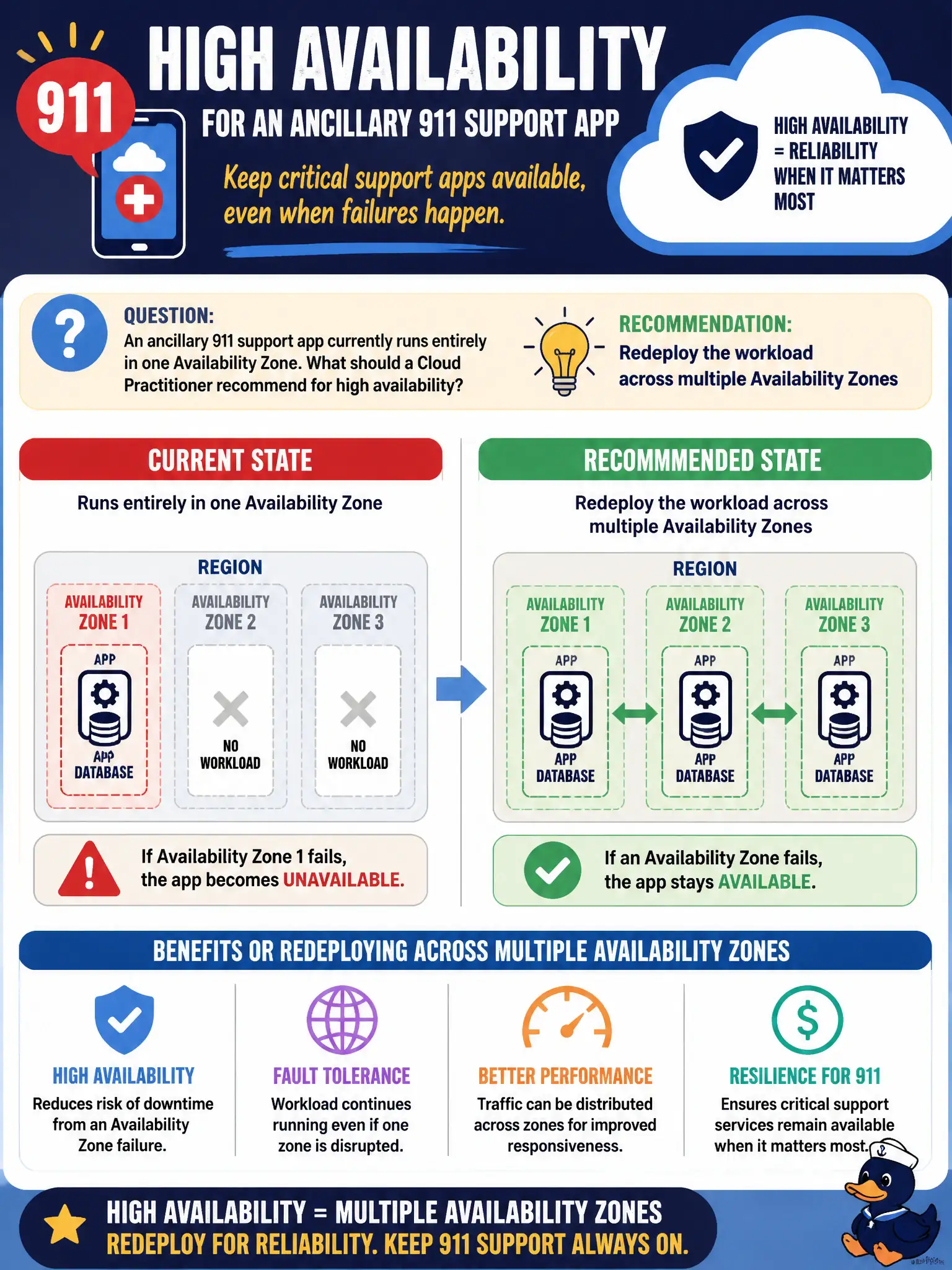
An ancillary 911 support app currently runs entirely in one Availability Zone. What should a Cloud Practitioner recommend for high availability?
Select an answer to reveal the explanation.
Short Explanation
One AZ for a 911-related helper app is like one bridge into town—when it is out, you are stuck. Spreading across multiple Availability Zones is the straightforward HA fix. Bigger boxes, one hard-coded host, or browser-only logic do not replace multi-AZ resilience.
Full Explanation
An ancillary 911 support app that currently runs entirely in one Availability Zone should be redeployed across multiple Availability Zones for high availability. A single-AZ design means power, cooling, or connectivity impairment in that AZ can take down the whole app. Spreading load-balanced compute (and resilient data services) across AZs is the foundational Cloud Practitioner recommendation for HA inside a Region—especially for public-safety-adjacent workloads.
Keeping the single-AZ design and only increasing instance size raises capacity but not AZ fault tolerance. Deleting load balancers so traffic always hits one fixed host creates a harder single point of failure. Moving the entire app solely to client-side JavaScript removes centralized server controls and does not provide a trustworthy 911 support architecture on which dispatch-adjacent tools can rely.
Exam caveat: Single-AZ to HA → multi-AZ. Bigger instance ≠ higher availability. Load balancers and Multi-AZ data tiers usually accompany the compute spread.
Operational check: place targets in at least two AZs behind a load balancer, enable Multi-AZ for any relational store, rehearse AZ loss in a controlled exercise with the public-safety IT partners, and update runbooks so on-call staff verify healthy AZ capacity during incidents before declaring service restoration.