
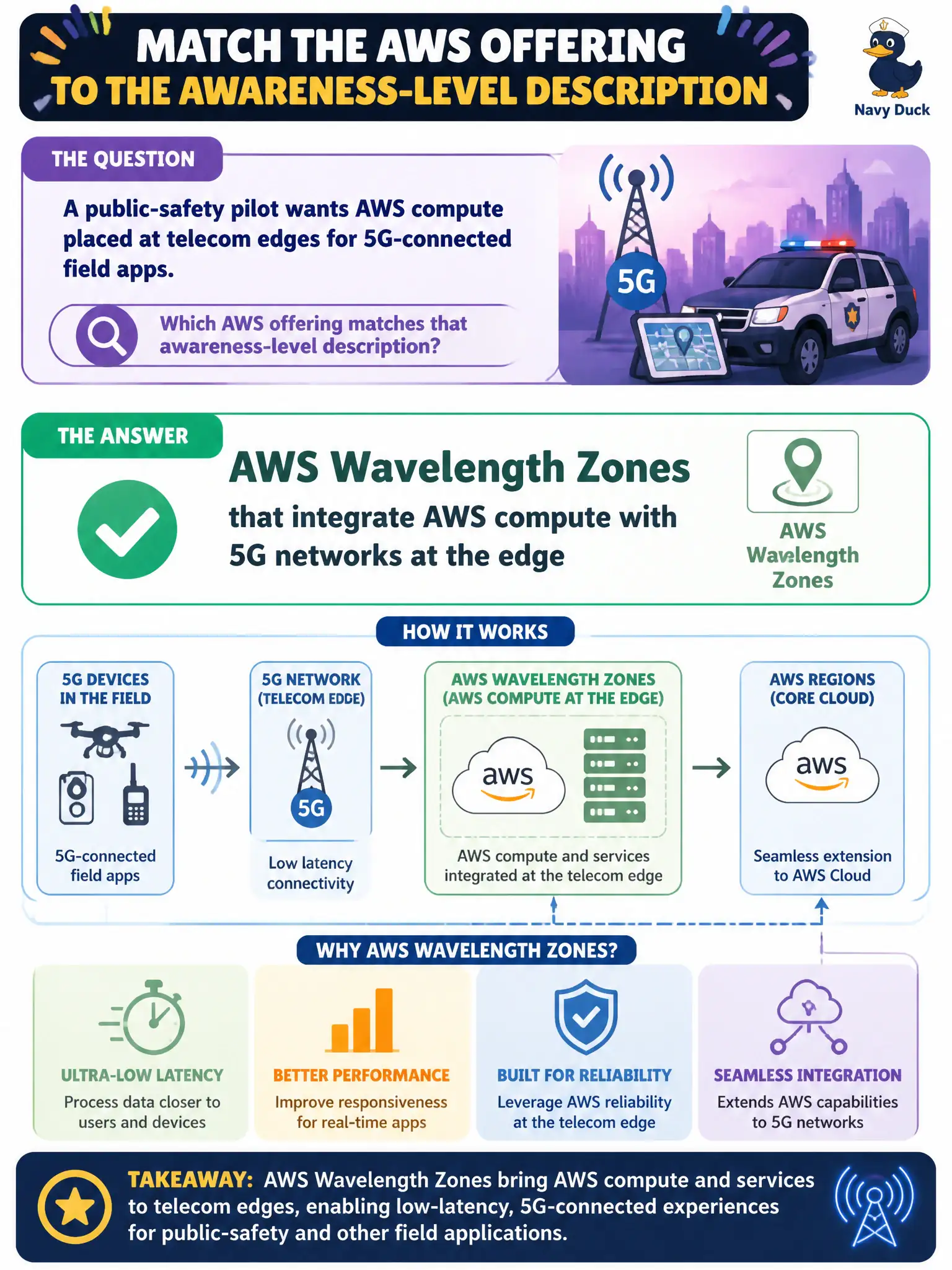
A public-safety pilot wants AWS compute placed at telecom edges for 5G-connected field apps. Which AWS offering matches that awareness-level description?
Select an answer to reveal the explanation.
Short Explanation
Wavelength is AWS sitting next to the 5G carrier edge so field apps get that last-hop speed. For a public-safety pilot on 5G, Wavelength Zones are the construct to recognize. RDS Multi-AZ, Artifact, and Macie solve database HA, compliance reports, and data discovery—not telecom-edge compute.
Full Explanation
A public-safety pilot that wants AWS compute placed at telecom edges for 5G-connected field apps should identify AWS Wavelength Zones. Wavelength embeds AWS compute and storage services within 5G provider networks at the edge, minimizing latency between 5G devices and the application. That awareness-level description is distinct from Regional Multi-AZ databases or content CDN edges, and it is the construct Cloud Practitioner materials associate with carrier 5G integration.
Amazon RDS Multi-AZ improves database availability inside a Region; it is not a 5G edge compute placement for desktop VPN users. AWS Artifact distributes compliance reports and agreements, not mobile game binaries. Amazon Macie discovers and classifies sensitive data in Amazon S3; it does not accelerate 5G radio firmware updates or host field-app compute at the telecom edge.
Exam caveat: Wavelength = AWS compute integrated with 5G telecom edges; Local Zones = metro extension closer than the parent Region; Outposts = AWS infrastructure in customer datacenters; CloudFront edges = content caching. Stems that mention 5G-connected field apps point to Wavelength.
Operational check: partner with a supported carrier, deploy the pilot application into a Wavelength Zone reachable from field devices, keep parent-Region components for non-latency-critical services, validate session handoff when devices leave coverage, and document security monitoring for the Wavelength extension in the public-safety architecture review.