
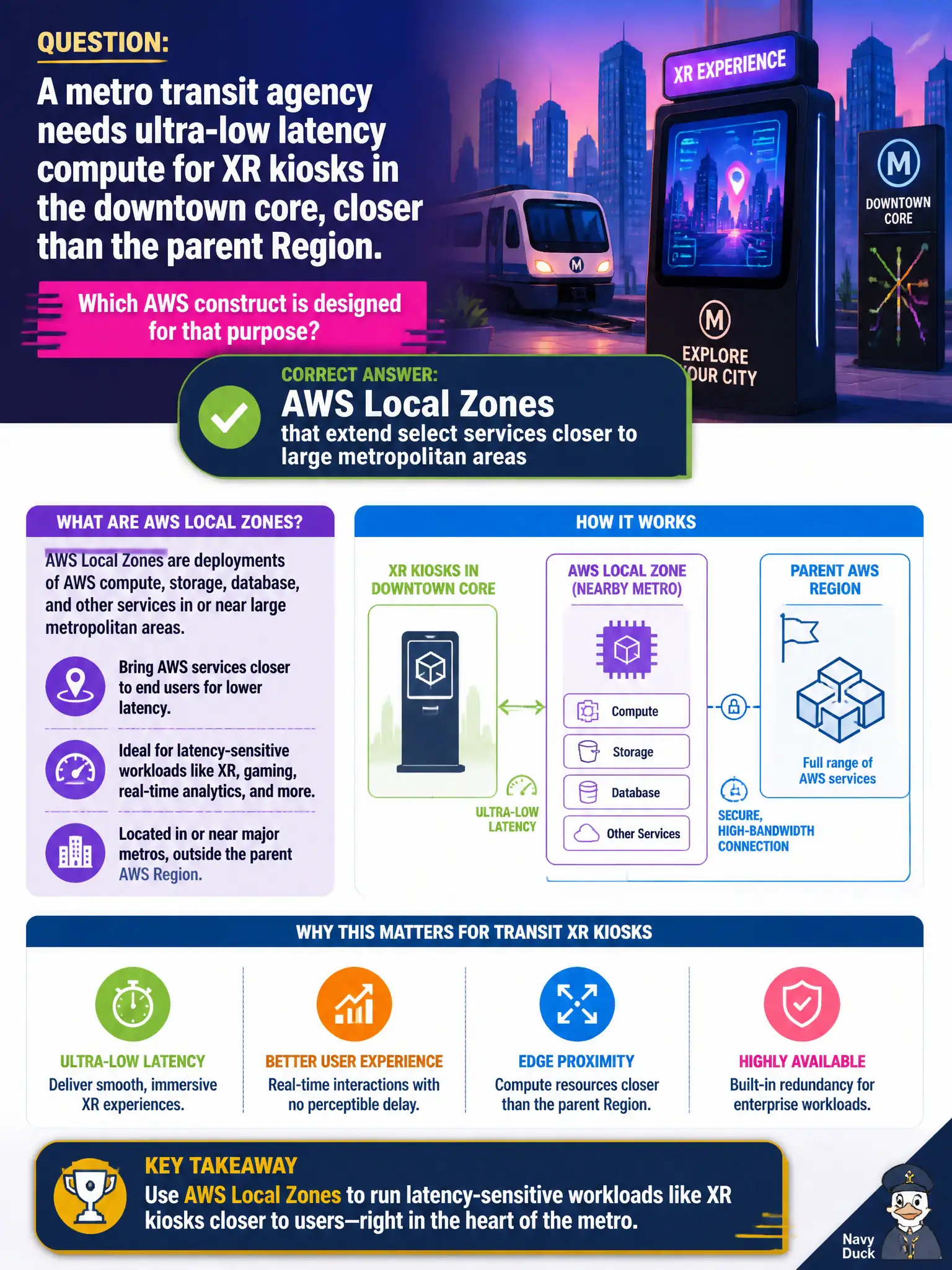
A metro transit agency needs ultra-low latency compute for XR kiosks in the downtown core, closer than the parent Region. Which AWS construct is designed for that purpose?
Select an answer to reveal the explanation.
Short Explanation
Local Zones pull a slice of AWS compute closer to a big metro so XR kiosks are not waiting on a distant Regional data center. That is the ultra-low-latency story for downtown. Edge caches are great for static content, not a full swap-in for those low-latency compute needs.
Full Explanation
A metro transit agency that needs ultra-low latency compute for XR kiosks in the downtown core—closer than the parent Region—should identify AWS Local Zones. Local Zones extend select AWS services into metropolitan areas so latency-sensitive workloads can run nearer to end users while remaining connected to the parent Region. That matches downtown kiosks needing compute proximity beyond what a distant Regional AZ provides.
AWS Outposts brings AWS infrastructure on premises and is not “exclusively for tape-backup vaults.” CloudFront edge locations cache and deliver content; they do not run full relational databases as a general compute extension. Choosing a second commercial cloud outside AWS is not the AWS Local Zone construct the question asks for.
Exam caveat: Local Zones ≈ select services closer to large metros; Wavelength ≈ compute embedded with 5G telecom edges; Outposts ≈ AWS racks in customer datacenters; CloudFront edges ≈ content caching. Match the stem’s “closer than the parent Region / metro” language to Local Zones.
Operational check: confirm the required instance families and services exist in the target Local Zone, extend the VPC into that Local Zone subnet for the kiosks, measure motion-to-photon or API latency against the parent Region baseline, and plan failover back to Regional capacity if the Local Zone service set is impaired.