
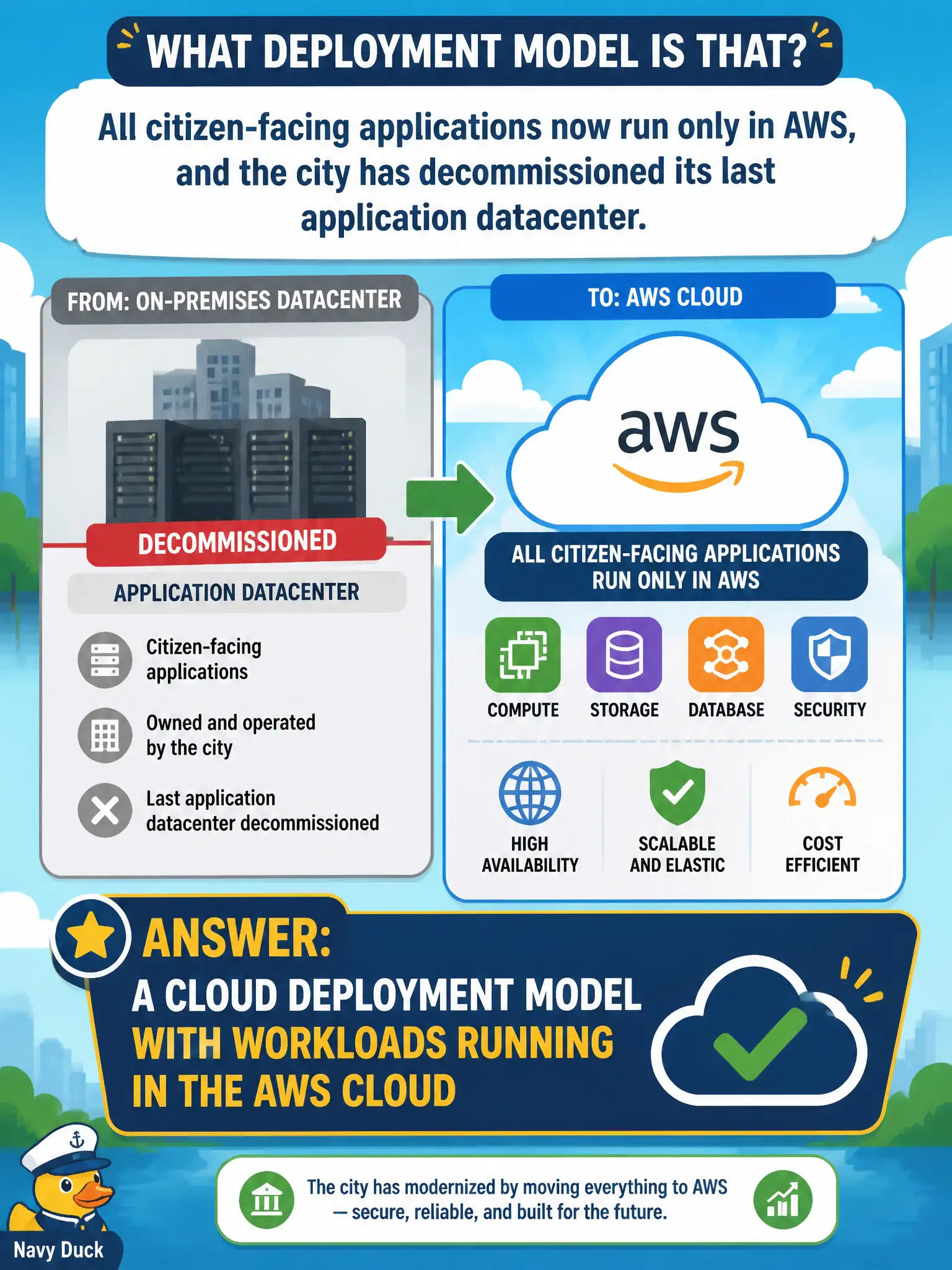
All citizen-facing applications now run only in AWS, and the city has decommissioned its last application datacenter. Which deployment model is that?
Select an answer to reveal the explanation.
Short Explanation
When the apps live in AWS and the old datacenter lights are off, you are in a cloud deployment model—provider cloud, not city-owned racks.
Full Explanation
When all citizen-facing applications run only in AWS and the city has decommissioned its last application datacenter, the deployment model is a cloud deployment model: workloads run in the AWS Cloud rather than in organization-owned application racks. The city may still operate end-user devices and network edges, but the application hosting footprint described is cloud-based.
An on-premises-only model would still own and run those application racks locally. A hybrid model requires ongoing use of both on-premises and cloud application hosting; the stem’s full decommission of the application datacenter removes that split for the described workloads. A colocation contract that forbids AWS APIs contradicts the scenario in which applications already run in AWS.
Exam caveat: “Decommissioned datacenter / runs only in AWS” is the classic cloud-model signal. Do not call it hybrid merely because users sit in city offices—hybrid refers to where workloads are hosted, not where employees work.
Operational check: update architecture inventories and continuity plans to remove dependencies on the retired facility, ensure Direct Connect or VPN links that only served that datacenter are resized or retired, verify backup and DR targets remain in approved Regions, and confirm procurement language now reflects cloud hosting for citizen-facing apps.