
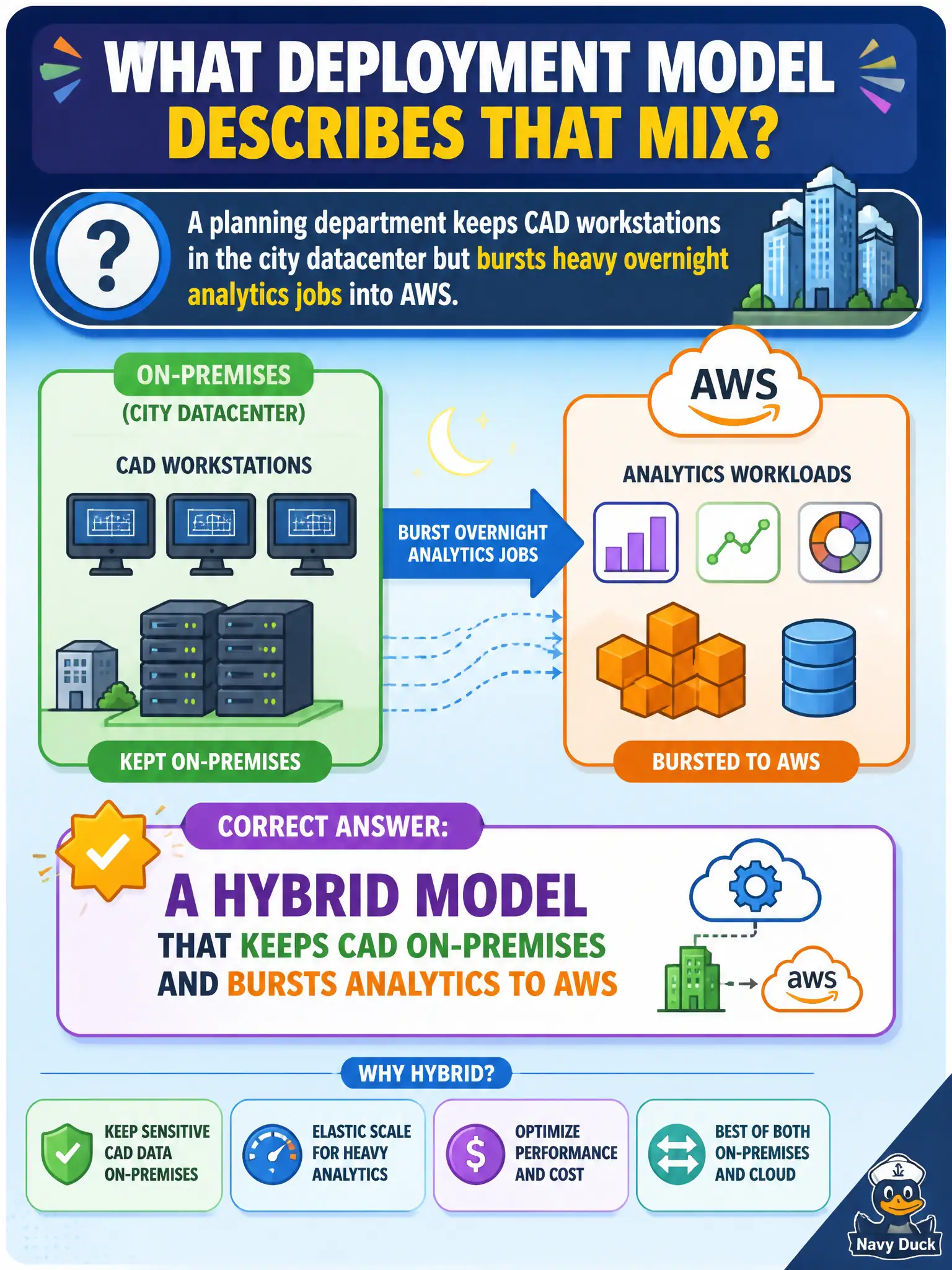
A planning department keeps CAD workstations in the city datacenter but bursts heavy overnight analytics jobs into AWS. Which deployment model describes that mix?
Select an answer to reveal the explanation.
Short Explanation
Some work stays in the city basement, some rides up to the cloud for big overnight jobs—that mix is hybrid. Not all-in cloud, not all-local forever.
Full Explanation
A planning department that keeps CAD workstations in the city datacenter but bursts heavy overnight analytics jobs into AWS is using a hybrid deployment model. Hybrid combines on-premises (or other facility-controlled) resources with cloud resources, connected through patterns such as VPN, Direct Connect, and identity integration. The CAD systems remain local for specialized hardware or software constraints, while elastic AWS compute absorbs analytics spikes without permanently expanding the datacenter.
A pure on-premises model would keep analytics in the city facility with no cloud burst. A cloud-only model would retire on-premises CAD immediately and run everything in AWS—which the stem does not describe. An edge-only model that never uses a Region or a city datacenter misstates both AWS edge constructs and the department’s actual mix of facilities.
Exam caveat: Cloud Practitioner deployment models—cloud, on-premises (private), and hybrid—are tested with scenario language. Look for “some on-prem, some AWS” as hybrid; “all in AWS” as cloud; “only in owned facility” as on-premises.
Operational check: document which datasets may leave the datacenter overnight, size the VPN or Direct Connect path for analytics burst traffic, use IAM roles and encrypted transfer (for example, DataSync or S3 over private connectivity), and schedule job windows so CAD users are not competing with extraction jobs on shared storage. Review hybrid cost and data-residency constraints quarterly.