
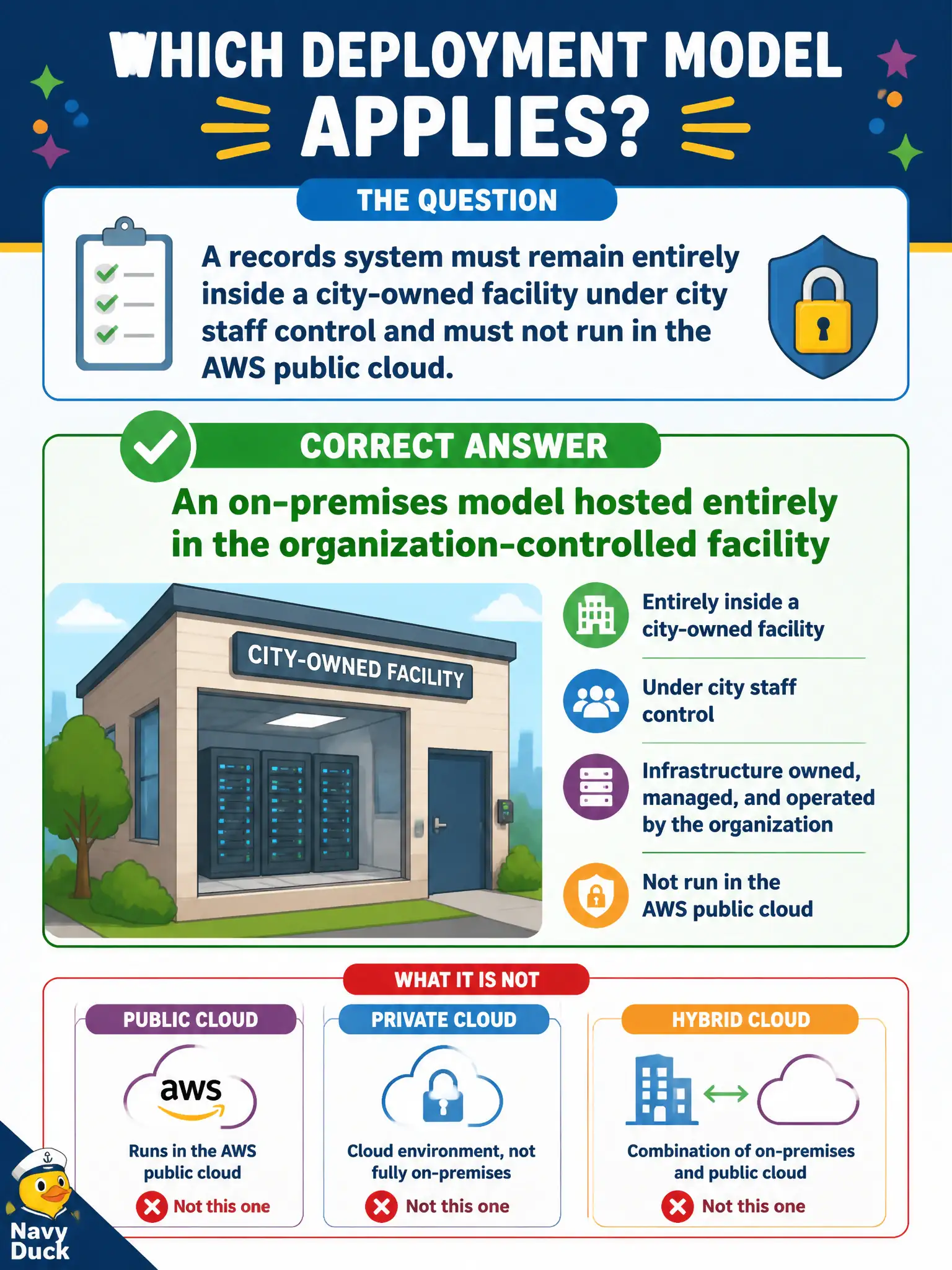
A records system must remain entirely inside a city-owned facility under city staff control and must not run in the AWS public cloud. Which deployment model applies?
Select an answer to reveal the explanation.
Short Explanation
If it never leaves the city building and city folks run the gear, that is on-premises—plain and simple. Public cloud and CDN edges are different stories.
Full Explanation
A records system that must remain entirely inside a city-owned facility under city staff control and must not run in the AWS public cloud follows an on-premises deployment model. On-premises (sometimes discussed as private cloud when virtualized in-facility) means the organization hosts and operates the system on infrastructure it controls in its own facility, meeting policy constraints that forbid public-cloud residency for that dataset.
An AWS Local Zone extends select AWS services closer to large metros but is still AWS infrastructure—not a replacement that keeps full city-facility control in the sense of “not running in AWS.” A pure public cloud model places the workload in AWS with no city-owned application hardware for that system. CloudFront edge caching accelerates content delivery; it is not a full substitute for on-premises hosting of a records system that must stay in-facility.
Exam caveat: Strict “must not run in the AWS public cloud / city-owned facility” language maps to on-premises. Local Zones, Outposts, and Wavelength are specialized AWS extensions—Outposts brings AWS racks on-premises, but this stem’s “must not run in the AWS public cloud” and “organization-controlled facility” framing is testing the classic on-premises model, not an Outposts nuance.
Operational check: keep the records platform on city-managed servers with facility access controls, document why the workload is out of AWS scope for auditors, and if future policy allows hybrid analytics, define a narrow, approved egress path rather than quietly copying PII to a public Region.