
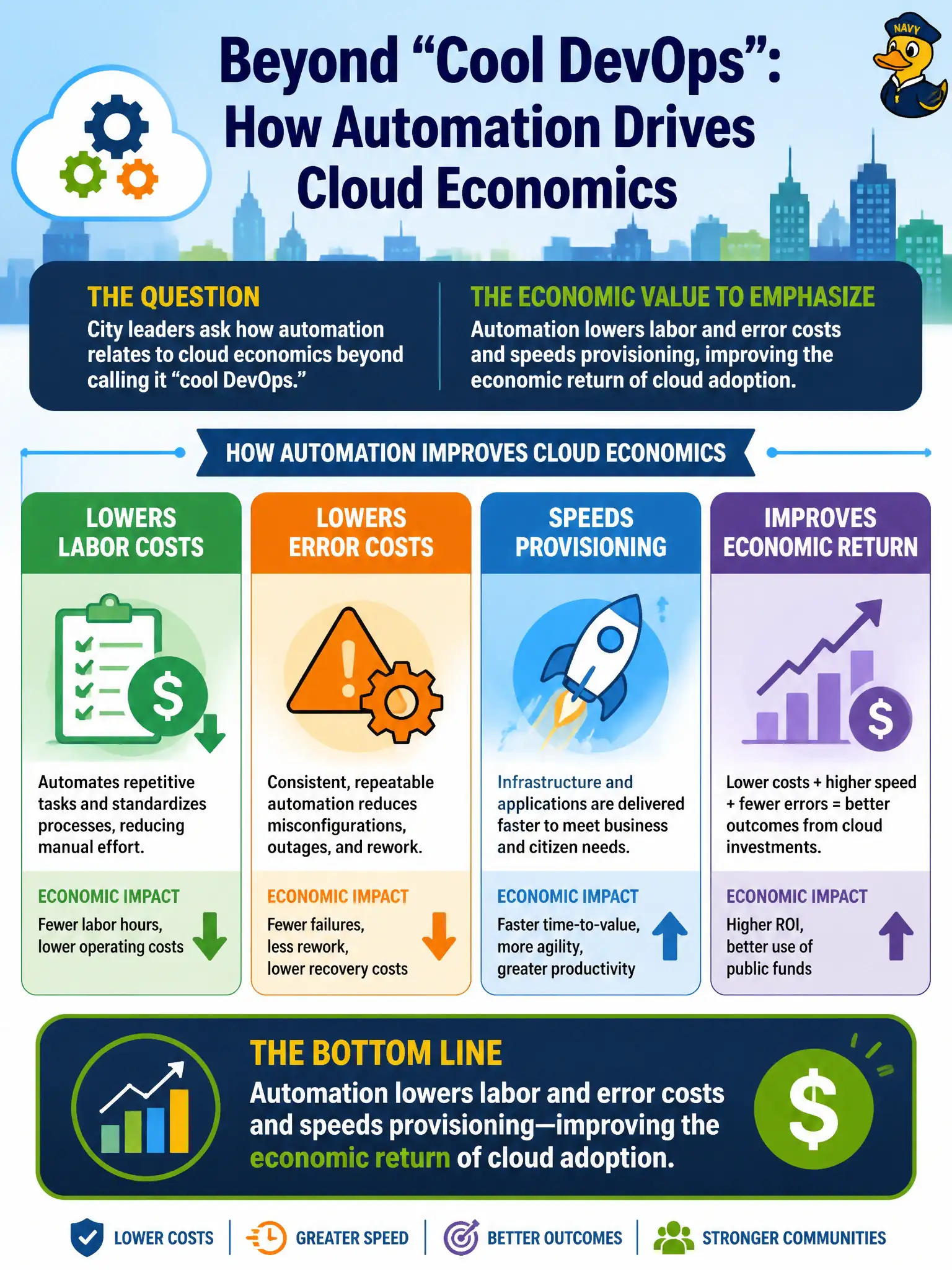
City leaders ask how automation relates to cloud economics beyond calling it “cool DevOps.” What economic value should the Cloud Practitioner emphasize?
Select an answer to reveal the explanation.
Short Explanation
Automation is not a hoodie slogan — it is fewer late-night click mistakes and faster “spin it up” moments. Less labor burn, fewer error reworks, quicker environments: that is money talking. DevOps coolness is optional; the economics are the point.
Full Explanation
Automation lowers labor and error costs and speeds provisioning, improving the economic return of cloud adoption—the value city leaders should hear beyond calling automation “cool DevOps.” Templates and pipelines turn repeated municipal environment work into cheaper, faster, less error-prone operations.
Automation does change labor hours, errors, and provisioning speed—not merely ticket names. Economic value does not appear only after rewriting every workload as mainframe batch. Cloud economics do not ignore automation; templates affect operational cost.
Exam caveat: Tie automation to measurable economic outcomes on the exam and in council decks. Operational check: baseline manual provisioning labor and change-failure rate, implement IaC for a landing-zone account set, and report hours saved and defects avoided after 90 days.
Municipal teams should keep a one-page decision record linking this Cloud Practitioner concept to resident outcomes, revisit it after major traffic or compliance changes, and ensure runbooks still match the chosen design.
Municipal teams should keep a one-page decision record linking this Cloud Practitioner concept to resident outcomes, revisit it after major traffic or compliance changes, and ensure runbooks still match the chosen design.