
During a CapEx versus OpEx discussion, leaders contrast buying a storage area network with paying monthly for Amazon S3. What distinction should the Cloud Practitioner highlight?
Select an answer to reveal the explanation.
Short Explanation
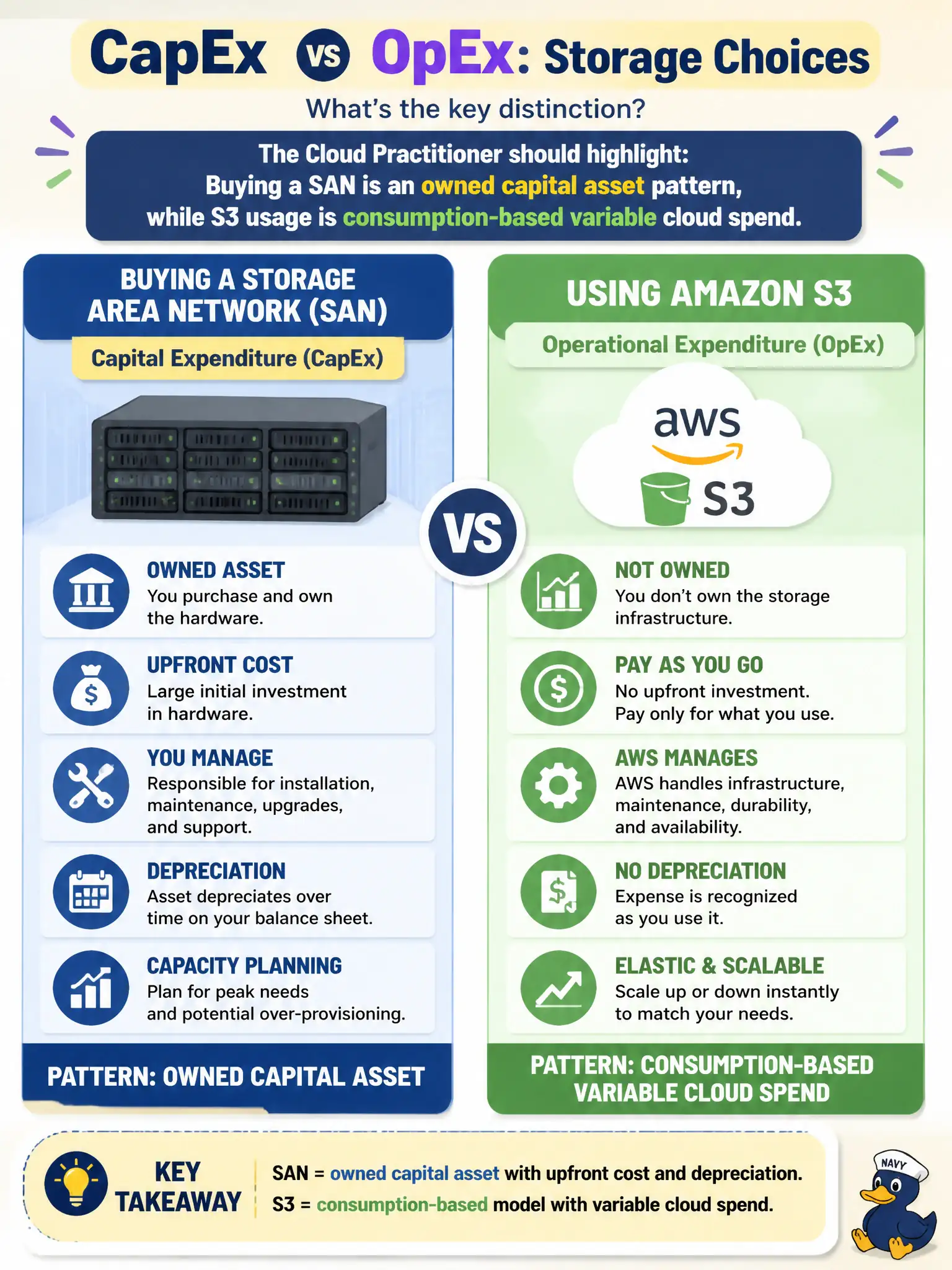
Buying a SAN is writing a big check for iron you own; paying for S3 is more like paying for storage as you use it. Same “we need a place for data” goal, different money shape. That CapEx-style versus consumption contrast is the teaching point.
Full Explanation
Buying a SAN is an owned capital asset pattern, while S3 usage is consumption-based variable cloud spend—the distinction to highlight when leaders contrast purchasing a storage area network with paying monthly for Amazon S3. CapEx ownership versus metered OpEx consumption is the economics lesson, not identical cash profiles.
S3 monthly charges are not identical to depreciating a purchased SAN over a fixed hardware life. A SAN purchase is not variable OpEx that scales to zero when unused. Amazon S3 is not acquired as a capital asset shipped to the municipal basement.
Exam caveat: Object storage consumption vs owned SAN is a classic CapEx/OpEx teaching pair on CLF-C02. Operational check: model five-year SAN ownership (hardware, refresh, power, space) versus projected S3 storage/request costs for the same archive class, including retrieval patterns.
Municipal teams should keep a one-page decision record linking this Cloud Practitioner concept to resident outcomes, revisit it after major traffic or compliance changes, and ensure runbooks still match the chosen design.
Municipal teams should keep a one-page decision record linking this Cloud Practitioner concept to resident outcomes, revisit it after major traffic or compliance changes, and ensure runbooks still match the chosen design.