
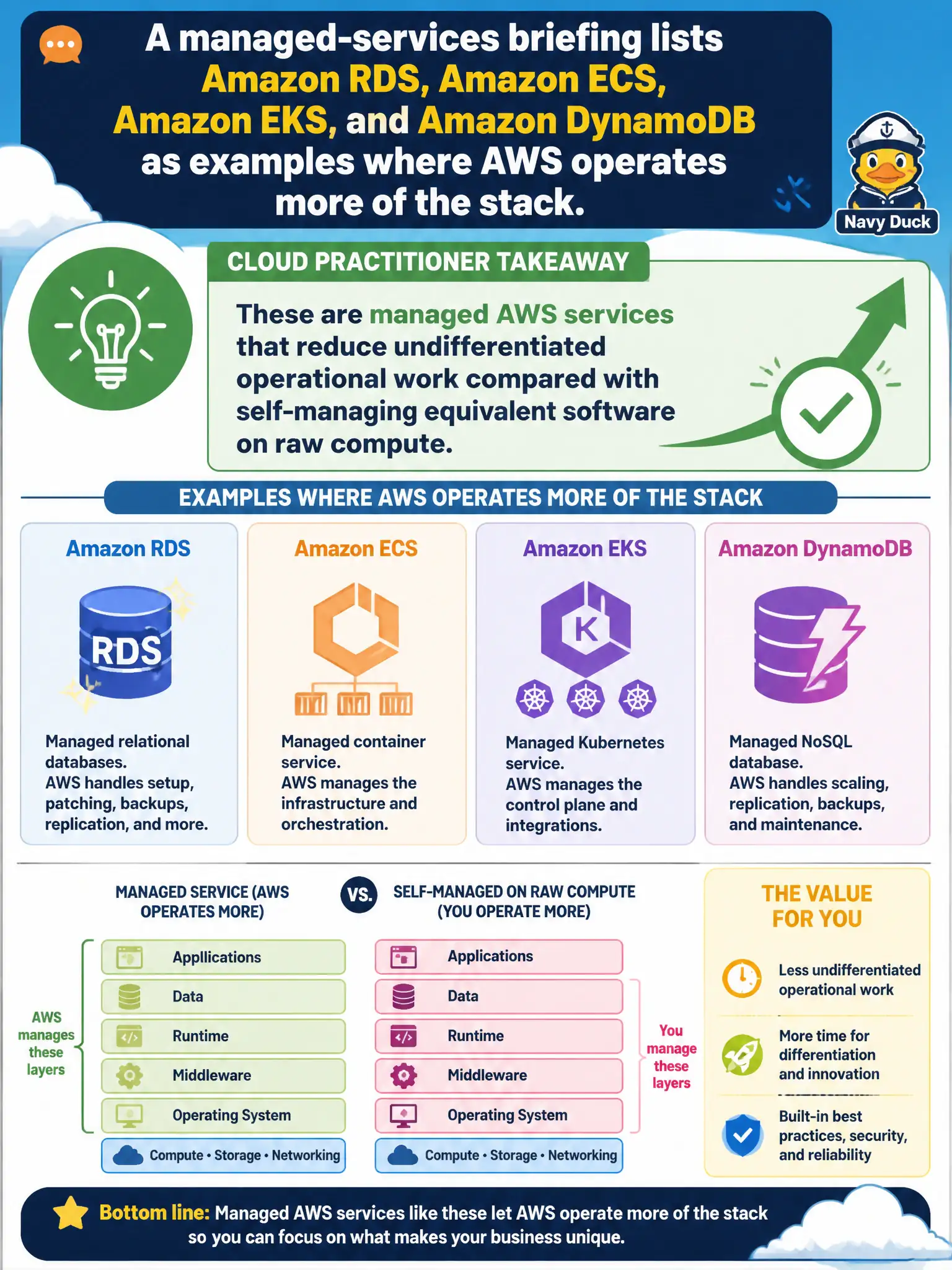
A managed-services briefing lists Amazon RDS, Amazon ECS, Amazon EKS, and Amazon DynamoDB as examples where AWS operates more of the stack. What is the Cloud Practitioner takeaway?
Select an answer to reveal the explanation.
Short Explanation
RDS, ECS, EKS, and DynamoDB are the “AWS runs more of the machinery” club. You still own what you build and who can access it, but you are not reinventing every cluster chore. That is the managed-services economics pitch in one breath.
Full Explanation
Amazon RDS, Amazon ECS, Amazon EKS, and Amazon DynamoDB are managed AWS services that reduce undifferentiated operational work compared with self-managing equivalent software on raw compute. The Cloud Practitioner takeaway is that managed services shift more stack operations to AWS so cities buy outcomes with less rack-and-stack and control-plane toil.
Those names are real services, not merely billing codes. Managed services decrease—not increase—customer rack-and-stack work for databases and container control planes relative to DIY. Using managed services does not eliminate shared responsibility or all customer security duties.
Exam caveat: Managed services ≠ zero customer responsibility. Operational check: list ops tasks removed by adopting each managed service in a briefing, and list residual duties (IAM, data, app config, network) the city still performs.
Municipal teams should keep a one-page decision record linking this Cloud Practitioner concept to resident outcomes, revisit it after major traffic or compliance changes, and ensure runbooks still match the chosen design.
Municipal teams should keep a one-page decision record linking this Cloud Practitioner concept to resident outcomes, revisit it after major traffic or compliance changes, and ensure runbooks still match the chosen design.