
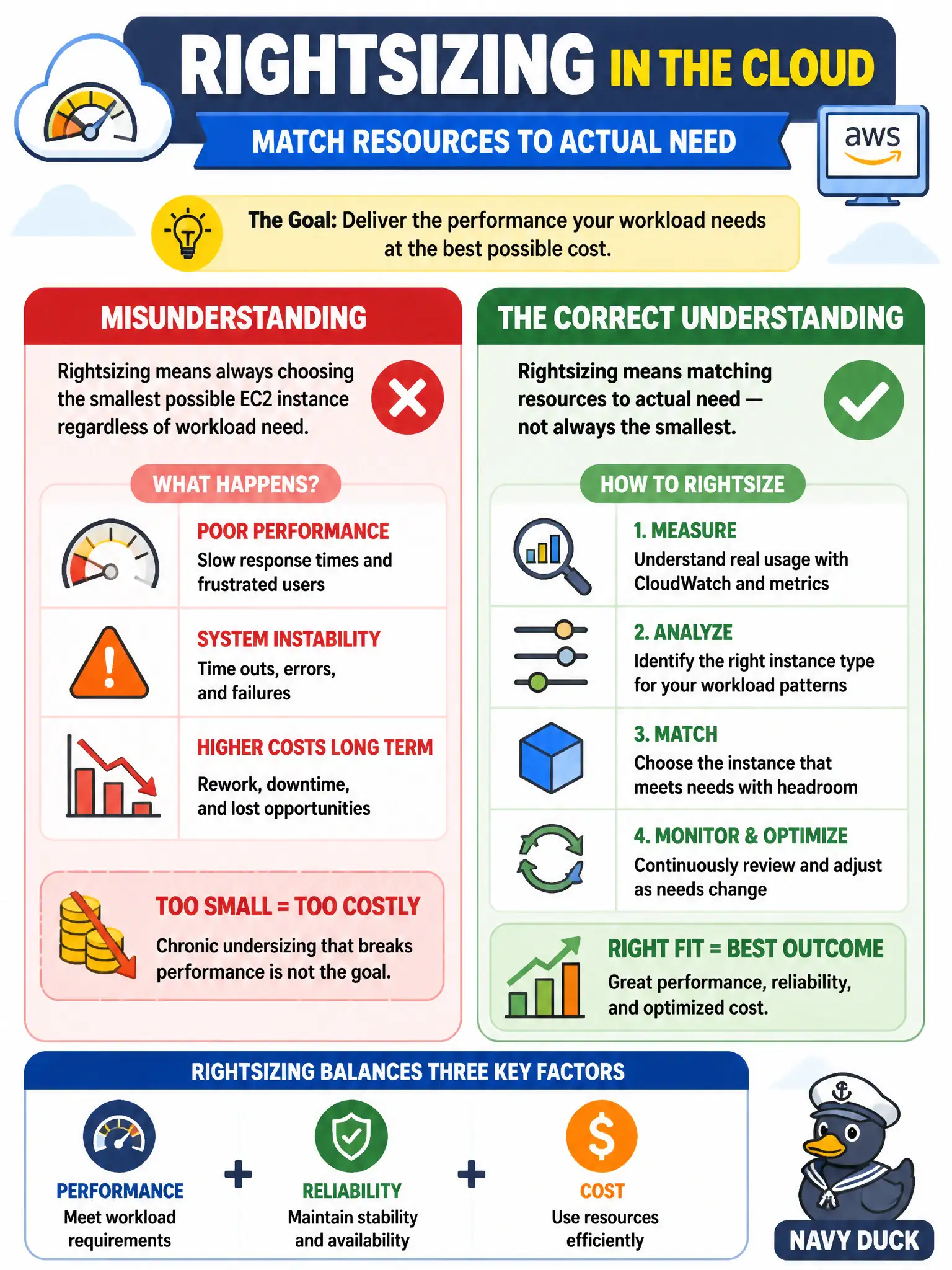
Finance staff assume rightsizing means always choosing the smallest possible EC2 instance regardless of workload need. How should the Cloud Practitioner correct that misunderstanding?
Select an answer to reveal the explanation.
Short Explanation
Rightsizing is a fitted suit, not a child’s jacket on an adult. Too big wastes money; too small rips at the seams when load hits. Match the need — that is the whole lesson for finance.
Full Explanation
Rightsizing means matching resources to actual need—chronic undersizing that breaks performance is not the goal. Finance staff who assume rightsizing always means the absolute smallest EC2 instance misunderstand the practice; municipal portals that starve CPU/memory fail residents even if the bill looks thrifty.
Rightsizing is not always the absolute smallest catalog type. It does not forbid performance testing in favor of lowest vCPU only. It does not require doubling capacity every quarter regardless of demand.
Exam caveat: Rightsizing = fit-to-need, not minimize-at-all-costs. Operational check: use utilization and latency SLOs together—downsize only when headroom is excess, and reject “smallest always” changes that breach citizen-facing performance targets.
Municipal teams should keep a one-page decision record linking this Cloud Practitioner concept to resident outcomes, revisit it after major traffic or compliance changes, and ensure runbooks still match the chosen design.
Municipal teams should keep a one-page decision record linking this Cloud Practitioner concept to resident outcomes, revisit it after major traffic or compliance changes, and ensure runbooks still match the chosen design.