
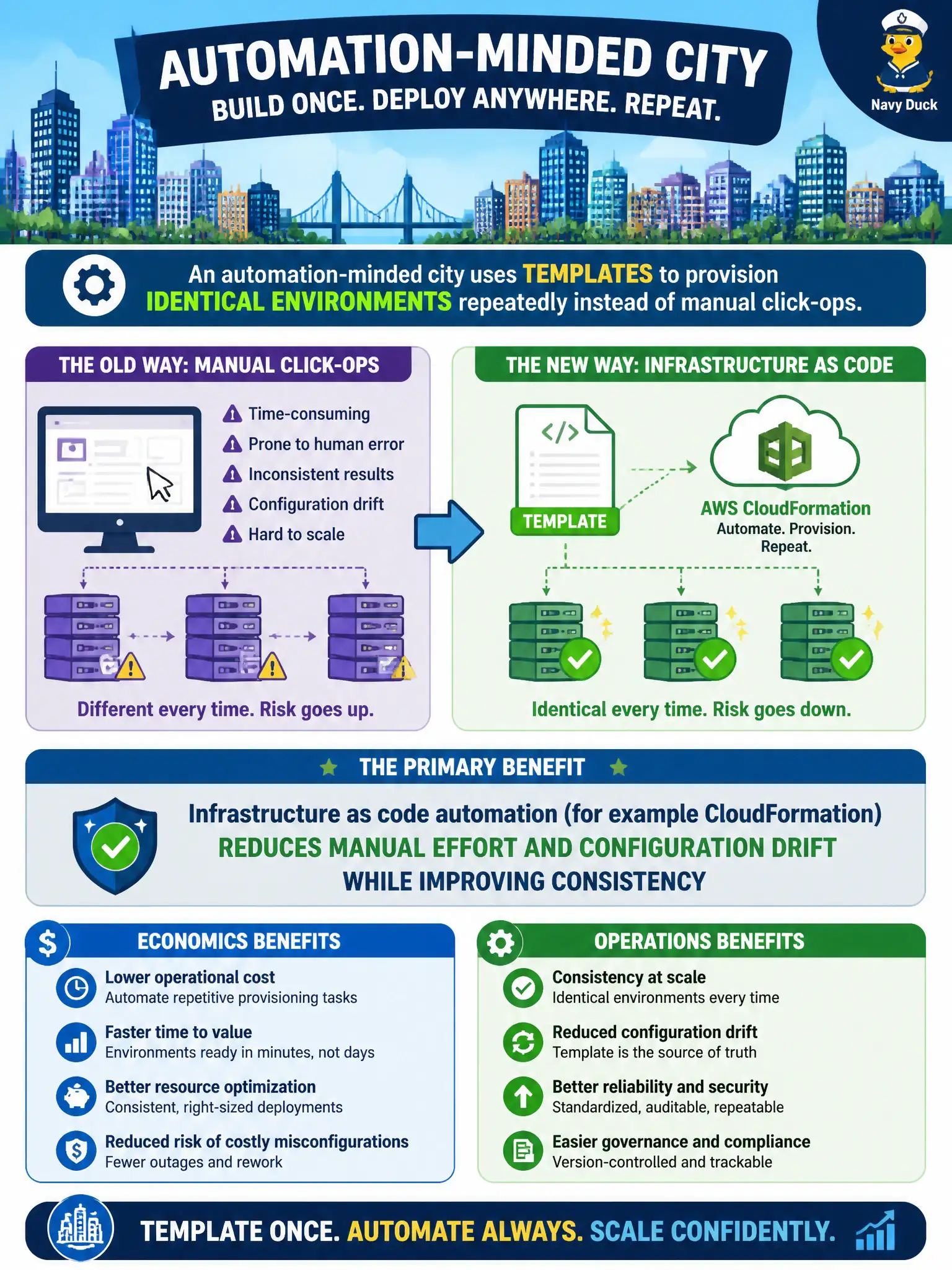
An automation-minded city uses templates to provision identical environments repeatedly instead of manual click-ops. Which economics and operations benefit does that primarily illustrate?
Select an answer to reveal the explanation.
Short Explanation
Templates are like a cookie cutter for environments — same shape every time, less “who clicked what?” surprise. CloudFormation-style IaC cuts manual toil and drift. That consistency is both an ops win and an economics win.
Full Explanation
Infrastructure as code automation (for example CloudFormation) reduces manual effort and configuration drift while improving consistency—the economics and operations benefit of using templates to provision identical environments repeatedly instead of manual click-ops. Cities gain repeatability for staging/prod parity and auditability of changes.
Templates forcing every environment to be unique so drift becomes the design goal inverts the purpose. Automation does not remove the need for identity, networking, or cost controls. Manual click-ops is not always cheaper or more consistent than repeatable templates.
Exam caveat: IaC appears as both operations excellence and cost/efficiency through reduced toil and drift. Operational check: encode a municipal environment in CloudFormation or equivalent, deploy twice to prove parity, block uncontrolled console drift via policy/process, and track provisioning time versus click-ops baselines.
Municipal teams should keep a one-page decision record linking this Cloud Practitioner concept to resident outcomes, revisit it after major traffic or compliance changes, and ensure runbooks still match the chosen design.
Municipal teams should keep a one-page decision record linking this Cloud Practitioner concept to resident outcomes, revisit it after major traffic or compliance changes, and ensure runbooks still match the chosen design.